Reflecto News is an online news platform covering major international political events, global economic developments, and security conflicts. The site provides updates on topics such as Chinese manufacturing dominance, Middle Eastern political tensions, and high profile legal arrests. Readers can access current articles organized by categories like World News, Iran, and USA.
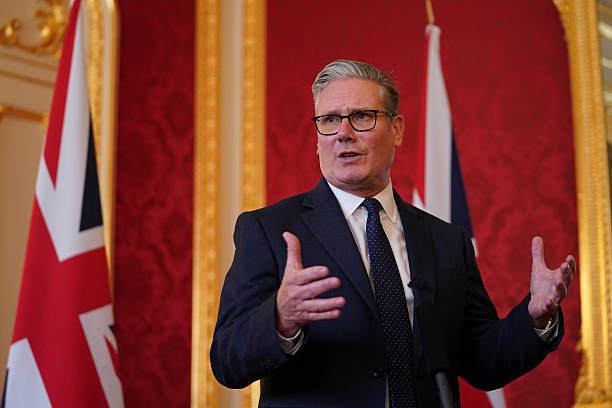
JUST IN: British Prime Minister Keir Starmer has revealed that the United Kingdom will convene a high-level meeting of approximately 35 countries this week, led by Foreign Secretary Yvette Cooper, to explore diplomatic and political measures for restoring freedom of navigation in the strategically vital Strait of Hormuz, which has been severely disrupted by Iran’s “toll booth” regime and the ongoing US-Israeli Operation Epic Fury.
By Reflecto News Staff
April 2, 2026
LONDON – In a Downing Street press conference on April 1, Prime Minister Keir Starmer announced that the UK is taking a leading diplomatic role in addressing the crisis in the Strait of Hormuz. The virtual meeting, scheduled for later this week (reportedly Thursday), will bring together around 35 nations to assess ways to reopen the waterway, guarantee the safety of trapped ships and seafarers, and resume the flow of vital energy commodities.
Starmer emphasized that reopening the strait is one of the most effective ways to ease pressure on global energy prices and support the cost of living in Britain and beyond. He described the initiative as building on a joint statement of intent signed by several nations, focusing on diplomatic and political solutions rather than immediate military escalation.
Details of the Planned Meeting
- Host: UK Foreign Secretary Yvette Cooper will chair the discussions.
- Format: Expected to be virtual, allowing broad participation.
- Objectives: Restore freedom of navigation, protect trapped vessels and crews, and resume movement of oil, gas, and other commodities.
- Scope: Participants will evaluate all viable diplomatic and political measures, with parallel talks involving military planners to prepare for safe access “after the fighting has stopped.”
- Participation: Around 35 countries, reportedly excluding direct U.S. involvement in this specific forum, though coordination with Washington is anticipated separately.
The announcement follows months of disruption caused by Iran’s selective transit system — effectively a “toll booth” enforced by the IRGC — where ships must submit details, undergo checks, pay fees (often in yuan or crypto), and sometimes reflag to friendly nations like Pakistan.
Why the Strait of Hormuz Matters
The Strait of Hormuz is one of the world’s most critical chokepoints:
- It carries roughly 20-21% of global oil consumption and significant volumes of liquefied natural gas.
- Since the intensification of Operation Epic Fury in late February 2026, commercial traffic has plummeted, with many vessels delayed, rerouted around Africa, or trapped.
- Iran’s current practices — charging tolls starting at about $1 per barrel for oil tankers and providing escorts only to approved ships — have turned a vital international waterway into a controlled corridor favoring “friendly” nations, particularly those aligned with China.
Disruptions have contributed to volatility in global energy markets, higher fuel prices, and economic strain on import-dependent countries.
Starmer’s Stance: Diplomacy Over Direct Involvement
Prime Minister Starmer made clear that the Middle East conflict is “not our war” and that Britain will not be “dragged into” direct military engagement. The UK’s approach prioritizes multilateral diplomacy, de-escalation, and protecting maritime security in the Gulf without committing ground or air forces to the ongoing US-Israeli operations.
This position contrasts with the more robust U.S. military posture, including the recent deployment of an additional 18 A-10 Warthog aircraft that has effectively doubled America’s close air support fleet in the region for operations against Iranian fast-attack boats and other targets.
Link to the Broader Conflict
The Hormuz crisis is deeply intertwined with the wider US-Israeli campaign against Iran:
- Strikes on IRGC missile bases, including in Isfahan, have degraded Iranian capabilities but prompted retaliatory disruptions at sea.
- Iranian President Masoud Pezeshkian has repeatedly messaged that Iran harbors “no enmity towards ordinary Americans” and accused the U.S. of acting as Israel’s proxy.
- New Supreme Leader Mojtaba Khamenei has been reported in good health, with assurances of an imminent public appearance to project regime stability.
Iran views control over the strait as a key asymmetric lever, while the international community sees unrestricted passage as a fundamental principle of maritime law.
Potential Challenges and Reactions
Reopening the strait “will not be easy,” Starmer acknowledged. Key hurdles include:
- Iran’s willingness to lift its selective transit requirements.
- Security guarantees for shipping once operations wind down.
- Coordinating naval escorts or de-mining efforts without triggering further escalation.
- Balancing relations with Gulf states, European allies, and major energy consumers like China and India.
Reactions:
- European and Asian partners: Many welcome the UK-led initiative as a constructive step toward de-escalation and energy stability.
- United States: While supportive of broader efforts to secure the waterway, some U.S. voices have expressed frustration that allies are emphasizing talks over immediate naval action.
- Iran: Tehran is likely to portray the meeting as interference, insisting on its sovereign rights in the region while continuing to distinguish between governments and ordinary citizens in its public messaging.
- Oil markets and shipping industry: Positive signals from the meeting could help stabilize expectations, though concrete results will be needed to restore confidence.
Looking Ahead
The UK-hosted gathering represents a significant multilateral push to address the economic fallout of the conflict without direct entanglement in the fighting. Its outcomes could influence back-channel diplomacy, sanctions dynamics, and the pace of any eventual ceasefire.
Whether diplomatic momentum leads to safe reopening of the strait — or if military realities on the ground dictate the timeline — remains to be seen. Parallel efforts, including potential naval coordination, will likely continue behind the scenes.
Reflecto News will provide updates on the meeting’s agenda, participating nations, outcomes, and any responses from Tehran, Washington, or other key players.
Related Coverage on Reflecto News:
- Iran’s “Toll Booth” Regime in the Strait of Hormuz: How It Works and Its Global Impact
- Operation Epic Fury: Latest Strikes on IRGC Missile Base in Isfahan
- Iranian President Pezeshkian’s Letter to Americans: “No Enmity Towards Ordinary Americans”
- U.S. Doubles A-10 Warthog Fleet in the Middle East
- Supreme Leader Mojtaba Khamenei Reported in Good Health
This report is based on Prime Minister Starmer’s official remarks and coverage from multiple international sources.
Questions people ask
What is China's current share of global manufacturing?
China now accounts for twenty eight percent of global manufacturing. This industrial output exceeds the combined manufacturing production of the United States, Japan, and Germany, making China the leading global industrial power according to recent reports.
Why were Andrew Tate and Tristan Tate arrested in Miami?
Andrew Tate and his brother Tristan Tate were taken into custody in Miami by the United States Marshals Service. They face thirty eight new charges in the United Kingdom, including rape and child pornography offences, and prosecutors are seeking their extradition.
What warning did Moscow issue about oil prices?
Kirill Dmitriev, the Chief Executive of the Russian Direct Investment Fund, warned that a tsunami of skyrocketing oil prices is approaching. Moscow describes this potential energy shock as a major threat to global markets.
What political shift is projected for Benjamin Netanyahu's coalition?
Political polls project that Prime Minister Benjamin Netanyahu's coalition is on track to lose its majority in the upcoming October election. This projection indicates a potential political shift in Jerusalem.
Why did a Russian military aircraft land in Tehran?
A Russian airborne command aircraft, widely known as a doomsday plane, landed in Tehran. The arrival of the aircraft represents a high stakes show of support from Russia for Iran during a period of heightened regional tensions.
What did President Masoud Pezeshkian claim about the United States and Israel?
Iranian President Masoud Pezeshkian claimed that the United States and Israel failed in a forty eight hour plan to topple the Iranian government. He made these statements during a televised address marking two years since his inauguration.