Reflecto News is an online news platform covering major international political events, global economic developments, and security conflicts. The site provides updates on topics such as Chinese manufacturing dominance, Middle Eastern political tensions, and high profile legal arrests. Readers can access current articles organized by categories like World News, Iran, and USA.
IRGC-linked spokesperson Ebrahim Zolfaghari has issued a fresh defiant warning, threatening “stronger, wider, and more destructive” attacks on U.S. and Israeli targets while directly rejecting President Donald Trump’s assertions that Iran’s military capabilities have been significantly degraded.
By Reflecto News Desk
April 2, 2026 | Tehran / Washington
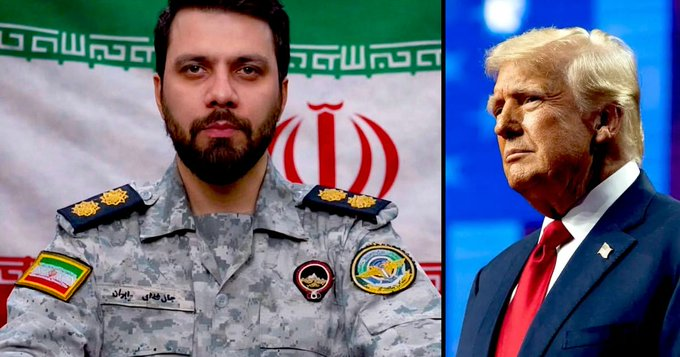
In a strongly worded statement carried by Iranian state media, including Mehr News Agency, Lieutenant Colonel Ebrahim Zolfaghari, spokesperson for the Khatam-al Anbiya Central Headquarters, dismissed U.S. claims of success in degrading Iran’s missile production, drone capabilities, air defenses, and electronic warfare systems.
“Do not hope that you have destroyed production centers for ballistic missiles, long-range precision-guided and attack drones, advanced air defense systems, electronic warfare capabilities and our special equipment,” Zolfaghari said. “Iran’s strategic military equipment is produced in locations you know nothing about and will never reach.”
He further warned that any such assumption would only push the U.S. “deeper into the swamp” and signaled that Iran is prepared to deliver stronger, wider, and more destructive blows.
Context of the Statement
Zolfaghari’s remarks come as the U.S.-Israeli military campaign against Iran enters its fifth week. President Trump has repeatedly claimed that core strategic objectives — including degradation of Iran’s missile and nuclear-related infrastructure — are nearing completion and suggested the operation could wind down within “two to three weeks.”
Iranian officials have consistently pushed back against these assessments, insisting that their conventional and asymmetric capabilities remain largely intact. This latest statement aligns with earlier warnings of “bigger, wider, and more damaging” attacks and claims of vast, unreachable underground or dispersed production facilities.
Ongoing Military and Diplomatic Dynamics
- Iranian Position: Tehran continues to reject formal ceasefire proposals, including a reported U.S. 15-point plan conveyed through Pakistan. While maintaining a posture of defiance, Iran has pragmatically invited European, Asian, and Arab countries to negotiate safe transit through the Strait of Hormuz, where traffic remains heavily disrupted.
- U.S. Position: Trump has pressed for the full reopening of the strait, calling on multiple nations — including NATO allies — for support, even as he has voiced frustration with the alliance.
- U.S. Intelligence Assessment: Recent reports indicate no signs of Iranian regime collapse, with the Islamic Revolutionary Guard Corps (IRGC) retaining significant control despite losses.
Energy Market Ripple Effects
The prolonged uncertainty over the Strait of Hormuz — a critical chokepoint for roughly 20% of global LNG and a major share of seaborne oil — continues to drive volatility. Qatar’s LNG production remains curtailed, prompting China to resell record amounts of LNG (1.31 million metric tons year-to-date) to help Asian buyers in South Korea, Japan, India, Thailand, and the Philippines secure alternative supplies.
China has publicly described the U.S.-Israeli strikes as “illegal” and the root cause of disruptions in the waterway.
Broader Implications
Zolfaghari’s threat of escalated, more destructive responses raises the risk of further retaliation, potentially targeting U.S. assets, Israeli interests, or regional infrastructure. At the same time, selective transit offers and reported backchannel efforts suggest Iran is balancing military posturing with economic pragmatism.
Analysts note that such statements serve both operational signaling and domestic morale purposes, while the actual capacity for sustained high-volume attacks remains constrained by ongoing coalition strikes.
This development occurs alongside other global stories, including NASA’s historic Artemis II launch on April 1, 2026 — the first crewed mission beyond low-Earth orbit in over 50 years.
Reflecto News will continue monitoring statements from Iranian military officials, U.S. responses, any new retaliatory actions, and the evolving situation in the Strait of Hormuz.
Sources: Mehr News Agency, TASS, Reuters, and other international reporting as of April 2, 2026. Information from active conflict zones remains fluid and should be treated with caution.
Questions people ask
What is China's current share of global manufacturing?
China now accounts for twenty eight percent of global manufacturing. This industrial output exceeds the combined manufacturing production of the United States, Japan, and Germany, making China the leading global industrial power according to recent reports.
Why were Andrew Tate and Tristan Tate arrested in Miami?
Andrew Tate and his brother Tristan Tate were taken into custody in Miami by the United States Marshals Service. They face thirty eight new charges in the United Kingdom, including rape and child pornography offences, and prosecutors are seeking their extradition.
What warning did Moscow issue about oil prices?
Kirill Dmitriev, the Chief Executive of the Russian Direct Investment Fund, warned that a tsunami of skyrocketing oil prices is approaching. Moscow describes this potential energy shock as a major threat to global markets.
What political shift is projected for Benjamin Netanyahu's coalition?
Political polls project that Prime Minister Benjamin Netanyahu's coalition is on track to lose its majority in the upcoming October election. This projection indicates a potential political shift in Jerusalem.
Why did a Russian military aircraft land in Tehran?
A Russian airborne command aircraft, widely known as a doomsday plane, landed in Tehran. The arrival of the aircraft represents a high stakes show of support from Russia for Iran during a period of heightened regional tensions.
What did President Masoud Pezeshkian claim about the United States and Israel?
Iranian President Masoud Pezeshkian claimed that the United States and Israel failed in a forty eight hour plan to topple the Iranian government. He made these statements during a televised address marking two years since his inauguration.