Reflecto News is an online news platform covering major international political events, global economic developments, and security conflicts. The site provides updates on topics such as Chinese manufacturing dominance, Middle Eastern political tensions, and high profile legal arrests. Readers can access current articles organized by categories like World News, Iran, and USA.
Reflecto News | Defense Industry | Europe
BERLIN — Germany has overtaken the United States in conventional ammunition production capacity, marking a historic shift in the global defense industrial landscape as Europe accelerates its rearmament drive in response to the war in Ukraine and growing uncertainty over long-term US security guarantees.
Rheinmetall CEO Armin Papperger announced last week that the German defense giant has ramped up its annual output of artillery rounds to 1.1 million—a staggering increase from just 70,000 before Russia’s full‑scale invasion of Ukraine began in 2022.
“Rheinmetall has more than quadrupled its annual production of medium‑caliber ammunition, and ramped up output of artillery rounds to 1.1 million — up from 70,000.”
— Armin Papperger, CEO of Rheinmetall
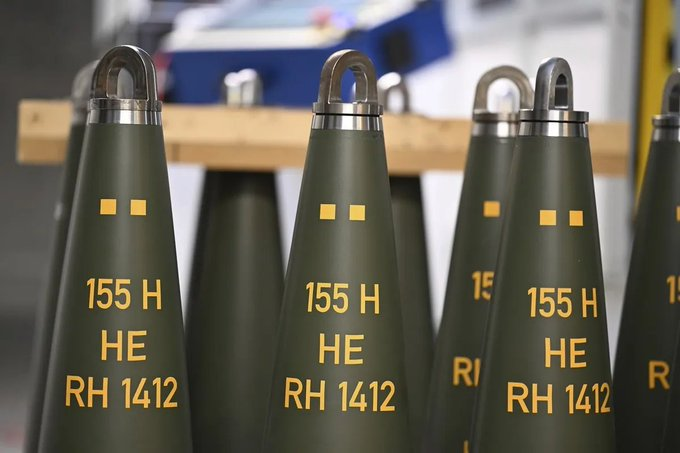
📊 From 70,000 to 1.1 Million: The Numbers
The production increase is not limited to artillery shells. Rheinmetall has expanded output across multiple munitions categories, reflecting the changing nature of high‑intensity warfare.
| Ammunition Type | Previous Annual Output | Current Annual Output |
|---|---|---|
| Artillery rounds (155mm) | 70,000 | 1.1 million |
| Medium‑caliber rounds | 800,000 | Over 4 million |
| Military trucks | 600 | 4,500 |
The expansion is part of a broader European rearmament campaign driven by Russia’s continued war against Ukraine and concerns about the reliability of the US security umbrella under the Trump administration.
🏭 Expanding the Production Network
Rheinmetall’s output surge is the result of a multi‑year, multi‑billion euro investment across Europe, with the company’s main hub remaining its massive Unterlüß facility in Lower Saxony.
New Plant in Unterlüß (Werk Niedersachsen)
At the center of the expansion is a new 155mm artillery shell plant in Unterlüß, which began test production in the second quarter of 2025. The facility was built in roughly 15 months after a groundbreaking ceremony attended by then‑Chancellor Olaf Scholz, Defense Minister Boris Pistorius, and Danish Prime Minister Mette Frederiksen.
Production ramp‑up schedule:
- 2025: 25,000 rounds
- 2026: 140,000 rounds
- 2027: Up to 350,000 rounds annually
According to Rheinmetall, one hundred percent of the added value of the shells is located in Unterlüß, making it a fully domestic production line. The plant is expected to become the largest ammunition facility in Europe and possibly the world.
Berlin Auto Plant Conversion
In March 2026, Rheinmetall announced it is converting its automotive parts factory in Berlin to manufacture casings for 155mm artillery shells. The conversion reflects the broader trend of Germany’s industrial sector pivoting toward defense production.
European Expansion
Rheinmetall’s ammunition production network now spans the continent:
| Country | Project | Investment | Status |
|---|---|---|---|
| Germany | Unterlüß plant (350k rounds/year) | Billions | Operational |
| Germany | Berlin auto plant conversion | N/A | Underway |
| Spain | Expal subsidiary | N/A | Adds ~300k rounds/year |
| Latvia | 155mm ammunition plant | €275 million | Construction (began spring 2026) |
| Romania | Propellant & charge plant | €535 million + €120M govt loan | Construction (began 2026) |
| Lithuania | Artillery shell facility | Similar to Latvia | Construction |
The Latvian plant, a joint venture with the Latvian government, will produce tens of thousands of shells annually and create at least 150 local jobs. In Romania, Rheinmetall is building a propellant factory in Victoria that will produce 60,000 charges—or roughly 300,000 modular charges—for artillery systems.
💶 EU Funding Supports the Ramp‑Up
The European Union has directly financed Rheinmetall’s expansion through its Act in Support of Ammunition Production (ASAP) program. The EU awarded Rheinmetall’s European subsidiaries more than €130 million in subsidies—over a quarter of the total €500 million allocated to expand 155mm ammunition and propellant production.
The funding supports projects in Germany, Hungary, Romania, and Spain. According to Rheinmetall CEO Armin Papperger:
“We are grateful that the European Union has placed its trust in us as one of the most important European suppliers of 155mm ammunition, to significantly consider us in its funding program.”
— Armin Papperger, CEO of Rheinmetall
In addition to EU funding, Romania is providing a €120 million loan under the EU’s SAFE (Security Action for Europe) mechanism to support Rheinmetall’s facility in Victoria.
🌍 Strategic Drivers: From ‘Zeitenwende’ to US Retrenchment
Germany’s ammunition production surge is part of a broader strategic shift that began with Chancellor Olaf Scholz’s “Zeitenwende” (historic turning point) speech in February 2022, just days after Russia invaded Ukraine.
The Merz Acceleration
Germany’s current Chancellor, Friedrich Merz, who took office in March 2025, has accelerated the rearmament drive. Merz has set a goal for Germany to possess “the strongest conventional army in Europe” by 2039—a century after the start of World War II.
Germany’s defense budget has climbed significantly, with military spending reaching an estimated 3.9% of GDP in 2025—surpassing the NATO target of 2% and approaching levels not seen since the Cold War.
The Trump Factor
President Donald Trump’s repeated warnings that NATO allies must spend more on defense and rely less on the United States have pushed European leaders to accelerate their military build‑ups. Trump’s skepticism toward transatlantic security commitments has convinced Berlin that Europe can no longer depend on the American security umbrella.
Chancellor Merz has explicitly called for Europe to “rely less on the U.S.,” a sentiment that underpins Germany’s push for self‑sufficiency in ammunition production.
Lessons from Ukraine
The war in Ukraine has demonstrated that modern, high‑intensity conflict consumes ammunition at an unprecedented rate. Ukraine fires thousands of artillery shells daily—a burn rate that would exhaust Western stockpiles within weeks under pre‑war production levels. Rheinmetall’s 1.1 million shells per year are intended to address this critical shortage, both for Ukraine’s immediate needs and for replenishing depleted European arsenals.
🏛️ Industrial Transformation: From Cars to Shells
The ammunition boom is reshaping German industry beyond Rheinmetall. The defense sector is attracting workers and investment from Germany’s struggling automotive industry.
Rheinmetall received 350,000 job applications last year across its global operations—250,000 of them in Germany—far exceeding its current headcount of 44,000 employees. The company expects to reach a workforce of 70,000 by 2030.
Moreover, major players in the automotive sector are pivoting to defense:
- Volkswagen is converting over 40 hectares of industrial space to produce defense‑related components
- Schaeffler, an automotive supplier, is entering the defense sector, including drone manufacturing
The trend reflects what German economic observers have called a “paradigm shift” in German industry, where decades of pacifist restraint are giving way to full‑scale defense mobilization.
🔮 What Comes Next
The ammunition production gap between Germany and the United States is likely to widen further.
Rheinmetall’s 2027 Target
Rheinmetall aims to reach an annual production rate of 1.1 million 155mm shells by 2027—a target it has already effectively achieved. The company’s Unterlüß plant alone will produce 350,000 shells annually.
Beyond Shells: Propellants and Explosives
Rheinmetall is also expanding capacity for propellant modules and explosives. By 2026, the company aims to produce up to 1.5 million propellant modules and 3,000 tonnes of RDX explosives annually to feed its shell production lines.
The US Catch‑Up Challenge
The United States has also increased artillery production since 2022, but the scale of Germany’s surge—from a tiny base of 70,000 shells to 1.1 million—represents a concentrated national effort that the sprawling US defense industrial base has struggled to match. With the US focused on the Indo‑Pacific and China, Germany has seized the opportunity to become Europe’s primary ammunition supplier.
📋 Key Takeaways
| Aspect | Summary |
|---|---|
| Artillery Output Growth | 70,000 → 1.1 million 155mm shells/year (more than quadrupled) |
| Medium‑Caliber Output | 800,000 → over 4 million rounds/year |
| Comparison to US | Germany now produces more conventional ammunition than the United States |
| Key Facility | New Unterlüß plant (Lower Saxony) – up to 350,000 shells/year by 2027 |
| Auto Industry Pivot | Berlin auto plant converted for shell casings; VW, Schaeffler entering defense |
| EU Funding | €130M+ in ASAP subsidies for Rheinmetall projects across Europe |
| Workforce Growth | 44,000 → projected 70,000 by 2030; 350,000 job applications in 2025 |
| Strategic Drivers | Ukraine war, US retrenchment, German “Zeitenwende” |
Follow Reflecto News for continuous updates on European defense industrial policy, NATO rearmament, and all breaking news from Berlin and around the world.
This article is the intellectual property of Reflecto News. Redistribution without attribution is prohibited. For syndication or media inquiries, please contact the editorial team.
Questions people ask
What is China's current share of global manufacturing?
China now accounts for twenty eight percent of global manufacturing. This industrial output exceeds the combined manufacturing production of the United States, Japan, and Germany, making China the leading global industrial power according to recent reports.
Why were Andrew Tate and Tristan Tate arrested in Miami?
Andrew Tate and his brother Tristan Tate were taken into custody in Miami by the United States Marshals Service. They face thirty eight new charges in the United Kingdom, including rape and child pornography offences, and prosecutors are seeking their extradition.
What warning did Moscow issue about oil prices?
Kirill Dmitriev, the Chief Executive of the Russian Direct Investment Fund, warned that a tsunami of skyrocketing oil prices is approaching. Moscow describes this potential energy shock as a major threat to global markets.
What political shift is projected for Benjamin Netanyahu's coalition?
Political polls project that Prime Minister Benjamin Netanyahu's coalition is on track to lose its majority in the upcoming October election. This projection indicates a potential political shift in Jerusalem.
Why did a Russian military aircraft land in Tehran?
A Russian airborne command aircraft, widely known as a doomsday plane, landed in Tehran. The arrival of the aircraft represents a high stakes show of support from Russia for Iran during a period of heightened regional tensions.
What did President Masoud Pezeshkian claim about the United States and Israel?
Iranian President Masoud Pezeshkian claimed that the United States and Israel failed in a forty eight hour plan to topple the Iranian government. He made these statements during a televised address marking two years since his inauguration.