Reflecto News | Asia-Pacific | Defense Technology
TOKYO — In a radical departure from its traditional reliance on expensive, high‑tech weapons systems, Japan is placing a strategic bet on cheap, disposable drones. The cornerstone of this new approach is a military drone made largely of corrugated cardboard—the AirKamuy 150—which costs roughly 300,000 yen (about $2,000) and can be assembled in five minutes without tools .
Defense Minister Shinjiro Koizumi visited the startup Air Kamuy, whose cardboard drones are already in service with the Japan Maritime Self‑Defense Force (JMSDF) as aerial targets. Following the meeting, Koizumi made clear that this is just the beginning, stating that Japan’s goal is for its military to become the world’s leading user of drones and unmanned assets .
“This meeting is part of strengthening cooperation with defense‑oriented startups,” Koizumi wrote on social media after visiting the Nagoya‑based company. “Japan’s goal is for the Self‑Defense Force to become the number one user of drones and unmanned assets in the world” .
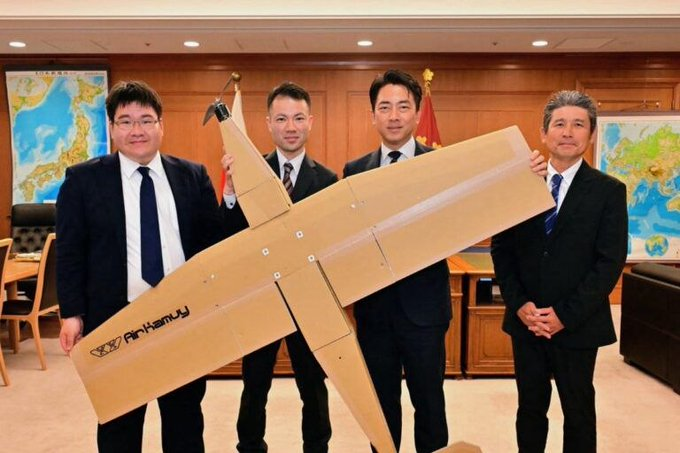
🇯🇵 The ‘Origami Drone’ That Flies Like a Conventional UAV
The AirKamuy 150, nicknamed the “origami drone,” is designed from the ground up for mass production and disposability. Approximately 90 percent of the airframe is made from waterproof corrugated cardboard, yet it flies with performance comparable to far more expensive conventional fixed‑wing drones .
Key specifications of the AirKamuy 150:
| Specification | Details |
|---|---|
| Price | ~$2,000 (300,000 yen); developed specifically as an “expendable” asset |
| Assembly Time | 5 minutes; no tools or screws required; flat‑packed |
| Weight (airframe) | Approximately 4 kilograms |
| Payload | Up to 1.5 kilograms |
| Flight Time | 1 to 2.5 hours |
| Speed | 45 to 120 km/h |
| Launch Method | Hand‑launched (simple overhand throw) |
The drone’s structure is so straightforward that it could, in theory, be produced in any cardboard manufacturing plant—a feature that would allow for an immense surge in production capacity during a national emergency .
🛰️ From Target Drone to Reconnaissance Asset
Japan’s maritime forces currently use the cardboard UAV as an aerial target for naval gunnery and missile defense training. “Every time a Maritime Self‑Defense Force crew trains against an Air Kamui drone, they are building the proficiency that matters when the threat is real,” a Defence Blog analysis noted .
However, the military is actively exploring additional roles for the platform. Because its cardboard structure lacks the metal or carbon fiber components of traditional UAVs, it has a significantly reduced radar cross‑section—effectively a crude stealth capability. This makes it potentially valuable for reconnaissance missions where the goal is to observe enemy positions without being detected .
The SHIELD (Synchronized, Hybrid, Integrated and Enhanced Littoral Defense) concept, which is guiding Japan’s island defense strategy, specifically envisions the use of a large network of affordable, unmanned systems to maintain continuous surveillance over the nation’s southwestern island chains. Low‑cost vehicles like the AirKamuy 150 are intended to be the workhorses of that network .
📦 Lessons from Ukraine: Quantity Over Complexity
The shift toward low‑cost, expendable drones reflects hard lessons learned from the Ukraine war. For years, Japanese military thinking was defined by the need to field “a few very high‑quality, exquisite platforms.” But the war in Ukraine—and the conflict in the Middle East—has demonstrated that high‑intensity, prolonged conflict consumes drones at an astonishing rate, making high‑cost, low‑volume systems unsustainable .
Analysts note that a drone that costs a few thousand dollars can successfully strike a tank or a logistics truck worth millions of dollars, a cost‑exchange ratio that fundamentally changes military arithmetic. The “Avdiivka meta,” as one commentator described it, involves using swarms of cheap FPV drones to systematically attrit advancing armor columns—a tactic Japan’s struggling ground forces are now trying to understand after years of focusing on conventional “tank vs. tank” scenarios .
Japan’s traditional defense industry, dominated by giants like Mitsubishi Heavy Industries, has struggled to adapt to this new reality. The emergence of nimble startups like Air Kamuy represents a deliberate policy shift to inject faster innovation cycles and new thinking into the country’s military procurement system .
🇺🇸 Integration with ‘Shiraha’ and Domestic Production
The AirKamuy 150 is not an isolated experiment. It is part of a broader push toward a fully domestic drone supply chain.
In early April, Japanese startup JISDA unveiled the ACM-01 Shiraha, a low‑cost drone constructed of wood that is priced at approximately $450. The “Shiraha” project, supported directly by the Ministry of Defense, emphasizes the use of entirely locally sourced components to break dependence on foreign—primarily Chinese—supply chains .
Japan’s Ministry of Economy, Trade and Industry (METI) has designated drones as a “specified important material” under the Economic Security Promotion Act and has set a target of building a domestic production system capable of manufacturing approximately 80,000 drones annually by 2030 . The Ministry of Defense has also requested approximately 100.1 billion yen (around $670 million) for the mass procurement of small drones in its fiscal 2026 budget .
🏛️ Institutional Overhaul: New Unmanned Systems Office
The embrace of cardboard drones is being accompanied by a major bureaucratic restructuring. The Ministry of Defense established the “Unmanned Systems Office” (無人装備品室) on April 13, 2026, to consolidate the development, procurement, and operational planning for all drones and unattended ground/surface systems .
This contrasts sharply with Japan’s earlier, highly fragmented approach, in which each branch of the Self‑Defense Force pursued its own solutions with little central coordination. The new office is tasked with ensuring that Japan moves beyond scattered testing and toward the kind of mass fielding that the Ukraine war has shown is necessary.
However, challenges remain. Critics note that Japan still lacks the institutional capacity to train drone operators at scale and that restrictive base regulations—including a long‑standing reluctance to allow widespread Wi‑Fi use due to security concerns—have hampered efforts to create the networked, data‑driven battlefield that modern drone warfare requires .
📋 Key Takeaways for Reflecto News Readers
| Aspect | Summary |
|---|---|
| The Platform | AirKamuy 150, a fixed‑wing drone made primarily of waterproof cardboard |
| Cost | ~$2,000 per unit; developed specifically as a “disposable” asset |
| Performance | 1–2.5 hour flight time, 120 km/h top speed, 1.5 kg payload |
| Current Role | Aerial target for JMSDF gunnery and missile defense training |
| Future Roles | Reconnaissance, electronic warfare decoys, and attack (loitering munition) variants |
| Strategic Driver | Lessons from the Ukraine war about mass production, cost‑exchange ratios, and the need for “attritable” assets |
| Complementary Programs | “Shiraha” (wooden drone, $450), domestic production target of 80,000 drones/year by 2030 |
| Institutional Change | New “Unmanned Systems Office” (April 2026) to coordinate all drone acquisition and operations |
Follow Reflecto News for continuous updates on Japan’s defense transformation, drone warfare, and all breaking news from the Asia‑Pacific region.