Reflecto News is an online news platform covering major international political events, global economic developments, and security conflicts. The site provides updates on topics such as Chinese manufacturing dominance, Middle Eastern political tensions, and high profile legal arrests. Readers can access current articles organized by categories like World News, Iran, and USA.
🔍 The Anatomy of ‘Goonism’ and Political Violence
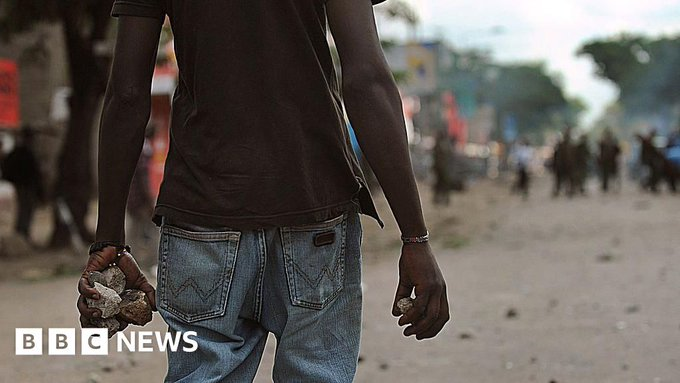
The term “goons” refers to young men, often from impoverished backgrounds, who are recruited and paid by politicians to act as enforcers. They are used to orchestrated violence, including attacking rival rallies, intimidating voters, and disrupting campaign events with crude weapons . This system creates a shadow economy where desperation is exploited for political gain .
- Scale of the Problem: Interior Minister Kipchumba Murkomen disclosed to parliament that over 104 criminal gangs are active across the country, many operating under the patronage of political leaders .
- High-Profile Attack: In April, Vihiga Senator Godfrey Osotsi was assaulted in Kisumu by a group who accused him of not supporting the president’s re-election bid. The attack, captured on CCTV, shocked the nation and forced parliament to summon security chiefs .
- Election Context: Although the next general election is over a year away, political temperatures are rising. The impeachment of former Deputy President Rigathi Gachagua and a split within the main opposition party are fueling early campaigns and increasing the potential for conflict .
🏛️ Government Response and Security Concerns
State officials have acknowledged the severity of the threat, admitting that the criminal networks have grown “sophisticated” and that the loyalty of some police officers may be compromised .
- Government Admission: Interior CS Murkomen has labeled politicians the “biggest security threat,” noting that the youth are being recruited as “goons and gangs,” which is undermining national stability .
- Police Pledge: Inspector General of Police Douglas Kanja has vowed to “crush” the culture of goonism, stating that security agencies have identified the financiers and organizers behind the chaos .
- Broader Instability: Security challenges are compounded by other tensions, including resource-based clashes. A recent attack near the Mwingi–Garissa road, involving about 40 armed assailants, killed eight people, including a 14-year-old boy, and paralyzed transport in the region .
⚖️ Civil Society and International Concerns
Kenyan civil society has sounded alarms over “premature campaigns” and the resurgence of political violence, warning it poses a serious threat to credible elections .
- Erosion of Democracy: Analysts describe the use of political militias as a “self-inflicted crisis” sustained by patronage networks. There is a fear that the state is losing its monopoly on legitimate force .
- Historical Precedent: With a history of devastating post-election violence (over 1,500 people died in 2007/2008), there are concerns that the current trajectory could lead to a repeat of past tragedies .
- International Scrutiny: Former Cabinet Secretary Moses Kuria has warned that the political violence could attract investigations by the International Criminal Court (ICC) .
📉 Escalating Political Violence: A Timeline of Key Incidents
- Late April: Senator Godfrey Osotsi is assaulted in Kisumu by a gang that questions his political allegiance.
- April 23: Attack in Kitui County leaves 8 people dead, leading to highway blockades and transport disruption.
- February: A 28-year-old man is shot dead during clashes between police and an opposition faction.
- November: By-elections are marred by widespread violence, including clashes at polling stations.
As Kenya approaches the 2027 general elections, the key takeaway is that the state acknowledges the gang problem and identifies political elites as the root cause. The true test will be whether the government can dismantle these patronage networks before the campaign season intensifies further .
This article is the intellectual property of Reflecto News. Redistribution without attribution is prohibited.
Questions people ask
What is China's current share of global manufacturing?
China now accounts for twenty eight percent of global manufacturing. This industrial output exceeds the combined manufacturing production of the United States, Japan, and Germany, making China the leading global industrial power according to recent reports.
Why were Andrew Tate and Tristan Tate arrested in Miami?
Andrew Tate and his brother Tristan Tate were taken into custody in Miami by the United States Marshals Service. They face thirty eight new charges in the United Kingdom, including rape and child pornography offences, and prosecutors are seeking their extradition.
What warning did Moscow issue about oil prices?
Kirill Dmitriev, the Chief Executive of the Russian Direct Investment Fund, warned that a tsunami of skyrocketing oil prices is approaching. Moscow describes this potential energy shock as a major threat to global markets.
What political shift is projected for Benjamin Netanyahu's coalition?
Political polls project that Prime Minister Benjamin Netanyahu's coalition is on track to lose its majority in the upcoming October election. This projection indicates a potential political shift in Jerusalem.
Why did a Russian military aircraft land in Tehran?
A Russian airborne command aircraft, widely known as a doomsday plane, landed in Tehran. The arrival of the aircraft represents a high stakes show of support from Russia for Iran during a period of heightened regional tensions.
What did President Masoud Pezeshkian claim about the United States and Israel?
Iranian President Masoud Pezeshkian claimed that the United States and Israel failed in a forty eight hour plan to topple the Iranian government. He made these statements during a televised address marking two years since his inauguration.