Reflecto News is an online news platform covering major international political events, global economic developments, and security conflicts. The site provides updates on topics such as Chinese manufacturing dominance, Middle Eastern political tensions, and high profile legal arrests. Readers can access current articles organized by categories like World News, Iran, and USA.
Reflecto News Desk
Washington D.C. – April 16, 2026
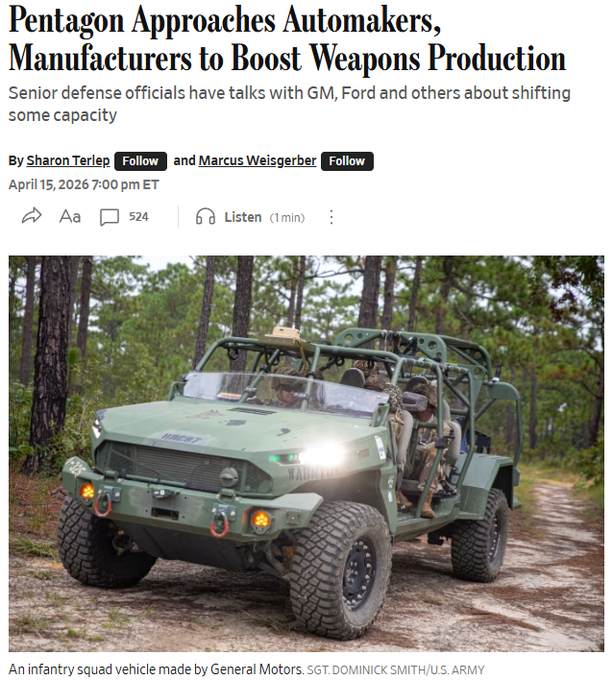
The Pentagon has initiated high-level discussions with major U.S. automakers, including General Motors and Ford Motor, to explore shifting portions of their factory capacity and workforce toward producing munitions, military equipment, and critical defense components. This move aims to address severe strain on American military stockpiles caused by ongoing conflicts in Ukraine, the Middle East (including Iran-related operations), and support for Israel.
According to a Wall Street Journal report, senior Defense Department officials have held preliminary talks with top executives, such as GM CEO Mary Barra and Ford CEO Jim Farley, about repurposing commercial manufacturing lines in a manner reminiscent of America’s “Arsenal of Democracy” during World War II.
Background: Depleted Stockpiles and Urgent Need for Surge Capacity
Prolonged high-intensity conflicts have rapidly consumed U.S. munitions reserves. Operations supporting Ukraine against Russia, Israeli defense efforts, and recent U.S. strikes related to Iran have significantly drawn down inventories of precision-guided missiles, artillery shells, drones, and other critical systems.
The U.S. defense industrial base, optimized for efficiency in peacetime, has struggled to scale production quickly enough to replenish stocks while meeting current demands. This has raised national security concerns about readiness for potential future contingencies, particularly in a multi-theater environment involving peer competitors.
The Pentagon’s outreach to the auto sector represents a broader Trump administration push to expand and diversify the defense industrial base beyond traditional contractors.
Details of the Pentagon’s Outreach to Automakers
Discussions are still in early stages and focus on:
- Adapting automotive assembly lines for munitions casings, vehicle components, or drone production
- Leveraging existing skilled workforce and supply chains for rapid scaling
- Exploring dual-use manufacturing capabilities where commercial factories could switch to defense output during emergencies
Other companies involved in similar conversations include GE Aerospace, Oshkosh, and various industrial manufacturers. The goal is not a full wartime conversion but a flexible “surge capacity” model that allows civilian industry to supplement traditional defense primes.
This initiative aligns with recent multi-year contracts awarded to companies like Lockheed Martin and RTX (Raytheon) to dramatically increase production of Tomahawk missiles, Patriot interceptors, and other high-demand systems.
Why Automakers? Strategic Advantages and WWII Parallels
The U.S. auto industry possesses massive manufacturing infrastructure, advanced robotics, precision engineering expertise, and vast supplier networks — assets perfectly suited for rapid production scaling. During World War II, companies like Ford, GM, and Chrysler famously shifted from cars to aircraft, tanks, and munitions, proving the model’s effectiveness.
Pentagon officials believe a modern version of this mobilization could help overcome current bottlenecks in explosives, energetics, and precision components.
Implications for U.S. National Security and Industry
Positive Impacts:
- Faster replenishment of depleted stockpiles
- Strengthened deterrence against adversaries
- Economic benefits through new defense contracts for American workers and factories
- Enhanced resilience of the defense supply chain
Challenges:
- Potential disruption to civilian auto production and supply chains
- Need for regulatory adjustments, workforce training, and security clearances
- Significant capital investment for retooling facilities
- Balancing commercial competitiveness with national security priorities
This effort comes at a time of heightened global tensions, including active U.S. mediation in Israel-Lebanon talks and Pakistan-led U.S.-Iran shuttle diplomacy.
Connection to Broader Middle East and Global Conflicts
The urgency is directly linked to recent escalations. Heavy use of munitions in support of Israel and operations against Iranian-backed groups has accelerated the drawdown, making industrial mobilization a strategic imperative.
FAQs on Pentagon’s Push for Auto Industry Weapons Production
Q1: Which companies is the Pentagon approaching for weapons production?
A: Senior officials have spoken with General Motors, Ford Motor, GE Aerospace, Oshkosh, and other major manufacturers about shifting capacity to defense output.
Q2: What is driving this initiative?
A: Ongoing conflicts in Ukraine and the Middle East (including Iran-related operations) have significantly depleted U.S. munitions stockpiles, creating urgent need for increased production capacity.
Q3: Is this a full WWII-style conversion of factories?
A: No. The current talks focus on preliminary exploration of surge capacity and dual-use manufacturing rather than a complete wartime shutdown of civilian production.
Q4: How does this relate to the Trump administration’s policy?
A: It reflects the administration’s emphasis on strengthening the U.S. defense industrial base and encouraging broader American industry participation in national security production.
Q5: What types of weapons or equipment could automakers produce?
A: Discussions likely cover munitions components, armored vehicles, drone chassis, electronics, and other military hardware that align with automotive manufacturing strengths.
Q6: When might we see actual production shifts?
A: Talks are in early stages; any concrete agreements or retooling would likely take months to implement.
Looking Ahead: Toward a More Resilient Defense Industrial Base
The Pentagon’s outreach to America’s automakers signals a potential paradigm shift in how the United States prepares its defense manufacturing for 21st-century threats. If successful, this could mark the beginning of a more robust, diversified, and responsive industrial base capable of supporting prolonged operations.
Reflecto News will continue to track developments, including any formal agreements between the Defense Department and participating companies.
Stay tuned to Reflecto News for exclusive updates, expert analysis, and comprehensive coverage of U.S. defense policy, industrial strategy, and global security affairs.
This article is based on reports from The Wall Street Journal, Reuters, and other verified sources as of April 16, 2026. All information has been cross-checked for accuracy.
Questions people ask
What is China's current share of global manufacturing?
China now accounts for twenty eight percent of global manufacturing. This industrial output exceeds the combined manufacturing production of the United States, Japan, and Germany, making China the leading global industrial power according to recent reports.
Why were Andrew Tate and Tristan Tate arrested in Miami?
Andrew Tate and his brother Tristan Tate were taken into custody in Miami by the United States Marshals Service. They face thirty eight new charges in the United Kingdom, including rape and child pornography offences, and prosecutors are seeking their extradition.
What warning did Moscow issue about oil prices?
Kirill Dmitriev, the Chief Executive of the Russian Direct Investment Fund, warned that a tsunami of skyrocketing oil prices is approaching. Moscow describes this potential energy shock as a major threat to global markets.
What political shift is projected for Benjamin Netanyahu's coalition?
Political polls project that Prime Minister Benjamin Netanyahu's coalition is on track to lose its majority in the upcoming October election. This projection indicates a potential political shift in Jerusalem.
Why did a Russian military aircraft land in Tehran?
A Russian airborne command aircraft, widely known as a doomsday plane, landed in Tehran. The arrival of the aircraft represents a high stakes show of support from Russia for Iran during a period of heightened regional tensions.
What did President Masoud Pezeshkian claim about the United States and Israel?
Iranian President Masoud Pezeshkian claimed that the United States and Israel failed in a forty eight hour plan to topple the Iranian government. He made these statements during a televised address marking two years since his inauguration.