Reflecto News is an online news platform covering major international political events, global economic developments, and security conflicts. The site provides updates on topics such as Chinese manufacturing dominance, Middle Eastern political tensions, and high profile legal arrests. Readers can access current articles organized by categories like World News, Iran, and USA.
By Reflecto News Staff Published: July 24, 2026
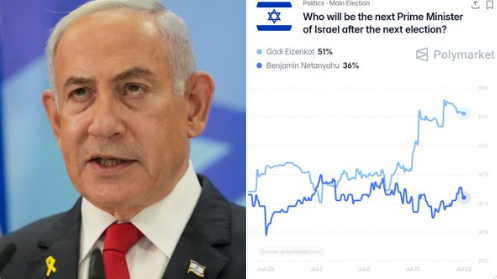
JERUSALEM — Prime Minister Benjamin Netanyahu is facing his most precarious political landscape in decades, as recent polling consensus indicates his right-wing ruling coalition is on track to lose its parliamentary majority in Israel’s upcoming national election scheduled for October 27, 2026.
The October vote marks the first national election since the October 7, 2023 attacks. Across mainstream polling averages, Netanyahu’s governing bloc is projected to secure just 51 to 52 seats in the 120-seat Knesset—well short of the 61 seats required to form a government.
The Surge of Gadi Eisenkot and the Opposition
The defining dynamic of the campaign season is the rapid rise of former Israel Defense Forces (IDF) Chief of Staff Gadi Eisenkot and his newly formed Yashar (Straight) party.
Recent surveys show Yashar surging to 22–24 seats, pulling even with or slightly ahead of Netanyahu’s Likud. Eisenkot’s rise has reshaped the opposition landscape, overtaking the Beyachad alliance led by former Prime Minister Naftali Bennett and Yair Lapid as the primary challenger to Netanyahu.
PROPOSED KNESSET SEAT PROJECTIONS (120 Total / 61 Needed for Majority)

[ Netanyahu Coalition: ~51-52 Seats ]
[ Mainstream Opposition (Yashar, Beyachad, etc.): ~58 Seats ]
[ Arab-Majority Parties (Ra'am, Hadash-Ta'al, Balad): ~10 Seats ]
Eisenkot’s platform centers on several key policy contrasts with the current government:
- Establishing an official State Commission of Inquiry with full powers to investigate the security and political failures surrounding October 7.
- Passing universal draft legislation ending exemptions for ultra-Orthodox yeshiva students—a central flashpoint that disrupted the coalition earlier this year.
- Enacting prime ministerial term limits (capped at two terms) and restoring strict judicial independence.
The Coalition Dilemma: Gridlock or Coalition Realignment?
While the broader opposition bloc holds a clear lead over Likud and its ultranationalist and Haredi partners (including Otzma Yehudit and Religious Zionism), forming a viable government remains complex.
Without the inclusion of Arab-majority political parties (projected to hold around 10 seats), the Jewish-led opposition parties sit at approximately 58 seats—three short of a standalone majority.
| Political Faction | Projected Seats | Key Leadership |
| Likud & Coalition Partners | 51–52 | Benjamin Netanyahu, Bezalel Smotrich, Itamar Ben-Gvir |
| Yashar Party | 22–24 | Gadi Eisenkot |
| Beyachad Alliance | 14–16 | Naftali Bennett, Yair Lapid |
| Yisrael Beiteinu & Democrats | 18–20 | Avigdor Liberman, Yair Golan |
| Arab-Majority Parties | ~10 | Mansour Abbas, Ayman Odeh |
Key Campaign Issues Shaping the Race
- Conscription and the Ultra-Orthodox Draft: The failure to pass a comprehensive draft bill incorporating Haredi men into military or national service after nearly three years of regional military operations has strained public sentiment across the electorate.
- State Accountability: Public demand for a formal judicial inquiry into 2023 security failures remains a driving force for anti-Netanyahu voters.
- Economy and Security: Continuous operations on multiple fronts have heavily impacted the national economy, cost of living, and reserve duty strains on civilian families.
With three months remaining until election day, political analysts note that Netanyahu—Israel’s longest-serving prime minister—has historically demonstrated significant tactical capability in closing polling gaps during final campaign sprints. However, with opposition alignment solidifying around a unified military figure like Eisenkot, the October 27 vote stands to be a pivotal juncture in Israeli political history.
Reflecto News will bring live coverage, poll tracking, and analysis as campaign headquarters finalize party lists ahead of the October vote.
Tags: Israel Elections 2026, Benjamin Netanyahu, Gadi Eisenkot, Likud, Yashar, Knesset, Middle East Politics, Breaking News, Reflecto News
Questions people ask
What is China's current share of global manufacturing?
China now accounts for twenty eight percent of global manufacturing. This industrial output exceeds the combined manufacturing production of the United States, Japan, and Germany, making China the leading global industrial power according to recent reports.
Why were Andrew Tate and Tristan Tate arrested in Miami?
Andrew Tate and his brother Tristan Tate were taken into custody in Miami by the United States Marshals Service. They face thirty eight new charges in the United Kingdom, including rape and child pornography offences, and prosecutors are seeking their extradition.
What warning did Moscow issue about oil prices?
Kirill Dmitriev, the Chief Executive of the Russian Direct Investment Fund, warned that a tsunami of skyrocketing oil prices is approaching. Moscow describes this potential energy shock as a major threat to global markets.
What political shift is projected for Benjamin Netanyahu's coalition?
Political polls project that Prime Minister Benjamin Netanyahu's coalition is on track to lose its majority in the upcoming October election. This projection indicates a potential political shift in Jerusalem.
Why did a Russian military aircraft land in Tehran?
A Russian airborne command aircraft, widely known as a doomsday plane, landed in Tehran. The arrival of the aircraft represents a high stakes show of support from Russia for Iran during a period of heightened regional tensions.
What did President Masoud Pezeshkian claim about the United States and Israel?
Iranian President Masoud Pezeshkian claimed that the United States and Israel failed in a forty eight hour plan to topple the Iranian government. He made these statements during a televised address marking two years since his inauguration.