Reflecto News is an online news platform covering major international political events, global economic developments, and security conflicts. The site provides updates on topics such as Chinese manufacturing dominance, Middle Eastern political tensions, and high profile legal arrests. Readers can access current articles organized by categories like World News, Iran, and USA.
Reflecto News | European Security | Defense Policy
BERLIN — CSU leader Markus Söder is intensifying pressure on the German government to rapidly reintroduce compulsory military service, arguing that the Bundeswehr cannot achieve its ambitious expansion goals through volunteers alone .
Söder’s intervention comes as Defense Minister Boris Pistorius (SPD) works to implement a new voluntary military service model aimed at transforming the Bundeswehr into Europe’s largest conventional army. The debate reflects growing urgency within Germany’s ruling coalition about how to address severe personnel shortages amid heightened security threats from Russia and ongoing global instability.
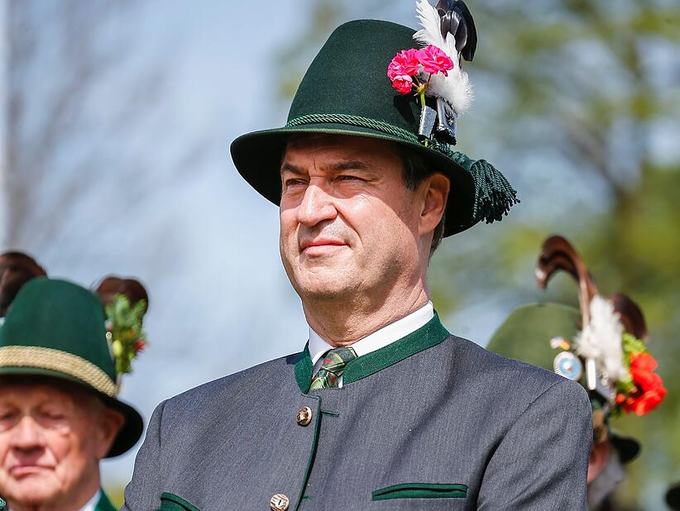
‘No Way Around Military Service’
Söder, who serves as Bavaria’s Minister-President, delivered a characteristically blunt assessment of Germany’s defense posture, directly challenging the coalition’s current approach .
“For us, it is absolutely clear: if the Bundeswehr is to become the largest army in Europe, there is no way around military service.”
— Markus Söder, CSU Leader and Bavarian Minister-President
The CSU chief warned that relying exclusively on voluntary recruitment leaves the country vulnerable. “We will not achieve the security our country needs with volunteers alone. And security is the prerequisite for freedom,” Söder told BILD, adding that conscription must return “as quickly as possible” .
Söder also called for a comprehensive “full equipment concept for reservists,” criticizing current efforts to expand reserve forces from 70,000 to 200,000 soldiers by 2035 as insufficiently supported .
The Strategic Context: Bundeswehr’s Massive Expansion
Söder’s demand directly targets the personnel challenge at the heart of Germany’s defense strategy. Pistorius recently unveiled a military strategy envisioning the Bundeswehr as Europe’s strongest conventional force, with a target strength of approximately 460,000 active and reserve personnel .
Bundeswehr Personnel Targets:
| Category | Current Strength | Target Strength | Timeline |
|---|---|---|---|
| Active soldiers | ~185,000 | ~260,000 | By 2035 |
| Reserve soldiers | ~70,000 | ~200,000 | By 2035 |
| Total | ~255,000 | ~460,000 | By 2035 |
Source: German Defense Ministry
The Bundeswehr currently faces a shortage of approximately 20,000 to 80,000 soldiers, depending on the estimate . This gap threatens Germany’s ability to meet its NATO commitments, particularly as the alliance faces increased pressure from Russia and instability following the Iran war.
Operating under Russia’s full-scale invasion of Ukraine, which began four years ago, defense officials across Europe have warned that NATO must prepare for potential conflict with Moscow. German intelligence assessments suggest that Russia could be capable of attacking NATO territory by the end of the decade, drastically shortening planning horizons.
Pistorius’ Alternative: Voluntary Service
The current government—a coalition of the CDU/CSU and SPD under Chancellor Friedrich Merz—initially agreed on a voluntary military service model rather than reinstating conscription. The reform, which took effect this year, requires all 18-year-old men (birth year 2008 and later) to complete a compulsory questionnaire and undergo medical examination. However, the actual decision to serve remains voluntary .
Pistorius recently expressed satisfaction with the questionnaire response rate, indicating that “reliable information” on potential recruitment numbers could be available by summer 2025 .
Current Voluntary Service Model:
| Requirement | Details |
|---|---|
| Men (born 2008+) | Mandatory questionnaire + medical examination |
| Women | Voluntary questionnaire + examination |
| Service decision | Remains voluntary for all |
| Reserve expansion | Target of 200,000 by 2035 |
Source: German Defense Ministry
Söder argues this approach is insufficient to close the looming personnel gap. Military experts note that even with aggressive recruitment, reaching the 460,000 target by 2035 would require an unprecedented increase in annual enlistments.
Reservist Challenges: ‘Incomprehensible’ Gaps
Söder’s critique extends beyond conscription to the management of existing personnel resources. He called on Pistorius to focus on better utilizing Germany’s reserve of former soldiers.
Reservist expert criticism:
The Bundeswehr maintains a “huge reservoir of former temporary soldiers” who could be recruited into reserve service. Many have “experience from deployment missions over the past years, some even multiple times,” according to Patrick Sensburg, a security expert and reserve colonel .
Sensburg criticized that “the Bundeswehr still hasn’t contacted this group and recruited them—this is incomprehensible” .
Unanswered questions about reserve strategy include:
- How the 200,000 reservists will achieve and maintain training levels meeting NATO standards
- Which reservists will serve homeland security versus host-nation support versus field replacement roles
- Who will supervise and administer these expanded reserve forces
Söder’s demand for a “full equipment concept” suggests he believes these questions are not being adequately addressed.
Political Feasibility: Coalition Constraints
Despite Söder’s urgency, immediate reintroduction of conscription faces substantial political obstacles.
Current coalition stance:
The coalition agreement between the CDU/CSU and SPD explicitly rules out reinstating compulsory military service. The SPD, in particular, remains skeptical of conscription, preferring the voluntary model championed by Pistorius .
However, several voices across the political spectrum have recently called for broader service requirements.
German President Frank-Walter Steinmeier recently advocated for a universal “service period for all,” though he acknowledged legal barriers. Extending service to women would require a constitutional amendment, which lacks the necessary two-thirds parliamentary majority .
Chancellor Friedrich Merz has also indicated that a compulsory service year—for both military and social service—may ultimately be unavoidable, given the severity of personnel shortages .
Söder’s public pressure campaign may be designed to shift coalition dynamics, potentially forcing a renegotiation of defense policy as security threats continue mounting.
Looking Ahead: The 2028-2035 Timeline
Söder has proposed a five-to-seven-year timeline for reinstating conscription—a slower reintroduction than his current “as quickly as possible” rhetoric might suggest .
Proposed timeline elements:
- Near-term (2025-2026): Enhance voluntary service attractiveness
- Higher financial support for volunteers
- Bonuses for subsequent education or training
- Improved recruitment infrastructure
- Medium-term (2026-2028): Develop conscription framework
- Clarify legal requirements
- Build training capacity
- Develop reserve integration concept
- Target (2028-2035): Gradual implementation
- Basic training period of at least seven months
- Phased rollout by birth cohorts
- Parallel reserve force expansion
This slower timeline reflects practical constraints, including the need to rebuild training infrastructure, acquire equipment for conscripts, and develop administrative capacity to process larger numbers of recruits.
A Growing Consensus—or a Coalition Flashpoint?
Söder’s latest salvo signals that the internal coalition debate over conscription is far from settled. While Pistorius proceeds with his voluntary model, the CSU continues to agitate for a return to mandatory service, backed by security experts and some military leaders.
The Bundeswehrverband, Germany’s armed forces association, recently passed a resolution supporting conscription’s reintroduction . Oberst Ulrich Kirsch, the association’s longtime head, stated that while he knows conscription currently lacks political majority, “it is urgently necessary to talk about it precisely. We need a broad societal debate with a timely result” .
Söder’s “there’s no way around it” framing may prove prescient if voluntary recruitment cannot close the personnel gap. But for now, the coalition’s official policy remains voluntary service—a tension that seems unlikely to resolve quickly.
Key Takeaways
| Aspect | Summary |
|---|---|
| Söder’s position | Mandatory service required for Bundeswehr expansion; volunteers insufficient |
| Defense target | 460,000 personnel (active + reserve) by 2035 |
| Current shortage | ~20,000–80,000 soldiers |
| Coalition stance | Voluntary service model only (explicitly rules out conscription) |
| Söder’s timeline | 5–7 years for phased reintroduction |
| Legal barriers | Constitutional amendment needed for female conscription |
| Other supporters | President Steinmeier (calls for “service period”), Chancellor Merz (open to debate) |
| Key opponent | Defense Minister Pistorius (supports voluntary model) |
Follow Reflecto News for continuous updates on European defense policy, German military reform, and all breaking news from around the world.
Questions people ask
What is China's current share of global manufacturing?
China now accounts for twenty eight percent of global manufacturing. This industrial output exceeds the combined manufacturing production of the United States, Japan, and Germany, making China the leading global industrial power according to recent reports.
Why were Andrew Tate and Tristan Tate arrested in Miami?
Andrew Tate and his brother Tristan Tate were taken into custody in Miami by the United States Marshals Service. They face thirty eight new charges in the United Kingdom, including rape and child pornography offences, and prosecutors are seeking their extradition.
What warning did Moscow issue about oil prices?
Kirill Dmitriev, the Chief Executive of the Russian Direct Investment Fund, warned that a tsunami of skyrocketing oil prices is approaching. Moscow describes this potential energy shock as a major threat to global markets.
What political shift is projected for Benjamin Netanyahu's coalition?
Political polls project that Prime Minister Benjamin Netanyahu's coalition is on track to lose its majority in the upcoming October election. This projection indicates a potential political shift in Jerusalem.
Why did a Russian military aircraft land in Tehran?
A Russian airborne command aircraft, widely known as a doomsday plane, landed in Tehran. The arrival of the aircraft represents a high stakes show of support from Russia for Iran during a period of heightened regional tensions.
What did President Masoud Pezeshkian claim about the United States and Israel?
Iranian President Masoud Pezeshkian claimed that the United States and Israel failed in a forty eight hour plan to topple the Iranian government. He made these statements during a televised address marking two years since his inauguration.