Reflecto News is an online news platform covering major international political events, global economic developments, and security conflicts. The site provides updates on topics such as Chinese manufacturing dominance, Middle Eastern political tensions, and high profile legal arrests. Readers can access current articles organized by categories like World News, Iran, and USA.
Reflecto News | Business & Economy | Argentina
BUENOS AIRES — Nissan has confirmed its complete withdrawal from vehicle production in Argentina, shifting entirely to an import-based business model as the Japanese automaker transfers its local commercial operation to the Grupo Simpa import consortium .
The decision follows the October 2025 closure of Nissan’s Córdoba plant, where the automaker produced approximately 25,000 Frontier pickups annually at its peak . The Frontier will now be imported from Mexico, joining the Versa, Sentra, Kicks, X-Trail, and Leaf in Nissan’s fully imported lineup .
“The decision to exit local production is framed within strategic changes in Nissan’s operations in Latin America to optimize performance and build a more agile business.”
— Nissan Argentina Official Statement
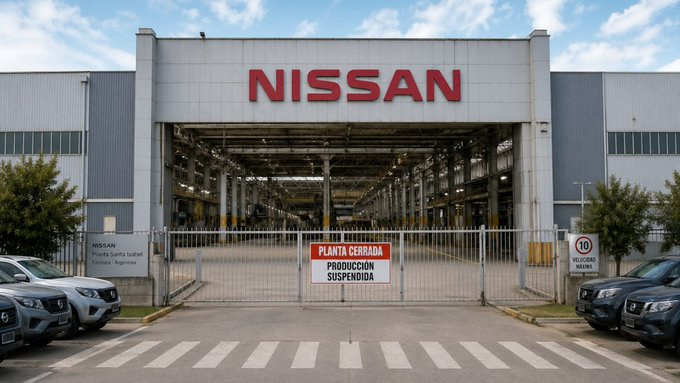
Nissan’s Retreat: From Local Production to Import-Only
Nissan’s withdrawal from Argentina marks the culmination of a process that began in 2024, when the automaker first signaled its intention to restructure its Latin American operations under the global “Re:Nissan” efficiency plan . The company had produced vehicles at the Santa Isabel plant in Córdoba since 2018, manufacturing the Frontier pickup .
Under the new arrangement, Nissan has signed a Memorandum of Understanding to transfer its commercial and logistics operations to Grupo Simpa (with Grupo Tagle holding a minority stake). The consortium will assume responsibility for importing, distributing, and marketing Nissan vehicles in Argentina .
Key elements of Nissan’s exit:
| Aspect | Details |
|---|---|
| Former production site | Santa Isabel, Córdoba (closed Oct 2025) |
| Peak annual production | ~25,000 units (Frontier pickup) |
| New operating model | Import-only via Grupo Simpa (90%) and Grupo Tagle (10%) |
| Transition timeline | July-September 2026 |
| Future structure | Part of Nissan Importers Business Unit (NIBU), which oversees 36 Latin American markets |
The transition is expected to be completed between July and September 2026. Nissan’s dealership network and customer service commitments, including the “Plan de Ahorro” savings program, are expected to continue under the new operators .
Mercedes-Benz Exited in February 2025
Nissan’s departure marks the second time in just over a year that a major automaker has exited direct control of its Argentine operations. In February 2025, after 74 years in the country, Mercedes-Benz sold its entire Argentine industrial and commercial operation to a local investor group led by Pablo Peralta .
The new entity, Prestige Auto, took over the Virrey del Pino plant (which produces the Sprinter van) and guaranteed the continuity of 1,700 jobs . Unlike Nissan’s import-only shift, Prestige Auto has actually increased local production—from 62 to 68 units per day within its first 60 days of operation—and has announced plans to invest $100 million to modernize the plant and expand exports .
Mercedes-Benz exit summary:
| Aspect | Details |
|---|---|
| Date of sale | February 2025 |
| New operator | Prestige Auto (led by Daniel Herrero, Alfonso Prat-Gay) |
| Plant location | Virrey del Pino, Buenos Aires |
| Employees | 1,700 jobs maintained |
| Production target (2026) | 20,000+ Sprinters |
| Planned investment | $100 million |
| Export markets | USA and Africa (in addition to Latin America) |
Where Nissan’s exit represents a retreat to pure importation, Mercedes-Benz’s transition has taken a different path: local operators have maintained—and even expanded—production and exports .
Why Foreign Automakers Are Leaving (or Restructuring)
The twin cases of Nissan and Mercedes-Benz reflect broader pressures on Argentina’s industrial sector. According to the Institute for Public Policy and Thought (IPyPP) , several Argentine companies have shifted from manufacturing to importing across sectors including kitchenware, appliances, automobiles, footwear, and food .
Three policy factors have driven this trend since President Javier Milei took office in December 2023 :
| Factor | Impact |
|---|---|
| Tariff liberalization | Reduced protection for domestic manufacturing |
| Currency appreciation | Made imports cheaper and exports less competitive |
| Market contraction | Falling wages reduced domestic consumption |
The results are stark. Manufacturing industrial production declined 8.7% in February 2026 compared to the same month in 2025. Within that, the category containing computers, televisions, and communications devices fell 24.6% , automobiles fell 24% , and garments fell 22.6% .
Since November 2023, approximately 100,000 jobs have been lost in Argentina’s industrial sector—an average of 160 jobs per day, according to studies by the University of Buenos Aires .
In the automotive sector specifically, production has collapsed. In February 2026 alone, output fell 30.1% year-over-year . Compared with February 2023—just three years earlier—automobile production has fallen by 54% , from 21,876 units to just 10,034 units .
Six out of every ten cars sold in Argentina are now imported —a dramatic reversal from the era when local manufacturing dominated .
What This Means for the Industry
The Nissan and Mercedes-Benz cases represent two possible futures for foreign manufacturers in Argentina:
- The Nissan path: Exit production entirely, shift to import-only, and hand commercial operations to local distributors
- The Mercedes-Benz path: Find a local investor willing to maintain production, preserve jobs, and even expand exports
Thus far, the Mercedes-Benz model appears to be the exception rather than the rule. Most foreign manufacturers have cut costs, reduced headcount, or exited entirely—not doubled down on local production.
The Broader Political and Economic Context
President Javier Milei’s economic policies have prioritized fiscal austerity, trade liberalization, and currency stability. While these policies have reduced inflation from its peak, they have also crushed domestic demand and made locally produced goods less competitive against imports .
The loss of 100,000 industrial jobs since late 2023—and the collapse of manufacturing output across multiple sectors—represents a significant political cost for the administration . Whether Milei’s economic reforms will eventually produce the conditions for a manufacturing revival remains an open question. For now, the trend is clear: foreign automakers are retreating, not investing.
Key Takeaways
| Aspect | Summary |
|---|---|
| Nissan’s move | Exits production entirely; shifts to import-only via Grupo Simpa |
| Production ceased | October 2025 (Córdoba plant) |
| Mercedes-Benz exit | Sold to local investor group (Prestige Auto) in February 2025 |
| Prestige Auto | Maintained production, preserved jobs, plans $100M investment, exports to USA/Africa |
| Industry-wide decline | Auto production fell 30.1% in February 2026 |
| Industrial job losses | 100,000 jobs lost since November 2023 |
| Import share | 60% of cars sold in Argentina are now imported |
| Key policy drivers | Tariff liberalization, currency appreciation, market contraction |
Follow Reflecto News for continuous updates on Argentina’s industrial sector, foreign investment trends, and all breaking business news from around the world.
This article is the intellectual property of Reflecto News. Redistribution without attribution is prohibited. For syndication or media inquiries, please contact the editorial team.
Questions people ask
What is China's current share of global manufacturing?
China now accounts for twenty eight percent of global manufacturing. This industrial output exceeds the combined manufacturing production of the United States, Japan, and Germany, making China the leading global industrial power according to recent reports.
Why were Andrew Tate and Tristan Tate arrested in Miami?
Andrew Tate and his brother Tristan Tate were taken into custody in Miami by the United States Marshals Service. They face thirty eight new charges in the United Kingdom, including rape and child pornography offences, and prosecutors are seeking their extradition.
What warning did Moscow issue about oil prices?
Kirill Dmitriev, the Chief Executive of the Russian Direct Investment Fund, warned that a tsunami of skyrocketing oil prices is approaching. Moscow describes this potential energy shock as a major threat to global markets.
What political shift is projected for Benjamin Netanyahu's coalition?
Political polls project that Prime Minister Benjamin Netanyahu's coalition is on track to lose its majority in the upcoming October election. This projection indicates a potential political shift in Jerusalem.
Why did a Russian military aircraft land in Tehran?
A Russian airborne command aircraft, widely known as a doomsday plane, landed in Tehran. The arrival of the aircraft represents a high stakes show of support from Russia for Iran during a period of heightened regional tensions.
What did President Masoud Pezeshkian claim about the United States and Israel?
Iranian President Masoud Pezeshkian claimed that the United States and Israel failed in a forty eight hour plan to topple the Iranian government. He made these statements during a televised address marking two years since his inauguration.