Reflecto News is an online news platform covering major international political events, global economic developments, and security conflicts. The site provides updates on topics such as Chinese manufacturing dominance, Middle Eastern political tensions, and high profile legal arrests. Readers can access current articles organized by categories like World News, Iran, and USA.
Published on Reflecto News | World News | Politics & Media
President Donald Trump launched a blistering attack on media coverage of the Iran war Saturday, accusing news organizations of being “CRAZY, or just plain CORRUPT” for failing to report what he described as a decisive American victory. In a lengthy post on Truth Social, Trump declared that the United States has “completely destroyed Iran’s Military, including their entire Navy and Air Force, and everything else” and that Iran’s “Leadership is DEAD!”
The president’s outburst came as his administration’s delegation continues high-stakes peace negotiations with Iranian officials in Islamabad, Pakistan. Trump’s characterization of the war’s outcome stands in stark contrast to the reality of ongoing talks, the continued closure of the Strait of Hormuz, and Iran’s demonstrated ability to threaten US naval assets .
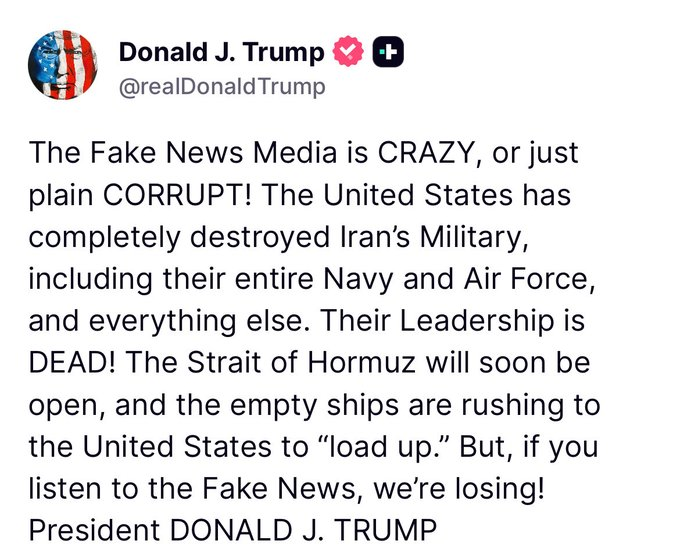
‘The Fake News Media is CRAZY, or just plain CORRUPT!’
President Trump’s Truth Social post was characteristically combative, targeting what he perceives as biased media coverage of the conflict.
“The Fake News Media is CRAZY, or just plain CORRUPT! The United States has completely destroyed Iran’s Military, including their entire Navy and Air Force, and everything else. Their Leadership is DEAD! The Strait of Hormuz will soon be open, and the empty ships are rushing to the United States to ‘load up.’ But, if you listen to the Fake News, we’re losing!” — President Donald Trump
The president’s claims of total victory come despite ongoing Iranian military capabilities. Just hours before Trump’s post, Iranian forces threatened to attack a US Navy destroyer within 30 minutes if it attempted to enter the Strait of Hormuz—a warning that caused the vessel to turn back .
The Reality: A War of Attrition, Not Annihilation
While US and Israeli strikes have inflicted significant damage on Iran’s military infrastructure, independent analysts and even some US officials have offered a more nuanced assessment than Trump’s declaration of total victory.
| Military Domain | Trump’s Claim | Independent Assessment |
|---|---|---|
| Navy | “Completely destroyed” | Major surface vessels damaged; small boat fleet remains operational |
| Air Force | “Completely destroyed” | Significant degradation; some aircraft and air defenses remain |
| Leadership | “DEAD!” | Supreme Leader Mojtaba Khamenei severely wounded but alive and governing |
| Missile arsenal | Not specified | Thousands of missiles reportedly remain |
Sources: US intelligence assessments, Reuters, multiple reports
US intelligence assessments indicate that while Iran’s arsenal has been significantly reduced, the country still retains thousands of ballistic missiles and the ability to carry out occasional attacks . The Islamic Revolutionary Guard Corps (IRGC) has demonstrated continued operational capability, including the recent threat to US naval vessels and the ongoing effective closure of the Strait of Hormuz .
Iran’s Leadership: ‘DEAD!’ or Wounded but Governing?
Trump’s claim that Iran’s leadership is “DEAD!” is contradicted by extensive reporting, including Reuters’ own investigation published just days ago. That investigation, based on three sources close to the inner circle of Supreme Leader Mojtaba Khamenei, revealed that the 56-year-old leader suffered catastrophic injuries in the February 28 airstrike that killed his father, former Supreme Leader Ali Khamenei .
| Leadership Status | Details |
|---|---|
| Ayatollah Ali Khamenei | Killed in February 28 airstrike |
| Mojtaba Khamenei | Severely wounded (facial disfigurement, possible leg loss) but alive |
| Governance | Continues via audio conference; “mentally sharp” |
| Public appearances | None since February 28 |
Sources: Reuters, sources close to Khamenei’s inner circle
While the “longtime leaders” Trump references may be gone, the Islamic Republic continues to function under the wounded Mojtaba Khamenei, who was named supreme leader on March 8 . The Iranian delegation currently negotiating in Islamabad operates under his ultimate authority, communicated via secure channels .
The Strait of Hormuz: ‘Soon Be Open’ vs. Iranian Control
Trump’s assertion that “the Strait of Hormuz will soon be open” stands in tension with events on the ground. Just hours before his post, Iran warned that a US Navy destroyer would be attacked within 30 minutes if it attempted to enter the strait—a warning that caused the vessel to turn back .
| Hormuz Status | Details |
|---|---|
| Trump’s claim | “Soon be open” |
| Current reality | Largely restricted; Iranian control |
| US naval movement | Destroyer turned back after Iranian warning |
| Shipping traffic | ~90% below pre-war levels |
Sources: Multiple news reports
While some vessels—including two Chinese supertankers—have begun crossing the strait, traffic remains a fraction of pre-war levels. Iran continues to require prior approval for all transits and maintains that the strait’s management has entered a “new phase” under IRGC supervision .
‘Empty Ships Are Rushing to the United States’
Trump’s claim that “empty ships are rushing to the United States to ‘load up'” reflects a genuine trend: the repositioning of very large crude carriers (VLCCs) from the Persian Gulf to the US Gulf Coast as buyers seek alternatives to disrupted Middle Eastern supplies.
| Shipping Trend | Details |
|---|---|
| Trump’s claim | Ships “rushing to the United States” |
| Observed reality | VLCCs repositioning to US Gulf Coast |
| US export capacity | Expanding terminals; “quick turnaround” |
| Market impact | Increased US crude and LNG exports |
Sources: Maritime tracking data, multiple reports
This shift represents a significant realignment of global energy trade patterns, with the United States capturing market share from Gulf producers. However, the long-term sustainability of this shift depends on the duration of the Hormuz crisis and the outcome of the Islamabad peace talks .
The ‘Fake News’ Target: Reporting vs. Propaganda
Trump’s accusation that the “Fake News Media” is reporting that “we’re losing” reflects a broader frustration with media coverage that has highlighted the costs and complexities of the war rather than declaring decisive victory.
| Media Coverage | Trump’s Characterization |
|---|---|
| Reported Iranian military capabilities | “We’re losing” |
| Noted US equipment losses (24 MQ-9 drones) | Negative coverage |
| Highlighted continued Hormuz restrictions | “Fake News” |
| Questioned administration claims | “Corrupt” |
Sources: Multiple news reports
Major news organizations have reported extensively on the US military’s achievements, including the degradation of Iran’s air defenses, the destruction of weapons factories, and the elimination of senior Iranian commanders. However, they have also noted the continued Iranian capabilities, the unresolved status of the strait, and the human and financial costs of the war .
The Islamabad Talks: Victory or Negotiation?
The timing of Trump’s victory declaration—while his own administration’s delegation negotiates with Iranian officials in Islamabad—presents a strategic contradiction. If the United States has achieved “complete” victory and Iran’s leadership is “DEAD!”, the purpose of ongoing negotiations is unclear.
| Talks Status | Details |
|---|---|
| US delegation | Vice President JD Vance, Jared Kushner, Steve Witkoff |
| Iranian delegation | Parliament Speaker Ghalibaf, Foreign Minister Araghchi |
| Key issues | Strait of Hormuz, nuclear program, sanctions, Lebanon |
| Status | Ongoing, described as “make or break” |
Sources: Government of Pakistan, multiple reports
The negotiations suggest that the war has not produced a decisive outcome that would render diplomacy unnecessary. Both sides continue to pursue their objectives at the negotiating table, and the outcome remains uncertain .
The ‘Quick Turnaround’ Tagline
Trump’s post concluded with “Quick turnaround!”—a tagline he has used in previous energy-related statements. The phrase suggests that the administration sees the current crisis as an opportunity for the United States to capture market share from Gulf producers and that American military power is enabling that economic opportunity .
Whether the “quick turnaround” refers to the reopening of the strait, the repositioning of tankers, or the conclusion of negotiations remains unclear—as does the timeline for any of these developments .
Frequently Asked Questions (FAQs)
1. What did President Trump claim about Iran’s military?
Trump declared that the United States has “completely destroyed Iran’s Military, including their entire Navy and Air Force, and everything else” and that Iran’s “Leadership is DEAD!” .
2. Is Iran’s military completely destroyed?
Independent assessments indicate significant degradation but not complete destruction. Iran retains thousands of ballistic missiles, small boat fleets, and the ability to threaten US naval assets and control the Strait of Hormuz .
3. Is Iran’s leadership dead?
Former Supreme Leader Ayatollah Ali Khamenei was killed in the February 28 airstrike. His successor, Mojtaba Khamenei, was severely wounded (facial disfigurement, possible leg loss) but is alive and continues to govern via audio conference .
4. Is the Strait of Hormuz open?
While some vessels have begun crossing, the strait remains largely restricted. Iran continues to require prior approval for all transits, and a US Navy destroyer turned back after receiving an Iranian threat of attack within 30 minutes .
5. Are ships rushing to the United States?
Yes. Very large crude carriers (VLCCs) are repositioning from the Persian Gulf to the US Gulf Coast as buyers seek alternatives to disrupted Middle Eastern supplies. This represents a significant realignment of global energy trade .
6. Why is Trump attacking the “Fake News Media”?
Trump is frustrated with media coverage that has highlighted the costs and complexities of the war rather than declaring decisive victory. He accuses news organizations of being “CRAZY, or just plain CORRUPT” for reporting that the US is “losing” .
7. What is the status of the Islamabad peace talks?
Negotiations between US and Iranian delegations are ongoing in Islamabad, Pakistan. The talks are described as “make or break” and cover key issues including the Strait of Hormuz, Iran’s nuclear program, sanctions, and Lebanon .
Stay informed with Reflecto News – Your trusted source for breaking defense and media intelligence. Subscribe for real-time updates on the Iran war, the Strait of Hormuz crisis, and the Islamabad peace talks.
Questions people ask
What is China's current share of global manufacturing?
China now accounts for twenty eight percent of global manufacturing. This industrial output exceeds the combined manufacturing production of the United States, Japan, and Germany, making China the leading global industrial power according to recent reports.
Why were Andrew Tate and Tristan Tate arrested in Miami?
Andrew Tate and his brother Tristan Tate were taken into custody in Miami by the United States Marshals Service. They face thirty eight new charges in the United Kingdom, including rape and child pornography offences, and prosecutors are seeking their extradition.
What warning did Moscow issue about oil prices?
Kirill Dmitriev, the Chief Executive of the Russian Direct Investment Fund, warned that a tsunami of skyrocketing oil prices is approaching. Moscow describes this potential energy shock as a major threat to global markets.
What political shift is projected for Benjamin Netanyahu's coalition?
Political polls project that Prime Minister Benjamin Netanyahu's coalition is on track to lose its majority in the upcoming October election. This projection indicates a potential political shift in Jerusalem.
Why did a Russian military aircraft land in Tehran?
A Russian airborne command aircraft, widely known as a doomsday plane, landed in Tehran. The arrival of the aircraft represents a high stakes show of support from Russia for Iran during a period of heightened regional tensions.
What did President Masoud Pezeshkian claim about the United States and Israel?
Iranian President Masoud Pezeshkian claimed that the United States and Israel failed in a forty eight hour plan to topple the Iranian government. He made these statements during a televised address marking two years since his inauguration.