Reflecto News is an online news platform covering major international political events, global economic developments, and security conflicts. The site provides updates on topics such as Chinese manufacturing dominance, Middle Eastern political tensions, and high profile legal arrests. Readers can access current articles organized by categories like World News, Iran, and USA.
By Reflecto News Desk
April 6, 2026
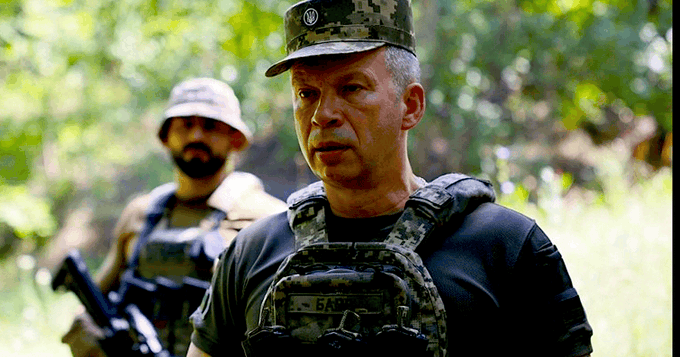
Ukraine’s Commander-in-Chief General Oleksandr Syrskyi has announced that Ukrainian forces have regained control of 480 square kilometers (approximately 185 square miles) of territory and 12 settlements since the end of January 2026. The gains were made primarily along the Oleksandrivka axis in the southeastern and eastern sectors, spanning parts of Dnipropetrovsk and Zaporizhzhia regions, even as Russian forces maintain pressure across a roughly 1,200 km frontline.
Syrskyi made the statement following a visit to the frontline, describing the operation as an ongoing counteroffensive that has disrupted Russian plans and exceeded previous Ukrainian territorial recoveries in similar actions.
General Oleksandr Syrskyi, Commander-in-Chief of the Armed Forces of Ukraine (file image).
Details of Ukrainian Gains on the Oleksandrivka Axis
According to Syrskyi, the operation on the Oleksandrivka direction began in late January 2026. Ukrainian units, including airborne assault forces, have liberated:
- 8 settlements in the Dnipropetrovsk region (eastern sector)
- 4 settlements in the Zaporizhzhia region (southeastern sector)
The total area reclaimed stands at 480 sq km. Syrskyi noted that this figure surpasses the results of the earlier Dobropillia counteroffensive operation, where Ukraine liberated over 430 sq km. He emphasized that success is measured by the liberation of territory, not just defensive holds.
Russian forces continue active assaults in nearby areas such as Ternove, Oleksandrohrad, Ivanivka, Zelenyi Hai, Andriivka-Klevtsove, Sichneve, and toward Sosnivka, Verbove, and Zlahoda. However, Ukrainian advances have forced Russia to redeploy units from other hotspots, including the Pokrovsk and Ocheretine sectors, to contain the Ukrainian push.
Assessed control of terrain in eastern Zaporizhzhia and Dnipropetrovsk Oblasts, illustrating contested areas and reported Ukrainian counteroffensives (March 2026 map).
Broader view of territorial control in eastern and southern Ukraine, highlighting Dnipropetrovsk and Zaporizhzhia regions.
Context: Russia’s Ongoing Spring Offensive on a 1,200 km Frontline
The Ukrainian gains come amid Russia’s continued large-scale offensive operations across nearly the entire 1,200 km (approximately 745 miles) frontline. Russian forces have focused efforts on creating buffer zones, particularly toward Dnipropetrovsk Oblast, and pressing advances in Donetsk Oblast hotspots like Pokrovsk.
Despite Russian momentum in several eastern sectors, Ukrainian forces have demonstrated resilience in the south and southeast. Earlier updates from Syrskyi indicated progressive gains: around 400 sq km by late February, increasing to over 470 sq km by late March, before reaching the current 480 sq km figure.
Analysts note that these Ukrainian counteractions represent one of the more notable territorial shifts for Kyiv in recent months, contrasting with the generally slow, grinding nature of Russian advances throughout much of 2025–2026.
Ukrainian soldiers in action on the frontline (illustrative of defensive and offensive operations in contested areas).
Strategic Implications and Shifting Battlefield Dynamics
Syrskyi’s announcement highlights potential shifts in battlefield momentum:
- Disruption of Russian plans: Ukrainian pressure on the Oleksandrivka axis has compelled Russia to divert resources from other priority directions.
- Net territorial comparison: In certain periods (e.g., February 2026), Ukraine reportedly regained more land than Russia captured, marking a reversal from earlier trends.
- Broader 2026 goals: Ukraine’s military leadership has outlined a strategy focused on strategic defense to exhaust Russian forces while seeking opportunities for localized offensives and long-range strikes on Russian infrastructure.
The gains, while modest compared to the overall scale of occupied territory (roughly 20% of Ukraine remains under Russian control as of early 2026), demonstrate Ukraine’s ability to conduct active operations even under sustained pressure.
Independent verification of exact territorial changes remains challenging due to the fluid nature of the front and restricted access. Open-source analysts and Western assessments, such as those from the Institute for the Study of War (ISW), track incremental movements but often note discrepancies between claims and confirmed advances.
What Lies Ahead?
The situation on the Oleksandrivka axis and across the broader frontline remains dynamic. Russian forces continue their spring offensive, while Ukraine focuses on depleting enemy resources through combined defensive stands, counterattacks, and deep strikes.
International support, including military aid and sanctions, continues to play a critical role in sustaining Ukraine’s defense capabilities.
Reflecto News will continue monitoring developments in the Russia-Ukraine war for verified updates on territorial changes, official statements, and frontline dynamics. Bookmark Reflecto News and follow our dedicated Ukraine coverage for accurate, timely reporting on this ongoing conflict.
Questions people ask
What is China's current share of global manufacturing?
China now accounts for twenty eight percent of global manufacturing. This industrial output exceeds the combined manufacturing production of the United States, Japan, and Germany, making China the leading global industrial power according to recent reports.
Why were Andrew Tate and Tristan Tate arrested in Miami?
Andrew Tate and his brother Tristan Tate were taken into custody in Miami by the United States Marshals Service. They face thirty eight new charges in the United Kingdom, including rape and child pornography offences, and prosecutors are seeking their extradition.
What warning did Moscow issue about oil prices?
Kirill Dmitriev, the Chief Executive of the Russian Direct Investment Fund, warned that a tsunami of skyrocketing oil prices is approaching. Moscow describes this potential energy shock as a major threat to global markets.
What political shift is projected for Benjamin Netanyahu's coalition?
Political polls project that Prime Minister Benjamin Netanyahu's coalition is on track to lose its majority in the upcoming October election. This projection indicates a potential political shift in Jerusalem.
Why did a Russian military aircraft land in Tehran?
A Russian airborne command aircraft, widely known as a doomsday plane, landed in Tehran. The arrival of the aircraft represents a high stakes show of support from Russia for Iran during a period of heightened regional tensions.
What did President Masoud Pezeshkian claim about the United States and Israel?
Iranian President Masoud Pezeshkian claimed that the United States and Israel failed in a forty eight hour plan to topple the Iranian government. He made these statements during a televised address marking two years since his inauguration.