Reflecto News is an online news platform covering major international political events, global economic developments, and security conflicts. The site provides updates on topics such as Chinese manufacturing dominance, Middle Eastern political tensions, and high profile legal arrests. Readers can access current articles organized by categories like World News, Iran, and USA.
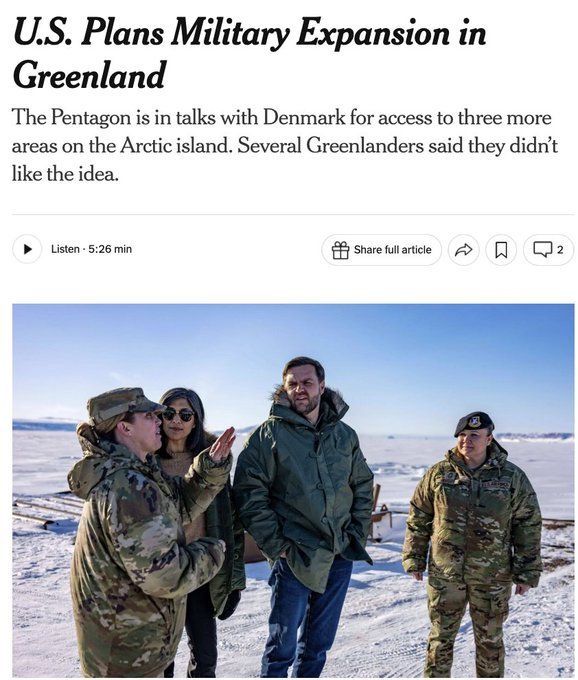
NUUK / COPENHAGEN — In what is being described as the most significant expansion of the American military presence in the Arctic since the height of the Cold War, the United States is in advanced negotiations with Denmark and the autonomous government of Greenland to gain access to three additional strategic sites. According to a report by the New York Times on Wednesday, April 1, 2026, the move aims to fortify NATO’s northern flank as the “Great Power Competition” for Arctic resources and transit routes intensifies.
The expansion would increase the number of active U.S. military sites on the world’s largest island from one to four, ending decades of American military “contraction” in the region.
1. Reclaiming the Past: The Three Target Sites
The Pentagon is specifically eyeing locations that served as vital logistical hubs during the 20th century, many of which have since transitioned to civilian or dual-use roles.
- Pituffik (Thule) Expansion: Currently the only active U.S. base in Greenland, Pituffik serves as a critical node for the Space Force’s global early-warning system. The new plan involves upgrading its deep-water port and runway capacity.
- Kangerlussuaq (Sondrestrom): Formerly known as Bluie West-8, this site features Greenland’s longest runway. Re-establishing a permanent U.S. presence here would provide a central hub for search-and-rescue (SAR) and rapid-response aerial patrols.
- Narsarsuaq (Bluie West-1): Located in the south, this former airfield is strategically positioned to monitor the GIUK Gap (Greenland, Iceland, and United Kingdom)—the primary maritime gateway for ships and submarines entering the Atlantic from the Arctic.
2. Strategic Drivers: Why Now?
The “Arctic Rush” of 2026 is driven by a combination of climate change and deteriorating relations with global rivals.
- The “Blue Arctic” Reality: As polar ice continues to recede, new shipping lanes—such as the Northern Sea Route—are becoming commercially viable. The U.S. views Greenland as the “unsinkable aircraft carrier” necessary to protect these corridors.
- Countering Russian/Chinese Ambition: Russia has recently re-opened over 50 Soviet-era Arctic military posts, while China has declared itself a “Near-Arctic State.” The U.S. expansion is a direct counter-signal intended to deter “gray zone” provocations in the High North.
- The “Energy Lockout” Context: With the ongoing U.S.-Iran war causing global energy volatility, Greenland’s vast untapped reserves of rare-earth minerals and potential offshore oil have become matters of “National Security” for Washington.
3. The “Nuuk-Copenhagen” Diplomacy
Unlike past eras, the U.S. is navigating a much more complex political landscape in 2026.
- Sovereignty Concerns: The Greenlandic government in Nuuk is pushing for “dual-use” agreements, ensuring that any military upgrades also benefit local civilian infrastructure, such as improved telecommunications and regional airports.
- The Danish “Bridge”: Denmark remains the formal treaty partner, but Copenhagen has emphasized that no deal will be signed without the “full and active consent” of the Greenlandic people, avoiding the diplomatic friction seen during the 2019 “Purchase Greenland” controversy.
Current U.S. Military Footprint in Greenland
| Metric | Current Status (April 1, 2026) | Proposed Expansion (2026-2030) |
| Active Bases | 1 (Pituffik Space Base) | 4 Sites (Total) |
| Primary Mission | Missile Warning / Space Surveillance | Power Projection / SAR / Maritime Monitoring |
| Personnel | ~600 (Rotational/Permanent) | Estimated 1,500 – 2,200 |
| Infrastructure Focus | Radar & Deep Space | Runways, Fuel Storage, Sub-sea Cable Hubs |
Analysis: The Return of the “North Atlantic Barrier”
The negotiations for Narsarsuaq and Kangerlussuaq represent a return to “geography-first” defense. By anchoring its presence in Greenland, the U.S. is essentially rebuilding the North Atlantic barrier that defined 20th-century stability.
However, as President Trump prepares for his 9:00 PM ET address tonight, the cost of this Arctic expansion—estimated to be in the billions of dollars—may face scrutiny from a domestic public already weary of the high price tag of the Iran conflict. For the Arctic, the message is clear: the “High North” is no longer a zone of low tension, but the new frontline of 21st-century deterrence.
Questions people ask
What is China's current share of global manufacturing?
China now accounts for twenty eight percent of global manufacturing. This industrial output exceeds the combined manufacturing production of the United States, Japan, and Germany, making China the leading global industrial power according to recent reports.
Why were Andrew Tate and Tristan Tate arrested in Miami?
Andrew Tate and his brother Tristan Tate were taken into custody in Miami by the United States Marshals Service. They face thirty eight new charges in the United Kingdom, including rape and child pornography offences, and prosecutors are seeking their extradition.
What warning did Moscow issue about oil prices?
Kirill Dmitriev, the Chief Executive of the Russian Direct Investment Fund, warned that a tsunami of skyrocketing oil prices is approaching. Moscow describes this potential energy shock as a major threat to global markets.
What political shift is projected for Benjamin Netanyahu's coalition?
Political polls project that Prime Minister Benjamin Netanyahu's coalition is on track to lose its majority in the upcoming October election. This projection indicates a potential political shift in Jerusalem.
Why did a Russian military aircraft land in Tehran?
A Russian airborne command aircraft, widely known as a doomsday plane, landed in Tehran. The arrival of the aircraft represents a high stakes show of support from Russia for Iran during a period of heightened regional tensions.
What did President Masoud Pezeshkian claim about the United States and Israel?
Iranian President Masoud Pezeshkian claimed that the United States and Israel failed in a forty eight hour plan to topple the Iranian government. He made these statements during a televised address marking two years since his inauguration.