Reflecto News is an online news platform covering major international political events, global economic developments, and security conflicts. The site provides updates on topics such as Chinese manufacturing dominance, Middle Eastern political tensions, and high profile legal arrests. Readers can access current articles organized by categories like World News, Iran, and USA.
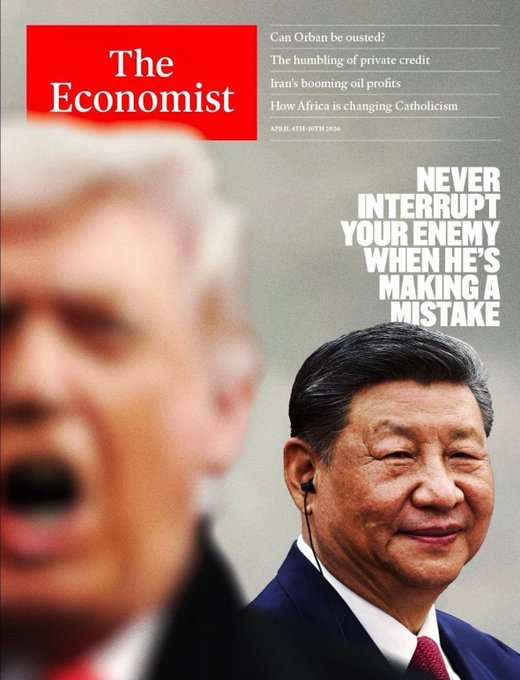
The latest cover of The Economist, released today, Wednesday, April 1, 2026, features the striking Napoleon Bonaparte maxim: “Never interrupt your enemy when he’s making a mistake.” The artwork—a minimalist, high-contrast illustration—depicts a silhouette of President Donald Trump looking toward a dark, chaotic horizon of the Middle East, while the shadows of Vladimir Putin and Xi Jinping watch from the periphery, appearing to hold back their own advisors.
1. The Core Argument: A “War of Choice” in Quagmire
The leading article argues that while Operation Epic Fury was designed to be a “30-day knockout blow” to the Iranian regime, it has instead entered a dangerous “second act” that primarily benefits America’s global rivals.
- Strategic Overreach: The magazine posits that the U.S. has “interrupted” its own long-term interests. By entangling the U.S. military in a high-intensity conflict over Tehran, Trump has inadvertently granted Russia and China exactly what they wanted: a distracted, overextended America.
- The “Mistake” of 2026: The Economist characterizes the February 28 “sneak attack” as a strategic error. Rather than causing a regime collapse, the bombardment has “hardened” the Iranian leadership and forced the Strait of Hormuz shut, creating a global energy crisis that serves Moscow’s treasury.
2. Who Stands to Gain?
The cover story breaks down how the “mistake” is being leveraged by the “silent observers” in Moscow and Beijing:
- Vladimir Putin’s Windfall: With the Strait of Hormuz closed, Russian Urals crude has surged to $104 per barrel. The Economist notes that Putin is the only leader currently “smiling,” as U.S. sanctions are being quietly waived to keep global markets from a total 1970s-style collapse.
- Xi Jinping’s “Stealth” Diplomacy: While the U.S. drops bombs, China is dropping “stealth jets” and infrastructure deals. The recent fast-tracking of J-35 jets to Pakistan and the move to position the Yuan as the primary currency for Gulf oil are cited as China’s way of “closing the gap” while the U.S. is busy in the trenches.
- The NATO Fray: The cover also alludes to Trump’s recent threats to withdraw from NATO. The magazine argues that by alienating European allies who refuse to support the Iran war, the U.S. is “dismantling its own shield” just when it needs it most.
3. The “FOMO” War and Market Manipulation
The editorial takes a sharp look at the “manufactured FOMO” (Fear Of Missing Out) being used in the information war.
- The Ceasefire Narrative: The magazine suggests that the White House’s claims of a “ceasefire request” from Iran (denied by Tehran today) are a desperate attempt to manipulate oil markets and lower $4-a-gallon gas prices before they cause a domestic political revolt in the U.S.
- Infrastructure Targeting: The strike on Amazon’s AWS in Bahrain and the damage to the Russian Orthodox church in Tehran are framed as signs of a campaign that has lost its precision and is now hitting the “wrong targets,” further isolating Washington.
Conclusion: The “April 6” Trap
The Economist concludes that the President’s self-imposed April 6 deadline is a “trap of his own making.” If he exits now, he leaves a scorched Iran and a closed Strait; if he escalates, he risks a “forever war” that cements the 21st century as the “Sino-Russian Century.” The magazine’s final verdict? “The Art of the Deal is failing because the President forgot the Art of War: he is making a mistake, and his enemies are more than happy to let him finish.”
Questions people ask
What is China's current share of global manufacturing?
China now accounts for twenty eight percent of global manufacturing. This industrial output exceeds the combined manufacturing production of the United States, Japan, and Germany, making China the leading global industrial power according to recent reports.
Why were Andrew Tate and Tristan Tate arrested in Miami?
Andrew Tate and his brother Tristan Tate were taken into custody in Miami by the United States Marshals Service. They face thirty eight new charges in the United Kingdom, including rape and child pornography offences, and prosecutors are seeking their extradition.
What warning did Moscow issue about oil prices?
Kirill Dmitriev, the Chief Executive of the Russian Direct Investment Fund, warned that a tsunami of skyrocketing oil prices is approaching. Moscow describes this potential energy shock as a major threat to global markets.
What political shift is projected for Benjamin Netanyahu's coalition?
Political polls project that Prime Minister Benjamin Netanyahu's coalition is on track to lose its majority in the upcoming October election. This projection indicates a potential political shift in Jerusalem.
Why did a Russian military aircraft land in Tehran?
A Russian airborne command aircraft, widely known as a doomsday plane, landed in Tehran. The arrival of the aircraft represents a high stakes show of support from Russia for Iran during a period of heightened regional tensions.
What did President Masoud Pezeshkian claim about the United States and Israel?
Iranian President Masoud Pezeshkian claimed that the United States and Israel failed in a forty eight hour plan to topple the Iranian government. He made these statements during a televised address marking two years since his inauguration.