Reflecto News is an online news platform covering major international political events, global economic developments, and security conflicts. The site provides updates on topics such as Chinese manufacturing dominance, Middle Eastern political tensions, and high profile legal arrests. Readers can access current articles organized by categories like World News, Iran, and USA.
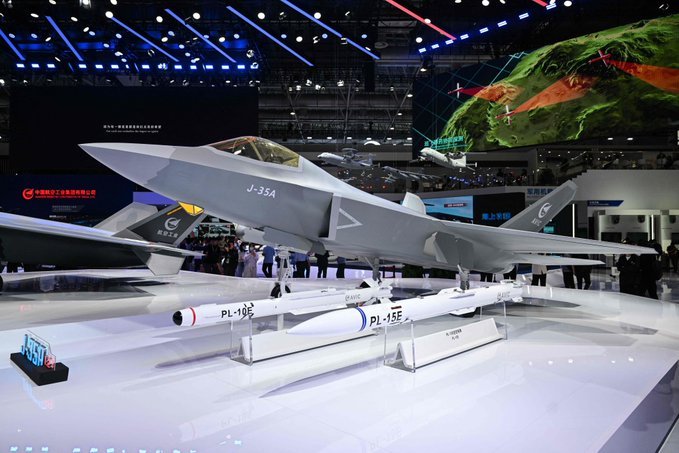
ISLAMABAD / BEIJING — In a move that significantly alters the balance of air power in South Asia, China has officially fast-tracked the delivery of its J-35A “Grey Falcon” fifth-generation stealth fighters to the Pakistan Air Force (PAF). According to reports from Dawn and regional defense monitors on Wednesday, April 1, 2026, the first units of the advanced stealth platform are expected to arrive in Islamabad as early as the first half of this year, years ahead of original procurement timelines.
The acceleration comes as Pakistan navigates a complex geopolitical landscape, with its neighbor Iran currently embroiled in Operation Epic Fury, and traditional rival India still years away from deploying its own indigenous stealth aircraft.
1. The “Grey Falcon” Induction
The J-35A (the export-ready land-based variant of the FC-31) is designed to give Pakistan a qualitative leap in situational awareness and “first-look, first-kill” capability.
- First Foreign Operator: Pakistan is set to become the first international customer of the J-35, reinforcing the “Iron Brotherhood” between Islamabad and Beijing.
- Initial Batch: Defense sources indicate an initial tranche of 4 to 12 aircraft is being prioritized for immediate delivery to allow for pilot conversion and infrastructure testing.
- The “40-Jet” Goal: The PAF has a long-term plan to acquire up to 40 J-35s by 2030, which will serve as the “high” end of a high-low mix alongside the JF-17 Block III and the J-10C.
2. Technological Edge: Shifting the Subcontinent Balance
The induction of a fifth-generation fighter provides the PAF with capabilities that are currently unmatched by any other air force in South Asia.
- Stealth & Survivability: With its diverterless supersonic inlets (DSI) and internal weapons bay, the J-35A features a radar cross-section (RCS) significantly smaller than the Rafale or Su-30MKI.
- PL-17 Compatibility: Reports suggest China may also supply the PL-17 ultra-long-range missile, which boasts a range of over 400 km, potentially pushing opposing AWACS and tankers further back from the border.
- Sensor Fusion: The J-35A’s advanced AESA radar and Distributed Aperture System (DAS) provide 360-degree spherical awareness, essential for modern networked warfare.
3. Regional Impact: The “Iran Factor”
The decision to fast-track these jets is being viewed through the lens of the ongoing war in Iran and the resulting regional instability.
| Metric | Pakistan Air Force (PAF) | Indian Air Force (IAF) |
| 5th Gen Platform | J-35A (Arriving 2026) | AMCA (Prototypes expected 2028-30) |
| Stealth Status | Operational Readiness | Reliance on 4.5 Gen (Rafale) |
| Primary Supplier | China (Strategic Partner) | Domestic / Mixed (France, Russia, US) |
| Decision Cycle | Accelerated due to Iran War | Scrambling to counter J-35 |
Analysis: Pakistan’s “Deterrence” Play
For Islamabad, the J-35 is more than just a fighter jet; it is a “doctrinal solution” to the growing gap in conventional forces. As Dawn noted in a recent analysis, the war in Iran has “rewritten the economics of power,” proving that high-end stealth and low-cost drone swarms are the future of survivability. By securing the J-35 now, Pakistan is ensuring it maintains a credible deterrent at a time when the Middle East is in flames and the U.S. is “strongly considering” a retreat from its traditional alliances like NATO.
While the cost of the program—estimated at $5 to $6 billion—poses a significant challenge for Pakistan’s economy, the strategic necessity of countering India’s superior numbers appears to have won out. As the April 6 deadline for the U.S. strategy in Iran looms, the arrival of Chinese stealth tech in Pakistan signals that a new, Beijing-anchored security architecture is rapidly taking shape in the East.
Questions people ask
What is China's current share of global manufacturing?
China now accounts for twenty eight percent of global manufacturing. This industrial output exceeds the combined manufacturing production of the United States, Japan, and Germany, making China the leading global industrial power according to recent reports.
Why were Andrew Tate and Tristan Tate arrested in Miami?
Andrew Tate and his brother Tristan Tate were taken into custody in Miami by the United States Marshals Service. They face thirty eight new charges in the United Kingdom, including rape and child pornography offences, and prosecutors are seeking their extradition.
What warning did Moscow issue about oil prices?
Kirill Dmitriev, the Chief Executive of the Russian Direct Investment Fund, warned that a tsunami of skyrocketing oil prices is approaching. Moscow describes this potential energy shock as a major threat to global markets.
What political shift is projected for Benjamin Netanyahu's coalition?
Political polls project that Prime Minister Benjamin Netanyahu's coalition is on track to lose its majority in the upcoming October election. This projection indicates a potential political shift in Jerusalem.
Why did a Russian military aircraft land in Tehran?
A Russian airborne command aircraft, widely known as a doomsday plane, landed in Tehran. The arrival of the aircraft represents a high stakes show of support from Russia for Iran during a period of heightened regional tensions.
What did President Masoud Pezeshkian claim about the United States and Israel?
Iranian President Masoud Pezeshkian claimed that the United States and Israel failed in a forty eight hour plan to topple the Iranian government. He made these statements during a televised address marking two years since his inauguration.