Reflecto News is an online news platform covering major international political events, global economic developments, and security conflicts. The site provides updates on topics such as Chinese manufacturing dominance, Middle Eastern political tensions, and high profile legal arrests. Readers can access current articles organized by categories like World News, Iran, and USA.
Published on Reflecto News | World News | Defense & Geopolitics
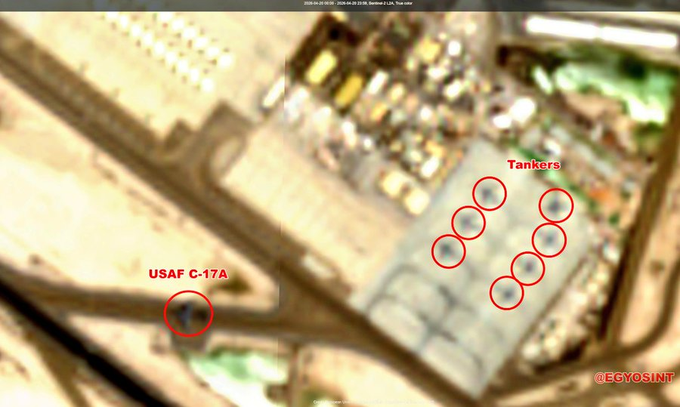
The United States has significantly increased its military presence at Al Dhafra Air Base in the United Arab Emirates, deploying approximately 12 U.S. Navy F/A-18 fighter jets alongside at least seven aerial refueling tankers and a C-17 cargo aircraft, according to satellite imagery and open-source intelligence reports . The buildup comes as the fragile ceasefire between the U.S. and Iran hangs in the balance, and as diplomatic efforts to secure a permanent deal remain stalled .
Satellite imagery captured on April 20, 2026, confirms the deployment, which was first reported by the Egyptian military affairs platform EGYOSINT . F/A-18 Hornets have been a central component of U.S. Central Command (CENTCOM) air operations throughout the war, conducting strikes against Iranian military infrastructure and providing air cover for naval assets enforcing the Strait of Hormuz blockade .
Al Dhafra: A Key Strategic Hub
Al Dhafra Air Base, located approximately 30 kilometers south of Abu Dhabi, has been a critical U.S. military installation since 2002, hosting the Air Force’s 380th Air Expeditionary Wing (AEW) . The base typically houses around 1,200 U.S. personnel, including active-duty members, Reservists, and Air National Guard units .
Before the war, the base hosted an array of advanced U.S. aircraft, including the F-22 Raptor stealth fighter, F-35 Lightning II, U-2 Dragon Lady spy planes, RQ-4 Global Hawk drones, and KC-10 tankers . The current deployment adds significant strike capability to an already formidable arsenal.
The base has not been immune to the conflict. Iran has repeatedly targeted Al Dhafra during its retaliatory strikes against U.S. assets, including a major attack on February 28 — the first day of the war — when the IRGC struck the base with ballistic missiles in response to joint U.S.-Israeli aerial strikes on Iran . Another reported attack occurred on March 26, with Iranian forces targeting maintenance and storage hangars at the base .
The Broader Buildup: A Regional Surge
The deployment at Al Dhafra is part of a larger U.S. military surge across the Middle East. The United States has been conducting a sustained, large-scale airlift operation, ferrying dozens of C-17 Globemaster III transport planes loaded with munitions, equipment, and defense systems from European hubs to bases across the Gulf region .
This logistical effort has been ongoing for weeks, with waves of heavy transport aircraft moving through European airspace toward destinations in Qatar, Saudi Arabia, Jordan, and the UAE . Defense analysts describe the operation as largely a resupply and prepositioning effort, ensuring that U.S. forces are fully stocked in case diplomacy fails and the conflict resumes .
Recent U.S. Military Buildup in the Region:
| Asset Type | Details |
|---|---|
| Carrier Strike Groups | Three carriers (USS George H.W. Bush, USS Abraham Lincoln, USS Gerald R. Ford) |
| Troops | Over 15,000 sailors and Marines |
| Aircraft | 200+ combat aircraft across all three carriers |
| F/A-18s at Al Dhafra | Approximately 12 additional strike fighters |
| Tankers | Minimum 7 aerial refueling aircraft |
| Cargo | At least 1 C-17, plus dozens more in broader airlift |
Sources: CENTCOM, open-source intelligence
Context: Ceasefire, Diplomacy, and Military Posture
The military buildup coincides with a fragile diplomatic window. President Trump extended the ceasefire indefinitely at Pakistan’s request, and a second round of peace talks — possibly in Islamabad — is being discussed . However, Iranian officials have publicly denied that any direct negotiations are scheduled, and Tehran continues to insist that the U.S. must lift its naval blockade of Iranian ports before talks can proceed.
The buildup serves multiple strategic purposes:
1. Negotiating Leverage
Defense analysts widely view the logistical surge as “negotiating from strength,” ensuring that U.S. forces are fully prepared in case diplomacy fails and military operations resume . The presence of advanced strike aircraft at Al Dhafra places them within easy range of Iranian targets.
2. Blockade Enforcement
The naval blockade of Iranian ports, now in its second week, has been enforced by a massive concentration of U.S. naval power, including three carrier strike groups. The air assets at Al Dhafra provide critical support for these operations, including intelligence, surveillance, reconnaissance, and potential strike capabilities.
3. Deterrence
By visibly reinforcing its positions across the Gulf, the U.S. signals to Tehran that any escalation will be met with overwhelming force. The deployment also reassures regional allies — particularly the UAE, Saudi Arabia, and Qatar — of America’s commitment to their defense.
4. Operational Readiness
The airlift includes munitions and defense systems, ensuring that U.S. forces can sustain combat operations if the ceasefire collapses . Resupply missions have occurred multiple times since early 2026, primarily to replenish stocks used in earlier strikes .
UAE’s Delicate Balancing Act
The deployment at Al Dhafra puts the UAE in a delicate position. The UAE hosts thousands of U.S. personnel and has been a critical partner in U.S. military operations for decades . However, at the start of the war, the UAE foreign ministry formally barred the use of its territory, airspace, and territorial waters for any “hostile military action” against Iran, calling for “dialogue, de-escalation, adherence to international law, and respect for state sovereignty” .
Despite this official stance, the U.S. military continues to operate from Al Dhafra, and the UAE has been targeted by Iranian retaliation regardless. Iranian attacks have struck the base multiple times, causing damage and, in at least one instance, killing a civilian from shrapnel in a nearby residential area .
What Comes Next
The U.S. military buildup shows no signs of slowing. Additional cargo aircraft are expected to join the logistical effort in the coming hours and days . The concentration of U.S. airpower at Al Dhafra adds to the three carrier strike groups already operating in the region — the largest U.S. naval deployment in the Middle East since the 2003 invasion of Iraq.
The coming days will determine whether this massive display of force will be used to enforce a diplomatic breakthrough or to prosecute a renewed military campaign.
Frequently Asked Questions (FAQs)
Q1: What aircraft have been deployed to Al Dhafra Air Base?
Approximately 12 U.S. Navy F/A-18 fighter jets, at least 7 aerial refueling tankers, and a C-17 cargo aircraft have been identified via satellite imagery .
Q2: When did the deployment occur?
Satellite imagery from April 20, 2026, confirms the presence of these aircraft at the base .
Q3: Why is the U.S. building up forces at Al Dhafra?
The buildup is part of a broader U.S. military surge across the Middle East, aimed at maintaining negotiating leverage, enforcing the naval blockade of Iranian ports, deterring Iranian escalation, and ensuring operational readiness should the ceasefire collapse .
Q4: Has the base been attacked during the war?
Yes. Iran has struck Al Dhafra multiple times, including on February 28 (the first day of the war) and again on March 26, damaging maintenance hangars and other facilities .
Q5: How does this deployment fit into the broader U.S. military posture?
The deployment at Al Dhafra complements the three carrier strike groups, over 15,000 troops, and 200+ combat aircraft already operating in the region. It is part of a sustained logistical surge that has seen dozens of C-17 transport aircraft ferrying munitions and equipment to Gulf bases .
Q6: Is the ceasefire still in effect?
Yes. President Trump extended the ceasefire indefinitely at Pakistan’s request. However, its future remains uncertain, and the U.S. military is preparing for all contingencies .
Stay informed with Reflecto News – Your trusted source for breaking defense, intelligence, and geopolitical reporting. Subscribe for real-time updates on the US-Iran standoff, military deployments, and global security developments.
Questions people ask
What is China's current share of global manufacturing?
China now accounts for twenty eight percent of global manufacturing. This industrial output exceeds the combined manufacturing production of the United States, Japan, and Germany, making China the leading global industrial power according to recent reports.
Why were Andrew Tate and Tristan Tate arrested in Miami?
Andrew Tate and his brother Tristan Tate were taken into custody in Miami by the United States Marshals Service. They face thirty eight new charges in the United Kingdom, including rape and child pornography offences, and prosecutors are seeking their extradition.
What warning did Moscow issue about oil prices?
Kirill Dmitriev, the Chief Executive of the Russian Direct Investment Fund, warned that a tsunami of skyrocketing oil prices is approaching. Moscow describes this potential energy shock as a major threat to global markets.
What political shift is projected for Benjamin Netanyahu's coalition?
Political polls project that Prime Minister Benjamin Netanyahu's coalition is on track to lose its majority in the upcoming October election. This projection indicates a potential political shift in Jerusalem.
Why did a Russian military aircraft land in Tehran?
A Russian airborne command aircraft, widely known as a doomsday plane, landed in Tehran. The arrival of the aircraft represents a high stakes show of support from Russia for Iran during a period of heightened regional tensions.
What did President Masoud Pezeshkian claim about the United States and Israel?
Iranian President Masoud Pezeshkian claimed that the United States and Israel failed in a forty eight hour plan to topple the Iranian government. He made these statements during a televised address marking two years since his inauguration.