Reflecto News is an online news platform covering major international political events, global economic developments, and security conflicts. The site provides updates on topics such as Chinese manufacturing dominance, Middle Eastern political tensions, and high profile legal arrests. Readers can access current articles organized by categories like World News, Iran, and USA.
Published on Reflecto News | World News | Geopolitics
China’s Foreign Ministry reiterated on Friday, April 24, 2026, that Taiwan is an “inalienable part of China’s territory” and that “no one can ever stop the eventual reunification of the country.” The statement, made by Foreign Ministry spokesman Guo Jiakun, comes amid heightened tensions in the Taiwan Strait and growing international focus on the island’s future .
The assertion was made during a routine press conference after a Japanese media outlet asked about a document from the U.S. Congressional Research Service that discussed China’s intent to exert influence over Taiwan’s elections.
“Taiwan is an inalienable part of China’s territory. … No one can ever stop the eventual reunification of China.” — Guo Jiakun, Chinese Foreign Ministry spokesman
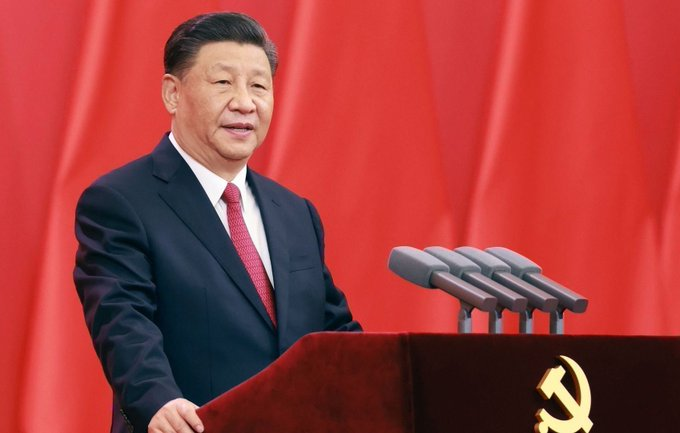
A Standard Refrain with Renewed Urgency
The language is not new. But it landed with added urgency given the current international environment. The United States is bogged down in a war with Iran, its naval forces are stretched thin, and its attention is divided. Some analysts have suggested that Beijing might see this as a window of opportunity to accelerate its timetable for unification — by peaceful means or otherwise.
The current moment resembles a slow-motion version of the Ukraine dilemma: a major power (China) viewing a strategic competitor (the United States) as distracted by conflicts elsewhere, with a “window of opportunity” for action.
The US Factor
The war with Iran has consumed US military resources. Three carrier strike groups are now deployed in the Middle East — the largest concentration of US naval power since the 2003 invasion of Iraq . The Pacific, by contrast, has seen a reduction in US naval presence.
US carrier deployment comparison:
| Region | Carriers Deployed |
|---|---|
| Middle East | 3 (George H.W. Bush, Abraham Lincoln, Gerald R. Ford) |
| Indo-Pacific | 1 (Ronald Reagan, homeported in Japan) |
Sources: US Navy, US Central Command
This imbalance has not gone unnoticed in Beijing.
The Chinese Foreign Ministry’s statement also comes just days after the US Congress approved a new package of military assistance to Taiwan, including the transfer of advanced air defense systems and anti-ship missiles. Beijing views such transfers as a violation of the “One China” principle and a breach of the three US-China communiqués.
The ‘Eventual Reunification’ Claim: Unchanged, Unwavering
“Eventual reunification” is the official formulation. It does not specify a timeline or a method. It simply asserts that the division of the Chinese nation is a temporary state — and that, in time, it will end.
Beijing has never abandoned the right to use force to prevent a formal declaration of Taiwanese independence. But it has also signaled a preference for peaceful means, including economic integration and cross-strait dialogue.
The Biden-Trump administration has maintained the US policy of “strategic ambiguity” — not committing to defend Taiwan but providing it with the means to defend itself. The latest Chinese warning argues that such ambiguity is a fig leaf for eventual recognition of Taiwanese sovereignty, which Beijing will never accept.
‘No One Can Stop’ — But Who’s Trying?
Guo’s assertion that “no one can ever stop” reunification is addressed not only to Taipei but also to Washington, Tokyo, and any other capital that might consider intervening in a cross-strait conflict. It is a statement of strategic confidence — or, depending on one’s perspective, a warning.
The “no one can stop” formulation is not new. It has been used by Chinese leaders for decades. But it gains new weight when spoken against the backdrop of a distracted United States and a rising Chinese military.
What Comes Next
China’s statement is unlikely to be the last on the subject. The 2026 national election campaign in the United States will inevitably involve discussions of Taiwan policy, as Republican and Democratic candidates stake out positions. Beijing will be watching closely.
Frequently Asked Questions (FAQs)
1. Is China planning to invade Taiwan?
China has not announced any invasion plan. Its stated policy is “peaceful reunification,” though it has never renounced the use of force to prevent a formal declaration of Taiwanese independence.
2. What did the Chinese Foreign Ministry say?
Spokesman Guo Jiakun stated that “Taiwan is an inalienable part of China’s territory” and that “no one can ever stop the eventual reunification of China.”
3. Why is China making this statement now?
The statement appears timed to a question about a US Congressional Research Service document. However, it also comes amid heightened cross-strait tensions and reduced US naval presence in the Pacific due to the Iran war .
4. How has the US responded?
The US has not issued an official response to this specific statement. The Biden-Trump administration maintains a policy of “strategic ambiguity” toward Taiwan.
5. How does the Iran war affect the Taiwan situation?
The US has deployed three carrier strike groups to the Middle East, reducing naval presence in the Pacific. Some analysts believe China may see this as a window of opportunity.
6. Is China preparing for conflict?
China has been modernizing its military, including its navy and air force, for years. Recent military exercises around Taiwan have simulated封锁 and amphibious assault operations.
Stay informed with Reflecto News – Your trusted source for breaking geopolitical and strategic intelligence. Subscribe for real-time updates on cross-strait relations, US-China competition, and regional security developments.
Questions people ask
What is China's current share of global manufacturing?
China now accounts for twenty eight percent of global manufacturing. This industrial output exceeds the combined manufacturing production of the United States, Japan, and Germany, making China the leading global industrial power according to recent reports.
Why were Andrew Tate and Tristan Tate arrested in Miami?
Andrew Tate and his brother Tristan Tate were taken into custody in Miami by the United States Marshals Service. They face thirty eight new charges in the United Kingdom, including rape and child pornography offences, and prosecutors are seeking their extradition.
What warning did Moscow issue about oil prices?
Kirill Dmitriev, the Chief Executive of the Russian Direct Investment Fund, warned that a tsunami of skyrocketing oil prices is approaching. Moscow describes this potential energy shock as a major threat to global markets.
What political shift is projected for Benjamin Netanyahu's coalition?
Political polls project that Prime Minister Benjamin Netanyahu's coalition is on track to lose its majority in the upcoming October election. This projection indicates a potential political shift in Jerusalem.
Why did a Russian military aircraft land in Tehran?
A Russian airborne command aircraft, widely known as a doomsday plane, landed in Tehran. The arrival of the aircraft represents a high stakes show of support from Russia for Iran during a period of heightened regional tensions.
What did President Masoud Pezeshkian claim about the United States and Israel?
Iranian President Masoud Pezeshkian claimed that the United States and Israel failed in a forty eight hour plan to topple the Iranian government. He made these statements during a televised address marking two years since his inauguration.