Reflecto News is an online news platform covering major international political events, global economic developments, and security conflicts. The site provides updates on topics such as Chinese manufacturing dominance, Middle Eastern political tensions, and high profile legal arrests. Readers can access current articles organized by categories like World News, Iran, and USA.
Published on Reflecto News | World News | Defense & Aerospace
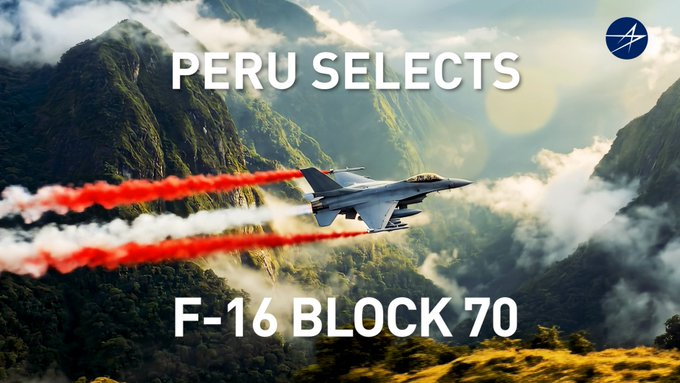
After a 14-year selection process, Peru has finalized its acquisition of 12 new F-16 Block 70 fighter jets from U.S. defense giant Lockheed Martin in a deal valued at approximately $2 billion, with the full package potentially reaching up to $3.4 billion. The contract, signed on April 20, 2026, marks a historic shift for the Peruvian Air Force (FAP), which will retire its aging fleet of Soviet-era MiG-29s and French Mirage 2000s in favor of the most advanced variant of the world’s most widely deployed multirole fighter.
A 14-Year Journey to Modernization
The decision to acquire the F-16 Block 70 culminates a procurement process that began in 2012 under the “Fighter of the Future” program. Over the years, Peru evaluated multiple platforms, including the Dassault Rafale, the Saab JAS 39 Gripen E/F, the Eurofighter Typhoon, and even Russian aircraft such as the MiG-35 and Su-30. In the final stage, the competition narrowed to three contenders: the American F-16, the French Rafale, and the Swedish Gripen.
Ultimately, factors such as the F-16’s lowest lifecycle cost, its unparalleled global support network (over 2,800 units in service across 29 nations), and its combat-proven track record tipped the scales in favor of the U.S. platform. The Block 70 is the newest and most capable F-16 ever built, featuring the longest service life of any fighter currently in production.
“Peru’s choice of the F-16 underscores the aircraft’s unmatched operational performance and combat record, as well as its ability to meet the most pressing defense requirements,” said Mike Shoemaker, Vice President of the Integrated Fighter Group at Lockheed Martin.
Contract Details: Costs, Capabilities, and Delivery
The contract was officially signed on April 20, and the Peruvian government has already executed an initial transfer of $462 million to Lockheed Martin. The $2 billion base agreement covers 12 F-16C (single-seat) and F-16D (two-seat) Block 70 aircraft, along with weapons, logistics support, and pilot training.
F-16 Block 70: Key Features
The F-16 Block 70 represents a generational leap over Peru’s current fleet. It is equipped with:
- AN/APG-83 AESA Radar: A state-of-the-art active electronically scanned array radar that provides fifth-generation fighter capabilities, delivering unprecedented situational awareness and targeting accuracy.
- Advanced Avionics and Architecture: Digital, open-architecture avionics that are 95% software-compatible with the F-35’s radar, ensuring long-term upgradeability.
- Enhanced Structural Life: The airframe boasts an extended service life of 12,000 flight hours, ensuring the jets will serve for decades. Some analysts suggest the Block 70s could remain operational beyond 2060.
- Auto-GCAS: An automated ground collision avoidance system that has saved the lives of 13 pilots and preserved 12 aircraft since its introduction.
- Weapons Integration: The contract reportedly includes two weapons systems not previously integrated into the Block 70 variant, customized to meet the Peruvian Air Force’s specific operational requirements.
While the base deal includes 12 aircraft with an option for 12 more, Lockheed Martin sought to sweeten the arrangement. The company reportedly offered to double the order to 24 F-16s for a total of $3.5 billion (just $80 million more than the original offer for 12), an offer that would have dramatically expanded Peru’s strike capabilities.
Delivery Timeline: 2029-2030
The first F-16 Block 70 aircraft are expected to arrive in Peru between 2029 and 2030. U.S. Ambassador to Peru, Bernie Navarro, confirmed that the preparatory phase will begin immediately, including:
- Pilot and technical crew training in the United States.
- Infrastructure upgrades at Peruvian air bases.
- Development of local maintenance and engineering capabilities, allowing Peru to achieve “full and total control of their fleet”.
The Fighter Jet Race in South America
Peru’s acquisition of the F-16 Block 70 marks a significant shift in the regional military balance and places it at the forefront of South American air power.
Peru’s Current Fleet vs. New Capabilities
The Peruvian Air Force currently operates a mix of aging platforms, including MiG-29s (acquired in the late 1990s) and Mirage 2000s (from the 1980s). The operational readiness of the Russian-made MiG-29s has been severely hampered by international sanctions and supply chain disruptions following the Ukraine war, making the transition to a Western platform a strategic necessity.
The F-16 Block 70 is a generational leap over these legacy systems. The AN/APG-83 AESA radar provides detection ranges and tracking capabilities far beyond the mechanical radars on the older Mirages and MiGs. Additionally, the operational and maintenance support from the U.S. will be a stark contrast to the logistical struggles of the Soviet-era fleet.
Comparing Regional F-16 Fleets
Peru is not the first South American nation to operate the Fighting Falcon, but it will be the first to operate the most advanced Block 70 variant.
- Chile: Operates approximately 46 F-16C/D Block 50 and MLU (Mid-Life Update) aircraft. While highly capable, these are older-generation platforms with mechanical radar systems (AN/APG-68) compared to the AESA-equipped Block 70.
- Argentina: Recently inducted 24 second-hand F-16AM/BM fighters from Denmark. These are extensively refurbished ex-European aircraft (Block 10/15 MLU), placing them in a lower capability tier than Peru’s new-build Block 70s.
- Venezuela: Operates a handful of original 1980s-era F-16s, but a long-standing U.S. arms embargo has severely degraded their operational readiness and modernization potential.
With 12 (and potentially up to 24) brand-new F-16 Block 70s, Peru is poised to leapfrog its neighbors in terms of raw technological capability, fielding a radar and avionics suite that rivals early 5th-generation fighters.
Other Competitors
The deal represents a significant loss for Saab, which had hoped the Gripen E would follow its successes in Brazil and Colombia. While the Gripen offers lower operating costs, the F-16’s vast existing support infrastructure and lower upfront procurement cost appear to have given it the edge. The French Rafale, though highly capable, was likely hampered by higher operational costs and a smaller regional support network compared to the ubiquitous F-16.
Political Controversy and Ministerial Resignations
The acquisition, while a strategic victory for the Air Force, triggered a political crisis in Lima. Interim President José María Balcázar attempted to postpone the signing of the contract to the next administration, canceling a planned ceremonial signing hours before it was to begin. Balcázar argued that a decision of this magnitude should be left to the incoming government following the July 2026 presidential election.
This move was met with fierce opposition from both Washington and his own cabinet.
- US Government Warning: The Trump administration warned that postponing or canceling the deal could have significant negative repercussions for bilateral relations between the United States and Peru.
- Ministerial Resignations: In protest of the president’s stance, Peruvian Defense Minister Carlos Diaz and Foreign Minister Hugo de Zela resigned. “A strategic decision has been taken in the area of national security with which I have a fundamental disagreement,” Diaz wrote in his resignation letter.
- Embassy Pressure: The U.S. Embassy in Lima issued a pointed statement noting their frustration, stating that every delay results in significant costs due to rising supplier prices and the dynamic global security environment.
What Comes Next
With the contract now signed and the initial payment transferred, the modernization of the Peruvian Air Force has officially begun. The next decade will see a complete transformation of Peru’s air combat capabilities, transitioning from a diverse but aging fleet of Russian and French origin to a homogenous, highly lethal squadron of 4.5-generation American fighters.
This acquisition not only strengthens Peru’s national sovereignty and air defense but also solidifies a long-term strategic partnership with the United States, integrating Peru into the global F-16 support network and potentially opening the door for further defense industrial collaboration.
Frequently Asked Questions (FAQs)
1. Exactly how many F-16s is Peru buying?
Peru has signed a contract for 12 F-16 Block 70 aircraft. The deal includes an option to purchase another 12 jets in the future, which would bring the total to 24.
2. What is the difference between the F-16 Block 70 and older F-16s?
The Block 70 is the most advanced F-16 ever produced. It features an AESA radar (AN/APG-83), an advanced glass cockpit, an extended structural life of 12,000 hours (compared to 8,000 for older models), and the Auto-GCAS safety system.
3. When will the first jets arrive in Peru?
U.S. Ambassador to Peru, Bernie Navarro, confirmed that the first deliveries are expected between 2029 and 2030.
4. Why did Peru pick the F-16 over the Gripen or Rafale?
The F-16 was chosen primarily for its lower lifecycle cost, its unparallelled global support infrastructure (29 operating nations), and the strategic value of deepening the defense partnership with the United States.
5. Will these jets give Peru an edge over its neighbors like Chile?
Yes. While Chile operates a large fleet of capable F-16s, they are older MLU and Block 50 models with mechanical radar. Peru’s Block 70s feature new AESA radars, giving them a technological advantage in situational awareness and targeting.
6. What prompted the political crisis in Peru regarding this deal?
Interim President José María Balcázar wanted to postpone the signing of the multi-billion dollar contract until after the July 2026 elections. His attempt to delay the deal led to the resignation of his Defense and Foreign Ministers and triggered a warning from the U.S. government.
Stay informed with Reflecto News – Your trusted source for breaking defense, aerospace, and geopolitical intelligence. Subscribe for real-time updates on Latin American military modernization and global security trends.
Questions people ask
What is China's current share of global manufacturing?
China now accounts for twenty eight percent of global manufacturing. This industrial output exceeds the combined manufacturing production of the United States, Japan, and Germany, making China the leading global industrial power according to recent reports.
Why were Andrew Tate and Tristan Tate arrested in Miami?
Andrew Tate and his brother Tristan Tate were taken into custody in Miami by the United States Marshals Service. They face thirty eight new charges in the United Kingdom, including rape and child pornography offences, and prosecutors are seeking their extradition.
What warning did Moscow issue about oil prices?
Kirill Dmitriev, the Chief Executive of the Russian Direct Investment Fund, warned that a tsunami of skyrocketing oil prices is approaching. Moscow describes this potential energy shock as a major threat to global markets.
What political shift is projected for Benjamin Netanyahu's coalition?
Political polls project that Prime Minister Benjamin Netanyahu's coalition is on track to lose its majority in the upcoming October election. This projection indicates a potential political shift in Jerusalem.
Why did a Russian military aircraft land in Tehran?
A Russian airborne command aircraft, widely known as a doomsday plane, landed in Tehran. The arrival of the aircraft represents a high stakes show of support from Russia for Iran during a period of heightened regional tensions.
What did President Masoud Pezeshkian claim about the United States and Israel?
Iranian President Masoud Pezeshkian claimed that the United States and Israel failed in a forty eight hour plan to topple the Iranian government. He made these statements during a televised address marking two years since his inauguration.