Reflecto News is an online news platform covering major international political events, global economic developments, and security conflicts. The site provides updates on topics such as Chinese manufacturing dominance, Middle Eastern political tensions, and high profile legal arrests. Readers can access current articles organized by categories like World News, Iran, and USA.
Reflecto News | Breaking News | Gulf Security
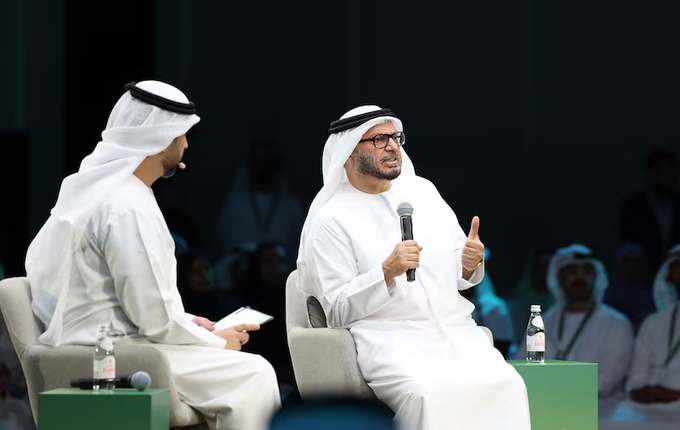
ABU DHABI — Dr. Anwar Gargash, diplomatic advisor to UAE President Sheikh Mohamed bin Zayed Al Nahyan, has issued a stark warning about Iran’s regional posture, stating that the Islamic Republic already “acts like a superpower” despite not possessing nuclear weapons—and urging the world to imagine how much more aggressive Tehran would become if it acquired the bomb .
The comments, made to The National, represent one of the most pointed public assessments of Iran’s behavior by a senior official close to the UAE’s leadership amid the ongoing war with the United States and Israel. They also highlight deepening Gulf concern that Tehran’s nuclear program is advancing unchecked while world powers remain focused on the immediate crisis .
“Iran is acting like a superpower, even without nuclear weapons. Imagine if it had them. We need a nuclear-free Middle East.”
— Dr. Anwar Gargash, Diplomatic Advisor to UAE President Sheikh Mohamed bin Zayed
‘Acting Like a Superpower’: What Gargash Means
Gargash’s characterization of Iran as a state that “acts like a superpower” reflects the growing concern among Gulf capitals about Tehran’s willingness to project military force across the region since the war began.
Actions cited by critics as demonstrating Iran’s ‘superpower’ posture :
| Action | Significance |
|---|---|
| Closure of the Strait of Hormuz | Disrupted ~20% of global oil supply; imposed costs on the entire world economy |
| Direct missile & drone attacks on US-Israeli assets | Demonstrated ability to strike deep into enemy territory |
| Control of four Arab capitals (Sana’a, Damascus, Baghdad, Beirut) | Extended Iranian influence across the region |
| Naval blockade defiance | Refused to concede despite massive US military pressure |
| Negotiating from strength | Demanded US lift blockade as precondition to talks, not the other way around |
Gargash’s “acting like a superpower” framing implies that Tehran’s influence far exceeds what its economic or military weight would otherwise justify—a gap that Gulf states find deeply destabilizing .
‘Imagine If It Had Them’: The Nuclear Dimension
The advisor’s warning about Iran acquiring nuclear weapons (“Imagine if it had them”) reflects a long-standing Gulf concern that a nuclear-armed Iran would fundamentally alter the regional balance of power—and that Tehran is closer to that threshold today than ever before.
Since the war began on February 28, Iran has continued to advance its nuclear program:
- Enrichment levels remain at near-weapons-grade (60% and above)
- Stockpile of enriched uranium continues to grow
- Inspector access has been restricted
- Diplomacy is stalled, with Tehran insisting the nuclear issue is not on the table in current ceasefire talks
The UAE itself has been directly targeted during the war. According to the Emirati Ministry of Defense, Iran launched approximately 550 ballistic and cruise missiles and some 2,200 drones at the UAE, most of which were intercepted. Several projectiles struck military and civilian targets across the country, prompting Abu Dhabi to urgently seek assistance from allies.
This context shapes the UAE’s nuclear calculus. Gargash’s statement may be read as:
- A warning to the international community that Iran’s nuclear program is not just Israel’s problem—it directly threatens the Gulf states
- An implicit justification for continued UAE engagement with Israel (which has secretly deployed an Iron Dome battery to defend the UAE during the war)
- A lament that despite the war and economic pressure, Iran’s nuclear program remains largely intact
The Nuclear-Free Middle East: A UAE Priority
The phrasing “We need a nuclear-free Middle East” is not new—it echoes longstanding UAE policy positions at the International Atomic Energy Agency (IAEA) and UN General Assembly. However, Gargash’s formulation—“Imagine if it had them”—frames the nuclear issue as an immediate security threat, not just a long-term non-proliferation goal.
The UAE has long advocated for a Weapons of Mass Destruction-Free Zone (WMDFZ) in the Middle East, a position endorsed by the UN General Assembly annually. The UAE was also the first Gulf state to sign a comprehensive safeguards agreement with the IAEA and to commit to forgoing domestic uranium enrichment, instead opting to purchase nuclear fuel on the international market for its peaceful nuclear energy program (Barakah).
By contrasting Iran’s behavior with the UAE’s voluntary restraint, Gargash implicitly argues that the regional nuclear problem is not symmetrical—it is driven by Iran’s refusal to accept international oversight and its continued enrichment activities .
Iran’s Response: ‘We Act as a Superpower Because We Are One’
Iranian officials have not directly responded to Gargash’s comments, but past statements from Tehran characterize its regional posture differently.
Supreme Leader Ayatollah Ali Khamenei—when still alive—characterized Iran’s influence as “natural” given its historical and civilizational weight in the region. More recently, Iranian officials have described their actions as “defensive” responses to US-Israeli aggression, and insisted that they seek a “balance of power” in the Gulf, not domination.
However, statements from senior Revolutionary Guard commanders about Iran’s ability to “close the Strait of Hormuz for as long as necessary” and to “target any enemy anywhere in the region” may appear to foreign audiences as precisely the superpower-like posture Gargash fears .
The Gulf Consensus on Iran’s Nuclear Program
While Saudi Arabia and the UAE have at times differed on the pace and intensity of confrontation with Tehran, the Iran war has substantially unified Gulf perspectives. Both Riyadh and Abu Dhabi view a nuclear-armed Iran as an existential threat.
Gulf positions on Iran’s nuclear program :
| Country | Public Position |
|---|---|
| UAE | “We need a nuclear-free Middle East” – Gargash |
| Saudi Arabia | Has stated it will seek its own nuclear capabilities if Iran acquires them |
| Qatar | More muted; maintains dialogue channels with Tehran |
| Bahrain & Kuwait | Strongly aligned with Saudi/UAE position |
Gargash’s statement reflects the majority view. The UAE has not yet stated that it would seek its own nuclear deterrent if Iran acquires nuclear weapons, but Saudi Arabia has .
Implications for US Policy
Gargash’s warning also carries a message for Washington: the Gulf states will not accept a nuclear deal that leaves Iran on the threshold of weaponization, even if it secures a temporary ceasefire and reopening of the Strait of Hormuz.
The UAE supported the 2015 Joint Comprehensive Plan of Action (JCPOA), which imposed strict limits on Iran’s nuclear program in exchange for sanctions relief. But since the US withdrawal from the JCPOA in 2017 and Iran’s subsequent escalation, Gulf states have concluded that Iran cannot be trusted to abide by any voluntary limitation.
Today, the UAE’s position is that any final agreement must include:
- Permanent, verifiable limits on Iran’s enrichment capacity
- Unfettered IAEA access to Iranian nuclear sites
- Addressing Iran’s ballistic missile program, which the JCPOA conspicuously omitted
Without those elements, Gargash’s “imagine if it had them” becomes not a hypothetical warning but a near-term reality.
Key Takeaways for Reflecto News Readers
| Aspect | Summary |
|---|---|
| Who | Dr. Anwar Gargash, Diplomatic Advisor to UAE President Sheikh Mohamed bin Zayed |
| Statement | Iran “acts like a superpower even without nuclear weapons. Imagine if it had them” |
| Context | During the war with Iran; UAE has been directly targeted (550 missiles, 2,200 drones) |
| Nuclear warning | A nuclear-armed Iran would be far more aggressive |
| UAE’s position | Advocates for nuclear-free Middle East; has forsworn domestic enrichment |
| Implicit message to US | A weak nuclear deal that leaves Iran on the threshold of weaponization is unacceptable |
| Broader Gulf view | Saudi Arabia has warned it would seek nuclear weapons if Iran acquires them |
Follow Reflecto News for continuous updates on Gulf security, Iran’s nuclear program, and all breaking news from the Middle East and around the world.
This article is the intellectual property of Reflecto News. Redistribution without attribution is prohibited. For syndication or media inquiries, please contact the editorial team.
Questions people ask
What is China's current share of global manufacturing?
China now accounts for twenty eight percent of global manufacturing. This industrial output exceeds the combined manufacturing production of the United States, Japan, and Germany, making China the leading global industrial power according to recent reports.
Why were Andrew Tate and Tristan Tate arrested in Miami?
Andrew Tate and his brother Tristan Tate were taken into custody in Miami by the United States Marshals Service. They face thirty eight new charges in the United Kingdom, including rape and child pornography offences, and prosecutors are seeking their extradition.
What warning did Moscow issue about oil prices?
Kirill Dmitriev, the Chief Executive of the Russian Direct Investment Fund, warned that a tsunami of skyrocketing oil prices is approaching. Moscow describes this potential energy shock as a major threat to global markets.
What political shift is projected for Benjamin Netanyahu's coalition?
Political polls project that Prime Minister Benjamin Netanyahu's coalition is on track to lose its majority in the upcoming October election. This projection indicates a potential political shift in Jerusalem.
Why did a Russian military aircraft land in Tehran?
A Russian airborne command aircraft, widely known as a doomsday plane, landed in Tehran. The arrival of the aircraft represents a high stakes show of support from Russia for Iran during a period of heightened regional tensions.
What did President Masoud Pezeshkian claim about the United States and Israel?
Iranian President Masoud Pezeshkian claimed that the United States and Israel failed in a forty eight hour plan to topple the Iranian government. He made these statements during a televised address marking two years since his inauguration.