By Reflecto News Staff
April 4, 2026
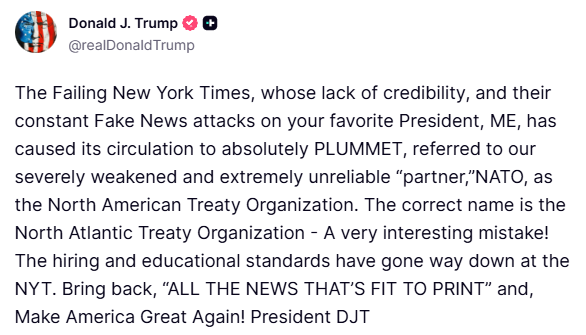
Lahore, Pakistan – In a fresh escalation of his long-running feud with the transatlantic alliance, U.S. President Donald Trump has referred to NATO as “our severely weakened and extremely unreliable ‘partner.’” The remark came in a Truth Social post slamming The New York Times for what he called a factual error in describing the organization’s full name.
The post, published today, highlights deepening rifts within NATO amid the ongoing U.S.-led military operations in Iran and disputes over securing the Strait of Hormuz—a critical global oil chokepoint.
The Trigger: A Media “Mistake” and Renewed NATO Criticism
Trump’s statement was a direct response to a New York Times article that allegedly referred to NATO as the “North American Treaty Organization” instead of the correct “North Atlantic Treaty Organization.” He seized the moment to deliver a broader indictment:
“The Failing New York Times… referred to our severely weakened and extremely unreliable ‘partner,’ NATO, as the North American Treaty Organization. The correct name is the North Atlantic Treaty Organization – A very interesting mistake!”
This language echoes Trump’s recent barrage of attacks on the 77-year-old alliance. Just days earlier, in an interview with The Telegraph published on April 1, Trump declared he is “strongly considering” pulling the United States out of NATO, labeling the bloc a “paper tiger” that Russian President Vladimir Putin also recognizes as weak.
President Donald Trump has repeatedly criticized NATO allies for insufficient support during the Iran conflict. (Image: DRN News/YouTube)
Historical Context: Trump’s Decades-Long Grievances with NATO
Trump’s skepticism toward NATO is not new. During his first term (2017–2021), he repeatedly accused European allies of freeloading on U.S. defense spending, demanding they meet the 2% of GDP target agreed upon by NATO members. He famously threatened to withdraw U.S. support if allies failed to “pay their fair share.”
In his second term, these criticisms have intensified. The current flashpoint is the U.S. and Israeli military campaign against Iran, launched in late February 2026. Trump has demanded NATO allies deploy forces to reopen the Strait of Hormuz after Iran effectively closed it in retaliation, disrupting global oil supplies. European nations have largely declined, citing legal concerns and reluctance to be drawn into offensive operations.
Map showing Iranian naval positions and exercises in the Strait of Hormuz, a key area of tension in the current conflict. (Image: Institute for the Study of War)
On Truth Social and in public remarks, Trump has accused allies of cowardice: “Without the USA, NATO is a paper tiger!” He has singled out leaders like UK Prime Minister Keir Starmer, mocking Britain’s naval capabilities and clean-energy policies.
The Iran War and the Strait of Hormuz: Catalyst for the Rift
The Strait of Hormuz handles about 20% of global oil trade. Iran’s closure of the waterway—following U.S.-Israeli strikes—has spiked energy prices worldwide. Trump has urged European nations dependent on Gulf oil to “build up some delayed courage” and seize control of the strait themselves, warning that the U.S. will no longer act as the world’s policeman.
NATO’s reluctance has frustrated the White House. Secretary of State Marco Rubio echoed the president, stating the alliance may need reexamination as it risks becoming a “one-way street.”
Iranian military assets positioned around the Strait of Hormuz underscore the strategic stakes of the current dispute. (Image: Alma Research and Education Center)
Reactions from Allies and Critics
European leaders have pushed back firmly. UK Prime Minister Keir Starmer reaffirmed NATO as “the single most effective military alliance the world has ever seen” while refusing to be “dragged into” the Iran war. French President Emmanuel Macron and other NATO officials have stressed collective defense under Article 5 but rejected unconditional support for U.S. operations in the Middle East.
NATO Secretary-General Mark Rutte has previously pushed back against Trump’s claims, insisting the alliance remains robust. However, recent polls show eroding trust: majorities in Germany, France, the UK, and Canada now view the U.S. as an unreliable ally.
U.S. Democrats and former officials have warned that Trump’s rhetoric damages deterrence against Russia and China. Former NATO ambassadors describe his comments as “completely disruptive.”
Implications: A Watershed Moment for Transatlantic Security?
Analysts warn that Trump’s threats—combined with his “America First” doctrine—could accelerate Europe’s push for strategic autonomy. Discussions in Brussels and European capitals already focus on independent defense initiatives, increased spending, and even alternative security guarantees if U.S. commitment wanes.
Legal experts note that withdrawing from NATO would require a one-year notice under Article 13 of the treaty and likely face congressional hurdles. Yet the mere threat undermines the alliance’s credibility.
The intertwined flags of the United States and NATO symbolize a partnership now under severe strain. (Image: Dreamstime)
Geopolitically, the rift plays into the hands of adversaries. Russia and China have long sought to divide the West; a weakened or fractured NATO would represent a strategic victory for Moscow and Beijing.
What Lies Ahead?
As the Iran conflict evolves and oil prices remain volatile, Trump’s latest salvo against NATO raises fundamental questions about the future of the post-World War II order. Will the alliance adapt through higher European contributions and reformed burden-sharing? Or will persistent U.S. skepticism lead to a fundamental realignment in global security architecture?
Reflecto News will continue to monitor developments from Washington, Brussels, and beyond. For now, one thing is clear: President Trump’s blunt characterization of NATO as a “severely weakened and extremely unreliable partner” signals that the era of unquestioned U.S. leadership in the alliance may be entering uncharted waters.