Iran’s Foreign Minister Abbas Araghchi has pushed back against what he described as misrepresentation by U.S. media regarding Tehran’s position on potential negotiations. In a clear statement, Araghchi emphasized Iran’s deep gratitude to Pakistan for its mediation efforts and clarified that Iran has never refused to travel to Islamabad. He stressed that Tehran’s focus remains on securing “conclusive and lasting” terms to end the “illegal war” imposed on Iran.
By Reflecto News Desk
April 4, 2026 | Tehran / Islamabad
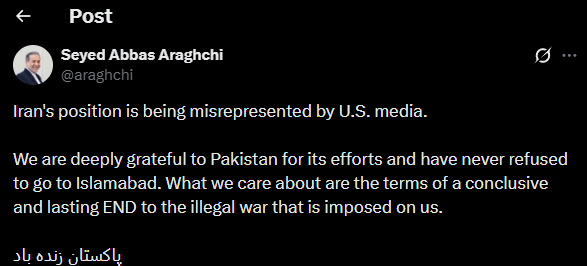
Speaking through official channels, Foreign Minister Araghchi stated:
“Iran’s position is being misrepresented by U.S. media. We are deeply grateful to Pakistan for its efforts and have never refused to go to Islamabad. What we care about are the terms of a conclusive and lasting END to the illegal war that is imposed on us.”
The remarks appear to address recent reports linking the wounding of former Iranian Foreign Minister Kamal Kharazi (who was reportedly overseeing back-channel engagement with Pakistan for a possible meeting involving U.S. Vice President JD Vance) to stalled diplomacy. Araghchi’s statement signals that Iran remains open to mediated talks — particularly through Pakistan — but insists on negotiations that deliver a permanent end to hostilities rather than temporary ceasefires.
Context of Pakistan’s Mediation Role
Pakistan has emerged as a key potential intermediary in the U.S.-Iran conflict. Earlier reports indicated Kharazi was actively involved in arranging indirect contacts via Islamabad. The wounding of Kharazi in strikes on his Tehran home (which also killed his wife) raised questions about whether the attack aimed to disrupt these channels. Araghchi’s comments reaffirm that Iran values Pakistan’s role and has not closed the door on direct or indirect engagement.
This diplomatic signaling comes amid intense military activity:
- Recent Iranian barrages against the UAE (23 ballistic missiles, 56 drones) and the claimed strike on an Israeli-linked ship at Bahrain’s Khalifa Port.
- U.S.-Israeli strikes on Iranian infrastructure, including the bombing of the B1 suspension bridge near Karaj.
- Ongoing U.S. combat search-and-rescue operations for the missing F-15E crew member, reinforced by the recent deployment of two HC-130J Combat King II tankers from Stuttgart.
- Persistent disruption of the Strait of Hormuz, with selective transits (French-linked and Indian vessels) but no full reopening expected soon.
Broader Diplomatic and Military Landscape
Araghchi’s statement fits into a pattern of mixed signals from Tehran:
- Iran’s Parliament Speaker has expressed openness to direct diplomacy with Gulf countries.
- Former Foreign Minister Mohammad Javad Zarif has urged Iran to “declare victory” and pursue negotiations.
- At the same time, Iranian forces continue asymmetric responses while claiming successful interceptions (including the recent Wing Loong II wreckage near Bushehr, initially presented as a U.S. MQ-9).
On the U.S. side, internal Pentagon tensions persist (including leadership changes under Defense Secretary Pete Hegseth), alongside significant aircraft losses tallied by OSINT sources.
Outlook
Whether Araghchi’s clarification leads to concrete movement toward talks in Islamabad or elsewhere will depend on the response from Washington and the trajectory of military actions on both sides. Pakistan’s role as a neutral facilitator could prove crucial in bridging the gap between demands for a “lasting end” to the war and ongoing coalition operations.
Reflecto News will continue monitoring any official U.S. or Pakistani responses, further statements from Iranian officials, developments in the search for the missing F-15E crew member, and the status of the Strait of Hormuz.
Sources: Iranian state media (IRIB, Tasnim, Mehr), statements by Foreign Minister Abbas Araghchi, Reuters, Al Jazeera, and regional diplomatic reporting as of April 4, 2026. The situation remains highly fluid with competing military and diplomatic narratives.