Reflecto News is an online news platform covering major international political events, global economic developments, and security conflicts. The site provides updates on topics such as Chinese manufacturing dominance, Middle Eastern political tensions, and high profile legal arrests. Readers can access current articles organized by categories like World News, Iran, and USA.
Reflecto News | Breaking News | US-Iran Relations
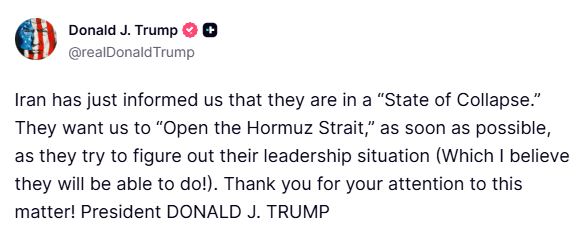
WASHINGTON — President Donald Trump announced Tuesday that Iran has informed the United States it is in a “State of Collapse” and is urgently requesting the reopening of the strategic Strait of Hormuz, which has been largely shut since the outbreak of war on February 28, 2026.
“Iran has just informed us that they are in a ‘State of Collapse.’ They want us to ‘Open the Hormuz Strait,’ as soon as possible, as they try to figure out their leadership situation (Which I believe they will be able to do!). Thank you for your attention to this matter!”
— President Donald J. Trump, via Truth Social
The President did not specify who in Tehran made the communication or through what channel it was delivered . His claim aligns with mounting reports of internal economic pressures and leadership uncertainty within the Islamic Republic.
🏛️ Leadership Uncertainty in Tehran
Trump’s reference to Iran’s “leadership situation” points to growing speculation about instability at the top of Iran’s political hierarchy.
Supreme Leader Mojtaba Khamenei—who assumed power following the death of his father, Ayatollah Ali Khamenei, on the first day of the war—has not appeared in public since February 28. Unconfirmed reports claim he was wounded in the initial US-Israeli strikes and may have been evacuated to Moscow for medical treatment .
A leadership vacuum could be emerging, with hardline figures within the Islamic Revolutionary Guard Corps (IRGC) jockeying for position while political elites push for a diplomatic off-ramp .
Trump’s assessment that Iran will “be able to” figure out its leadership suggests he calculates that either the current leadership will survive or a new faction will emerge with whom the US can negotiate—perhaps a more pragmatic successor willing to make concessions on the nuclear program and the strait .
🚢 The Urgent Request: ‘Open the Hormuz Strait’
If the White House narrative is accurate, Tehran’s urgent request to reopen the strait signals that the Islamic Republic’s economic pressures have reached a breaking point.
Key economic pressures:
- Oil exports blocked – US naval blockade has cut Iranian exports by roughly 70% .
- Storage capacity exhausted – Kpler reported that unused crude oil storage has dropped to 12-22 days of capacity remaining .
- Gasoline shortages imminent – Without exports, Iran cannot pay for refined fuel imports, risking domestic unrest .
- Currency collapse – The Iranian rial has plummeted, further eroding purchasing power .
Iran’s proposal to the US—submitted via Pakistani mediators—seeks a phased deal: first, a permanent ceasefire and reopening of the strait; then, later negotiation of the nuclear file . Trump has previously expressed dissatisfaction with this sequencing, insisting that Iran’s nuclear program must be addressed before any sanctions relief . However, Tehran might now be signaling that its timeline has accelerated due to the collapsing economy .
🇺🇸 The US Position: ‘We Hold All the Cards’
Trump’s post emphasizes that the US is in the dominant position, a posture the administration has carefully cultivated throughout the war.
- Ceasefire extended – The original ten-day truce brokered by Pakistan (effective April 8) has been extended indefinitely by Trump .
- Talks stalled – First round of US-Iran peace talks in Islamabad collapsed; second round not scheduled .
- Military pressure maintained – US naval blockade continues; military options remain on the table .
- US envoys home – Trump canceled a planned trip of US envoys to Pakistan on April 25 .
Trump’s public framing—thanking the public for their attention—is characteristic of his use of social media to shape public perception. The Truth Social post may be intended to:
- Pressure Tehran into making further concessions by exposing a supposed declaration of weakness
- Strengthen Trump’s domestic political position (approval ratings uncertain; midterms looming)
- Signal to global oil markets that the strait may reopen soon
🔮 What Comes Next
If Trump’s claim is accurate, it could set in motion three immediate scenarios:
- Negotiations accelerate – The US may agree to a phased deal (reopening the strait in exchange for Iran suspending enrichment).
- Iran denies collapse – Tehran could reject Trump’s characterization as “psychological warfare,” but still participate in talks.
- Collapse without collapse – A “state of collapse” might be a negotiating tactic—an attempt to secure US relief without fundamentally compromising on Iran’s nuclear program.
A former Iranian diplomat told Reuters on condition of anonymity: “The regime is under severe pressure, but it is not on its knees. Trump is hyping the situation to force a better deal. Iran will resist.”
For now, the Strait of Hormuz remains largely closed. But Trump’s message is unmistakable: the ball is in Iran’s court—and the US is waiting.
📋 Key Takeaways for Reflecto News Readers
| Aspect | Summary |
|---|---|
| Trump’s claim | Iran says it is in a “State of Collapse,” wants the strait reopened “as soon as possible” |
| Leadership situation | Uncertainty over Supreme Leader Mojtaba Khamenei (wounded; not seen in public) |
| Iran’s economic crisis | Oil exports down 70%; storage capacity 12-22 days; gasoline shortages imminent |
| Iran’s proposal to US | Phased deal: reopen strait first → nuclear talks later |
| US posture | “We hold all the cards”; naval blockade continues; ceasefire extended |
| Trump’s stated belief | Iran will “be able to” figure out its leadership |
Follow Reflecto News for continuous updates on Trump’s Truth Social statements, the unfolding Iran-US ceasefire, and all breaking news from around the world.
This article is the intellectual property of Reflecto News. Redistribution without attribution is prohibited. For syndication or media inquiries, please contact the editorial team.
Updated: April 28, 2026
Questions people ask
What is China's current share of global manufacturing?
China now accounts for twenty eight percent of global manufacturing. This industrial output exceeds the combined manufacturing production of the United States, Japan, and Germany, making China the leading global industrial power according to recent reports.
Why were Andrew Tate and Tristan Tate arrested in Miami?
Andrew Tate and his brother Tristan Tate were taken into custody in Miami by the United States Marshals Service. They face thirty eight new charges in the United Kingdom, including rape and child pornography offences, and prosecutors are seeking their extradition.
What warning did Moscow issue about oil prices?
Kirill Dmitriev, the Chief Executive of the Russian Direct Investment Fund, warned that a tsunami of skyrocketing oil prices is approaching. Moscow describes this potential energy shock as a major threat to global markets.
What political shift is projected for Benjamin Netanyahu's coalition?
Political polls project that Prime Minister Benjamin Netanyahu's coalition is on track to lose its majority in the upcoming October election. This projection indicates a potential political shift in Jerusalem.
Why did a Russian military aircraft land in Tehran?
A Russian airborne command aircraft, widely known as a doomsday plane, landed in Tehran. The arrival of the aircraft represents a high stakes show of support from Russia for Iran during a period of heightened regional tensions.
What did President Masoud Pezeshkian claim about the United States and Israel?
Iranian President Masoud Pezeshkian claimed that the United States and Israel failed in a forty eight hour plan to topple the Iranian government. He made these statements during a televised address marking two years since his inauguration.