Reflecto News is an online news platform covering major international political events, global economic developments, and security conflicts. The site provides updates on topics such as Chinese manufacturing dominance, Middle Eastern political tensions, and high profile legal arrests. Readers can access current articles organized by categories like World News, Iran, and USA.
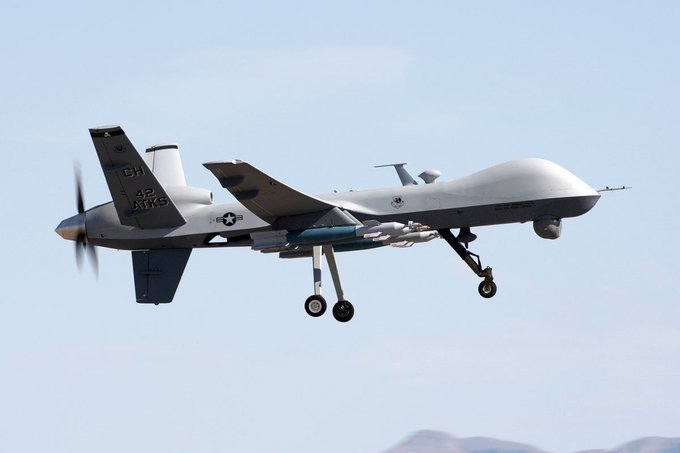
WASHINGTON, D.C. — The high-intensity air campaign over Iran has exacted a significant price on the United States’ unmanned fleet. CBS News reported on Wednesday, April 1, 2026, that the U.S. military has now lost a total of 16 MQ-9 Reaper drones since the outbreak of hostilities on February 28.
The latest losses—two aircraft downed near the central city of Isfahan—were confirmed by U.S. officials speaking on the condition of anonymity. The milestone highlights the persistent lethality of Iranian air defense systems, even after a month of sustained suppression by U.S. and Israeli stealth fighters.
1. The Rising Cost of Attrition
The MQ-9 Reaper, a mainstay of U.S. intelligence and precision-strike operations, has proven vulnerable in the “contested” airspace over Iran, unlike the permissive environments of the previous decade.
- Financial Impact: At approximately $30 million per unit, the loss of 16 Reapers represents a nearly $480 million blow to the Air Force’s operational budget in just over 30 days.
- Vulnerability: Analysts note that while the Reaper is an exceptional platform for long-endurance surveillance, its relatively slow top speed of 480 km/h makes it an ideal target for Iran’s modernized Khordad-15 and Bavar-373 surface-to-air missile systems.
- Strategic Role: Despite the losses, the Pentagon continues to fly dozens of Reaper “orbits” daily. These drones are credited with “closing the kill chain” by identifying mobile missile launchers and tracking IRGC leadership in real-time.
2. Operation Epic Fury: Drone Loss Timeline
The rate of attrition has fluctuated as the conflict has moved through different phases of intensity.
- The “First Wave” (Feb 28 – March 10): 11 Reapers were lost in the first ten days as U.S. forces focused on dismantling Iran’s early-warning radar network.
- The “Middle Phase” (March 11 – March 30): Losses slowed as the U.S. introduced LUCAS (Low-Cost Uncrewed Combat Attack System) drones to act as decoys, but another 3 Reapers were confirmed lost to “technical failure” and “hostile fire.”
- The “Isfahan Strikes” (April 1): The 15th and 16th Reapers were lost today while conducting surveillance over suspected underground nuclear facilities in central Iran.
3. Comparative Aerial Losses (As of April 1, 2026)
| Asset Type | U.S. / Coalition Losses | Primary Cause |
| MQ-9 Reaper | 16 | Iranian SAMs / Electronic Warfare |
| F-15 Strike Eagle | 3 | Friendly Fire (Kuwaiti Air Defense) |
| K-135 Tanker | 1 | Refueling Accident (Iraq) |
| LUCAS Drones | “Significant” | Intentional Attrition / Decoys |
Analysis: A 10% Fleet Depletion?
The loss of 16 Reapers in a single month is unprecedented in modern drone warfare. Combined with the half-dozen Reapers shot down by Houthi rebels in Yemen over the last year, some defense experts estimate that the U.S. Air Force has lost nearly 10% of its total operational Reaper fleet in the current regional conflagration.
However, the Pentagon maintains that the trade-off is necessary. By using unmanned Reapers for high-risk missions over Isfahan and Tehran, the U.S. has managed to keep its manned fighter pilots—flying F-35s and F-22s—largely out of harm’s way. As President Trump prepares for his 9:00 PM ET address, the “Reaper Toll” serves as a stark reminder that even a high-tech “Operation Epic Fury” comes with a mounting bill in both hardware and tax dollars.
Questions people ask
What is China's current share of global manufacturing?
China now accounts for twenty eight percent of global manufacturing. This industrial output exceeds the combined manufacturing production of the United States, Japan, and Germany, making China the leading global industrial power according to recent reports.
Why were Andrew Tate and Tristan Tate arrested in Miami?
Andrew Tate and his brother Tristan Tate were taken into custody in Miami by the United States Marshals Service. They face thirty eight new charges in the United Kingdom, including rape and child pornography offences, and prosecutors are seeking their extradition.
What warning did Moscow issue about oil prices?
Kirill Dmitriev, the Chief Executive of the Russian Direct Investment Fund, warned that a tsunami of skyrocketing oil prices is approaching. Moscow describes this potential energy shock as a major threat to global markets.
What political shift is projected for Benjamin Netanyahu's coalition?
Political polls project that Prime Minister Benjamin Netanyahu's coalition is on track to lose its majority in the upcoming October election. This projection indicates a potential political shift in Jerusalem.
Why did a Russian military aircraft land in Tehran?
A Russian airborne command aircraft, widely known as a doomsday plane, landed in Tehran. The arrival of the aircraft represents a high stakes show of support from Russia for Iran during a period of heightened regional tensions.
What did President Masoud Pezeshkian claim about the United States and Israel?
Iranian President Masoud Pezeshkian claimed that the United States and Israel failed in a forty eight hour plan to topple the Iranian government. He made these statements during a televised address marking two years since his inauguration.