Reflecto News is an online news platform covering major international political events, global economic developments, and security conflicts. The site provides updates on topics such as Chinese manufacturing dominance, Middle Eastern political tensions, and high profile legal arrests. Readers can access current articles organized by categories like World News, Iran, and USA.
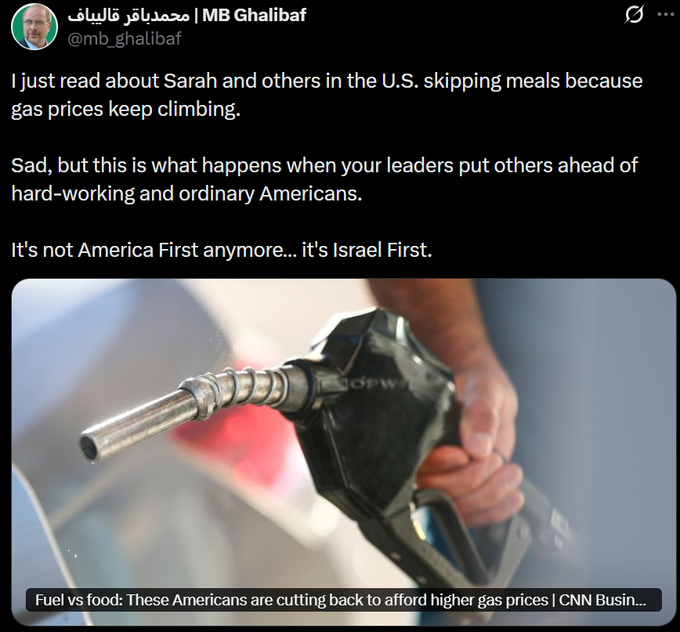
Iranian Parliamentary Speaker Mohammad Bagher Qalibaf escalated his rhetorical offensive against the White House on Tuesday, March 31, 2026, claiming that the American public is “skipping meals” due to the economic fallout of the month-long war. The comments, aimed at undermining President Donald Trump’s domestic support, come as the two nations remain locked in a tense “shadow negotiation” over a potential ceasefire.
The irony of Qalibaf’s “trolling” is not lost on regional analysts, as the Trump administration recently identified him as a key figure in back-channel talks—a claim the Iranian leadership continues to flatly deny.
The Economic Narrative: Gas and Groceries
In a speech broadcast on state-affiliated media, Qalibaf attempted to flip the narrative of “maximum pressure” back onto Washington.
- The Claim: “While the American leadership bragged about crushing our economy, it is the American people who are now skipping meals to pay for gas,” Qalibaf stated. He specifically cited the “unprecedented” rise in U.S. diesel and gasoline prices, which have surged by over 40% in some states since the start of Operation Epic Fury.
- Domestic Agitation: Qalibaf’s remarks appear designed to resonate with reports from CBS News and other outlets detailing the “ripple effect” of the war on U.S. farmers and the working class, who are grappling with $7-per-gallon diesel in states like California.
- The “Warmonger” Label: The Speaker accused Trump of “burning the wealth of Americans” to fuel a “failed crusade” in the Middle East, echoing the anti-interventionist sentiments occasionally voiced by the President’s own political base.
The “Qalibaf Paradox”
The U.S. State Department and President Trump have recently suggested that the path to peace involves direct dialogue with Qalibaf, whom they view as a relatively “pragmatic” hardliner compared to the IRGC’s top brass.
- The Trump Claim: In a recent Truth Social post, Trump suggested that the U.S. was “making progress” in talks with Qalibaf, whom he described as someone who “understands the art of a deal.”
- The Tehran Denial: Qalibaf has publicly ridiculed these reports, calling them “fabricated American psychological warfare.” His daily “trolling” of the President is seen as an effort to maintain his “revolutionary credentials” at home and avoid being labeled a collaborator by the IRGC.
- The “Islamabad Track”: While the U.S. points to Qalibaf, the Iranian Foreign Ministry maintains that all legitimate negotiations are flowing through the Pakistani-mediated 15-point peace plan.
Strategic Trolling or Signal?
Diplomatic observers are divided on whether Qalibaf’s insults represent a genuine breakdown in communication or a calculated “good cop, bad cop” strategy.
- Hardliner Pressure: By attacking Trump’s economic record, Qalibaf shields himself from accusations that he is “soft” on the Great Satan, especially following the recent IRGC ultimatum targeting 18 U.S. companies.
- Market Sensitivity: Qalibaf’s focus on energy prices is a direct jab at one of Trump’s most sensitive political vulnerabilities—the $100+ per barrel oil price that has fueled domestic inflation and disrupted over 11,000 global flights.
| Event Detail | Status (March 31, 2026) |
| Qalibaf’s Claim | Americans are “skipping meals” due to fuel costs |
| U.S. Stance | Actively seeking to negotiate with Qalibaf |
| Iranian Stance | Denying direct talks; mocking U.S. economic stability |
| Key Economic Pain | Diesel >$7/gal (CA); Urea Fertilizer +50% |
| Peace Deadline | April 6, 2026 |
Export to Sheets
The “April 6” Threshold
As the April 6 deadline for a regional settlement nears, the war of words is reaching a fever pitch. While the U.S. maintains that the Iranian regime is “nearing complete destruction,” Qalibaf’s daily broadsides suggest that Tehran still believes it can “outwait” the American public’s tolerance for high energy prices and economic disruption.
Questions people ask
What is China's current share of global manufacturing?
China now accounts for twenty eight percent of global manufacturing. This industrial output exceeds the combined manufacturing production of the United States, Japan, and Germany, making China the leading global industrial power according to recent reports.
Why were Andrew Tate and Tristan Tate arrested in Miami?
Andrew Tate and his brother Tristan Tate were taken into custody in Miami by the United States Marshals Service. They face thirty eight new charges in the United Kingdom, including rape and child pornography offences, and prosecutors are seeking their extradition.
What warning did Moscow issue about oil prices?
Kirill Dmitriev, the Chief Executive of the Russian Direct Investment Fund, warned that a tsunami of skyrocketing oil prices is approaching. Moscow describes this potential energy shock as a major threat to global markets.
What political shift is projected for Benjamin Netanyahu's coalition?
Political polls project that Prime Minister Benjamin Netanyahu's coalition is on track to lose its majority in the upcoming October election. This projection indicates a potential political shift in Jerusalem.
Why did a Russian military aircraft land in Tehran?
A Russian airborne command aircraft, widely known as a doomsday plane, landed in Tehran. The arrival of the aircraft represents a high stakes show of support from Russia for Iran during a period of heightened regional tensions.
What did President Masoud Pezeshkian claim about the United States and Israel?
Iranian President Masoud Pezeshkian claimed that the United States and Israel failed in a forty eight hour plan to topple the Iranian government. He made these statements during a televised address marking two years since his inauguration.