Reflecto News is an online news platform covering major international political events, global economic developments, and security conflicts. The site provides updates on topics such as Chinese manufacturing dominance, Middle Eastern political tensions, and high profile legal arrests. Readers can access current articles organized by categories like World News, Iran, and USA.
Reflecto News | Breaking News | Middle East Security & Diplomacy
JERUSALEM / ABU DHABI — In a previously undisclosed military move, Israel secretly deployed an Iron Dome air defense system alongside Israeli troops to the United Arab Emirates during the recent war with Iran, marking the first time the system has been used outside Israeli or American soil .
The operation, revealed by two Israeli officials and one U.S. official to Axios, saw Prime Minister Benjamin Netanyahu order the Israel Defense Forces (IDF) to dispatch the missile defense battery after a phone call with UAE President Sheikh Mohammed bin Zayed Al Nahyan early in the conflict .
Why the UAE Needed Protection
Throughout the war, which began on February 28, 2026, the UAE was the most targeted country in the region by Iranian attacks . According to the Emirati Ministry of Defense, Iran launched approximately:
| Weapon Type | Number Fired at UAE |
|---|---|
| Ballistic & cruise missiles | ~550 |
| Drones | ~2,200 |
While the majority were intercepted, several projectiles struck military and civilian targets across the country, prompting Abu Dhabi to urgently seek assistance from allies .
A Historic First for Iron Dome
The deployment represented an unprecedented milestone for Israel’s defense establishment:
- First international deployment – Israel had never sent an Iron Dome battery to another country prior to this
- First use outside Israel/U.S. – The UAE became the first country outside of Israel and the United States to operate the system
- Dozens of interceptions – The system successfully intercepted dozens of Iranian missiles aimed at Emirati territory, according to an Israeli official
The deployment included not just the battery and interceptor missiles, but also several dozen IDF operators who traveled to the UAE to run the system .
The Broader Military Coordination
The Iron Dome deployment was just one component of deepening Israel-UAE military cooperation during the war. Israeli and Emirati officials told Axios that the two countries have been coordinating closely both militarily and politically since the conflict began .
Additional Israeli actions included:
- The Israeli Air Force conducting strikes in southern Iran to neutralize short-range missiles aimed at the UAE and other Gulf countries
- Extensive intelligence sharing between the two nations
- Joint assessments of incoming threats
Israel’s ambassador to the United States, Yechiel Leiter, also confirmed during the war that certain Gulf countries were using Israeli expertise in drone and missile interception, stating: “We’ve extended our help” .
‘We Are Not Going to Forget It’: Emirati Gratitude
Perhaps most significant than the military operation itself is the political capital it appears to have generated. Senior Emirati officials have expressed profound gratitude for Israel’s assistance at a critical moment.
“We are not going to forget it,” a senior Emirati official said, referring to the assistance from Israel and Netanyahu specifically .
A second Emirati official placed the Israeli help within a broader context of allied support, noting that the United States, France, the United Kingdom, Italy, and Australia also stepped up to help the UAE defend itself .
“It was a real eye-opening moment. To see who our real friends are,” the Emirati official added.
Tareq al-Otaiba, a former official at the UAE’s National Security Council, wrote in an article for the Arab Gulf States Institute (AGSI) that “primarily, the United States and Israel have proved to be true allies by offering support through extensive military aid, intelligence sharing, and diplomatic backing” .
Political Sensitivity in the Gulf
The deployment of Israeli troops on Emirati soil could have been politically explosive under normal circumstances. The Arab Gulf states have historically avoided hosting foreign troops from non-Muslim nations, let alone Israeli forces .
However, Emirati officials told Axios that the war with Iran fundamentally shifted mindsets within the UAE. One official stated that anyone seen as helping protect the country against Iranian attacks would now be viewed positively, regardless of their nationality .
This shift aligns with public statements from senior Emirati leadership. Dr. Anwar Gargash, Senior Political Advisor to the UAE President, said in March 2026 that the confrontation with Iran was strengthening the strategic alliance between Gulf states and Israel, adding that Israel’s role in the Arabian Gulf region was poised to grow .
Potential Domestic Israeli Backlash
The decision to share the Iron Dome system was not without potential political risk for Netanyahu at home. At the time of the deployment, Israel itself was taking heavy fire from Iranian missiles, and some Israelis might question why a limited defense asset was being sent abroad rather than retained exclusively for home defense .
Nevertheless, Netanyahu ordered the deployment following his conversation with bin Zayed, prioritizing the strategic alliance with the UAE over potential domestic criticism.
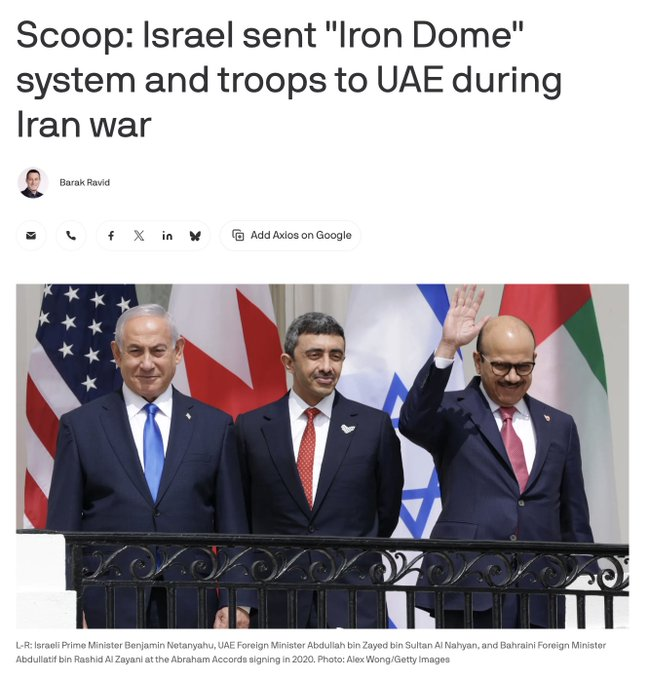
The 2020 Abraham Accords Legacy
Israel and the UAE signed a peace treaty (the Abraham Accords) in 2020, normalizing diplomatic relations for the first time. While there have been differences between the two countries since — particularly over issues relating to Gaza — both Israeli and Emirati officials describe the current partnership as the closest it has ever been .
The secret Iron Dome deployment represents the tangible, operational manifestation of that deepened relationship. Rather than remaining a symbolic political agreement, the Abraham Accords have evolved into a active military alliance in the face of a shared Iranian threat.
Gargash’s March statements further confirmed this trajectory, as he noted that Gulf states view Iran as the biggest and most direct threat to their national security and that the UAE is ready to participate actively in any international effort to secure strategic waterways .
Broader Context: Gulf Security Realignment
The deployment did not occur in isolation. Throughout the war, Gulf states faced sustained Iranian missile and drone attacks, with alerts sounding across Dubai, Abu Dhabi, and other regional capitals .
According to the Jerusalem Post, Gulf states have been under growing pressure from Iranian fire, and one of the reasons they have hesitated to launch overt counterattacks is concern about “the day after” — what happens if the Iranian regime survives the conflict .
This uncertainty has paradoxically accelerated security cooperation. By relying on Israeli technology and expertise during the war, the UAE has effectively tested and validated a security partnership that many in the region once considered unthinkable.
What Emirati Officials Are Saying Publicly
In addition to the off-record gratitude expressed to Axios, Emirati officials have made striking public statements about the realignment. Gargash told an American research center that “the current ground reality necessitates overcoming the stereotypical ideological images that prevailed in past decades” .
He specifically noted that Israel may still be classified as a threat in the Levant due to the nature of the Palestinian conflict, but “calculations in the Gulf differ fundamentally” . This geographical and political distinction reflects Emirati pragmatism, where conflict paths are separated based on direct security interests.
Regarding the U.S. role, Gargash denied any decline in Washington’s regional influence, rather arguing that the recent Iranian attacks proved the centrality of the American security umbrella .
Looking Forward: The New Middle East Alliance
The secret Iron Dome deployment signals a new phase in Middle Eastern geopolitics. The shared threat perception of Iran has effectively transformed the Abraham Accords from diplomatic recognition into operational military cooperation.
Iran, not Israel, has consistently launched thousands of rockets and drones at the UAE — a fact that Emirati officials increasingly emphasize when justifying their partnership with Jerusalem .
As one Emirati official summed it up: “Anyone seen as helping protect the country against Iranian attacks will be seen in a positive way” .
For Israel, the deployment provides strategic depth and validates its air defense systems on the international market and battlefield. For the UAE, it provides a proven protective layer against the most immediate threat to its national security.
And for the broader region, it suggests that the post-October 7 realignment — where shared concerns about Iran override historical Arab-Israeli enmity — continues to accelerate, even during active conflict.
Frequently Asked Questions (FAQs)
Q1: When did Israel deploy the Iron Dome to the UAE?
The deployment occurred “early in the war with Iran,” which began on February 28, 2026. The Axios report was published on April 25, 2026 .
Q2: Has Israel ever deployed Iron Dome to another country before?
No. This was the first time Israel sent an Iron Dome battery to another country. The UAE is the first country outside the U.S. and Israel to operate the system .
Q3: How effective was the Iron Dome in the UAE?
According to Israeli officials cited by Axios, the system intercepted dozens of Iranian missiles aimed at Emirati territory .
Q4: Did Israeli troops operate the system?
Yes. The deployment included not just the battery and interceptors, but several dozen IDF operators who traveled to the UAE .
Q5: Why does the UAE need Israeli air defense?
The UAE was the most targeted country in the region during the war, facing approximately 550 missiles and 2,200 drones from Iran. While most were intercepted, some struck military and civilian targets .
Q6: Could this deployment be politically sensitive in the Gulf?
Yes. Hosting Israeli troops on Arab soil could have been controversial. However, Emirati officials said the war changed mindsets — anyone helping defend the country is now viewed positively .
Q7: Is the Israel-UAE relationship still strong after Gaza disagreements?
Yes. Despite differences over Gaza, both Israeli and Emirati officials say their partnership is currently the closest it’s ever been .
Q8. What is the significance of “We are not going to forget it”?
A senior Emirati official used this phrase specifically about Israeli assistance. It suggests the UAE will remember Israel’s help diplomatically and politically, potentially leading to even closer ties in the future .
Key Takeaways for Reflecto News Readers
| Aspect | Summary |
|---|---|
| The deployment | Israel sent Iron Dome battery + troops to UAE during Iran war |
| Timing | Early in conflict (post-February 28, 2026) |
| Reason | UAE sustained ~550 missiles + 2,200 drones from Iran |
| Historic first | First Iron Dome deployment outside Israel/U.S. |
| Effectiveness | Dozens of Iranian missiles intercepted |
| Emirati reaction | “We are not going to forget it” — deep gratitude expressed |
| Political shift | War changed Gulf mindsets about hosting Israeli forces |
| Broader impact | Abraham Accords evolving into operational military alliance |
Sources and Further Reading
Reflecto News has compiled this report from verified sources including Axios (original scoop), The Times of Israel, Israel Hayom, Breaking the News, and statements from Emirati and Israeli officials. Additional context from Al-Quds, Ahram Online, the Jerusalem Post, and FX168. All information is accurate as of publication.
Follow Reflecto News for continuous updates on Middle East security realignments, Gulf-Israel relations, and all breaking news from around the world.
This article is the intellectual property of Reflecto News. Redistribution without attribution is prohibited. For syndication or media inquiries, please contact the editorial team.
Questions people ask
What is China's current share of global manufacturing?
China now accounts for twenty eight percent of global manufacturing. This industrial output exceeds the combined manufacturing production of the United States, Japan, and Germany, making China the leading global industrial power according to recent reports.
Why were Andrew Tate and Tristan Tate arrested in Miami?
Andrew Tate and his brother Tristan Tate were taken into custody in Miami by the United States Marshals Service. They face thirty eight new charges in the United Kingdom, including rape and child pornography offences, and prosecutors are seeking their extradition.
What warning did Moscow issue about oil prices?
Kirill Dmitriev, the Chief Executive of the Russian Direct Investment Fund, warned that a tsunami of skyrocketing oil prices is approaching. Moscow describes this potential energy shock as a major threat to global markets.
What political shift is projected for Benjamin Netanyahu's coalition?
Political polls project that Prime Minister Benjamin Netanyahu's coalition is on track to lose its majority in the upcoming October election. This projection indicates a potential political shift in Jerusalem.
Why did a Russian military aircraft land in Tehran?
A Russian airborne command aircraft, widely known as a doomsday plane, landed in Tehran. The arrival of the aircraft represents a high stakes show of support from Russia for Iran during a period of heightened regional tensions.
What did President Masoud Pezeshkian claim about the United States and Israel?
Iranian President Masoud Pezeshkian claimed that the United States and Israel failed in a forty eight hour plan to topple the Iranian government. He made these statements during a televised address marking two years since his inauguration.