Reflecto News is an online news platform covering major international political events, global economic developments, and security conflicts. The site provides updates on topics such as Chinese manufacturing dominance, Middle Eastern political tensions, and high profile legal arrests. Readers can access current articles organized by categories like World News, Iran, and USA.
Published on Reflecto News | World News | Energy & Economy
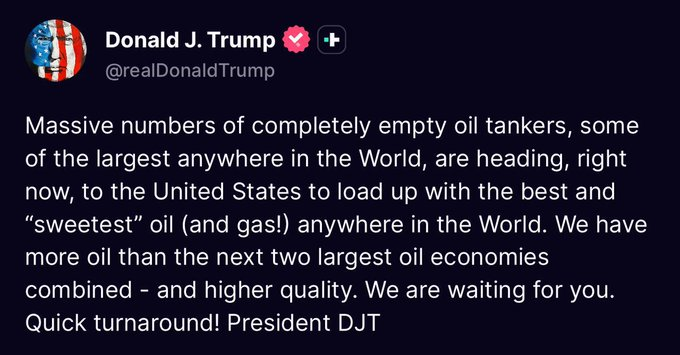
In a characteristically assertive statement posted to his Truth Social platform, President Donald Trump has announced that “massive numbers of completely empty oil tankers” are currently heading to the United States to load up with American crude oil and liquefied natural gas. The president framed the development as a direct result of the ongoing crisis in the Middle East, positioning the United States as the world’s premier energy supplier at a time when traditional sources are disrupted .
Trump’s statement, which described American oil as the “best and ‘sweetest’ anywhere in the World,” comes as the Strait of Hormuz remains largely restricted and global energy markets scramble for alternatives to disrupted Middle Eastern supplies. The president emphasized that the United States has “more oil than the next two largest oil economies combined” and touted the “quick turnaround” available to buyers .
‘We Are Waiting for You’
President Trump’s statement was characteristically direct and promotional, urging international buyers to turn to American energy producers.
“Massive numbers of completely empty oil tankers, some of the largest anywhere in the World, are heading, right now, to the United States to load up with the best and ‘sweetest’ oil (and gas!) anywhere in the World. We have more oil than the next two largest oil economies combined – and higher quality. We are waiting for you. Quick turnaround!” — President Donald Trump
The president’s reference to “sweet” oil refers to crude with low sulfur content, which is easier and less expensive to refine into gasoline and other high-demand products. American shale oil, particularly from the Permian Basin in Texas and New Mexico, is known for its high quality and has transformed the United States into the world’s largest oil producer .
| US Oil Advantage | Details |
|---|---|
| Total production | World’s largest oil producer |
| Comparative scale | More than next two largest oil economies combined |
| Crude quality | “Sweet” (low sulfur), easier to refine |
| Export capacity | Expanding LNG terminals and port facilities |
| Turnaround time | “Quick” per president’s statement |
Sources: President Trump’s Truth Social, EIA data
The Geopolitical Context: Capitalizing on the Hormuz Crisis
Trump’s announcement must be understood within the context of the ongoing crisis in the Strait of Hormuz, through which approximately 20% of the world’s oil normally passes. Since the outbreak of hostilities with Iran on February 28, the strategic waterway has remained largely restricted, with Iran imposing a limit of 15 ships per day requiring prior approval from the Islamic Revolutionary Guard Corps (IRGC) .
| Hormuz Crisis Impact | Status |
|---|---|
| Normal daily transits | ~130-140 vessels |
| Current daily transits | ~10-15 vessels |
| Stranded vessels | ~800-1,000 |
| Oil price impact | Elevated near $100/barrel |
| Global supply disruption | Significant |
Sources: Kpler, Lloyd’s List, S&P Global
The disruption of Middle Eastern oil flows has created an urgent global demand for alternative supplies. The United States, as the world’s largest oil producer and a net exporter, is uniquely positioned to fill this gap. Trump’s announcement suggests that American producers and exporters are mobilizing to capture market share previously held by Gulf producers .
The ‘Sweet’ Advantage: American Crude Quality
President Trump’s emphasis on the “sweetness” of American crude is not merely promotional—it reflects a genuine quality advantage. Sweet crude oil, which contains less than 0.5% sulfur, is more valuable than sour crude because it requires less refining to produce gasoline, diesel, and other high-demand products .
Key characteristics of American sweet crude:
- Low sulfur content: Reduces refining costs and emissions
- High API gravity: Produces higher yields of valuable products
- Shale oil consistency: Provides reliable quality for refiners
- Proximity to export terminals: Gulf Coast ports offer efficient loading
The American refining industry has also invested heavily in infrastructure to support exports, including expanded pipeline networks, storage facilities, and LNG terminals. These investments have positioned the United States to respond quickly to global supply disruptions .
US Energy Dominance by the Numbers
President Trump’s claim that the United States has “more oil than the next two largest oil economies combined” requires some context. While the United States is the world’s largest oil producer, surpassing Saudi Arabia and Russia, the claim about total reserves depends on the specific metric used .
| Country | Oil Production (million b/d) | Proven Reserves (billion barrels) |
|---|---|---|
| United States | ~13.2 | ~47 |
| Saudi Arabia | ~9.0 | ~267 |
| Russia | ~10.0 | ~80 |
| Combined #2 & #3 | ~19.0 | ~347 |
Sources: EIA, OPEC, BP Statistical Review
While the United States leads in production, Saudi Arabia and Russia possess larger proven reserves. However, Trump’s statement about production—that the US produces more than the next two largest producers combined—is accurate and reflects the remarkable growth of American shale oil over the past decade .
The ‘Quick Turnaround’ Promise: Logistics and Capacity
President Trump’s promise of “quick turnaround” reflects the efficiency of American export infrastructure. The US Gulf Coast, particularly the ports of Houston, Corpus Christi, Beaumont, and New Orleans, features extensive loading facilities capable of handling very large crude carriers (VLCCs) and other large vessels .
Key US export advantages:
- Deepwater ports: Capable of loading VLCCs without lightering
- Pipeline connectivity: Direct links from production areas to export terminals
- Storage capacity: Extensive tank farms near export points
- LNG terminals: Expanding export capacity for natural gas
The “empty oil tankers” heading to the United States likely include VLCCs that would typically load in the Persian Gulf but are now seeking alternative sources. The repositioning of these vessels represents a significant shift in global shipping patterns and a potential long-term realignment of energy trade routes .
Implications for Global Energy Markets
President Trump’s announcement carries significant implications for global energy markets, US foreign policy, and the trajectory of the energy transition.
For global energy markets:
- Increased US exports could help offset disruptions from the Middle East
- American sweet crude may command premium prices due to quality and reliability
- Long-term contracts may shift toward US suppliers if the Hormuz crisis persists
For US foreign policy:
- Energy exports provide diplomatic leverage with allies and trading partners
- Reduced dependence on Middle Eastern oil enhances US strategic flexibility
- European and Asian buyers may deepen energy ties with Washington
For the energy transition:
- Increased US fossil fuel production could slow investment in renewables
- However, natural gas exports (LNG) are positioned as a “bridge fuel” to lower-carbon future
- The crisis highlights the geopolitical risks of fossil fuel dependence
Response from Iran and Other Producers
Iranian officials have not directly responded to Trump’s statement, but Tehran’s leadership has consistently framed the Hormuz crisis as a response to US-Israeli aggression. Supreme Leader Mojtaba Khamenei has declared that Iran will take the management of the strait into a “new phase,” suggesting that Tehran intends to maintain regulatory control over the waterway regardless of the outcome of current negotiations .
Other major producers, including Saudi Arabia and Russia, are likely monitoring the situation closely. Saudi Arabia, in particular, has traditionally been the world’s swing producer and may seek to maintain market share against rising US exports .
What Comes Next: Export Surge or Temporary Disruption?
The number of tankers heading to the United States and the duration of any export surge will depend on several factors:
| Factor | Impact on US Exports |
|---|---|
| Hormuz reopening | Rapid reopening could reduce demand for US oil |
| ISG+ negotiations | Successful peace talks may restore Middle Eastern flows |
| US production capacity | Can ramp up to meet increased demand |
| Port and pipeline capacity | Existing infrastructure can handle increased volumes |
| Global price differentials | US crude must remain competitively priced |
If the Strait of Hormuz remains restricted for an extended period, US exports could capture significant market share from Gulf producers, potentially reshaping global energy trade patterns for years to come. If the Islamabad talks succeed and the strait reopens quickly, the tanker repositioning may prove temporary.
President Trump’s message is clear: the United States is ready, willing, and able to supply the world’s energy needs. As he put it: “We are waiting for you. Quick turnaround!”
Frequently Asked Questions (FAQs)
1. What did President Trump say about oil tankers heading to the US?
President Trump announced that “massive numbers of completely empty oil tankers” are heading to the United States to load up with American crude oil and LNG. He described American oil as the “best and ‘sweetest’ anywhere in the World” and emphasized that the US has “more oil than the next two largest oil economies combined” .
2. Why are tankers heading to the US now?
The crisis in the Strait of Hormuz has disrupted Middle Eastern oil flows, creating global demand for alternative supplies. The United States, as the world’s largest oil producer, is positioned to fill this gap .
3. What does “sweet” oil mean?
“Sweet” crude oil has low sulfur content (less than 0.5%), making it easier and less expensive to refine into gasoline, diesel, and other high-demand products. American shale oil is known for its sweet quality .
4. Does the US really have more oil than the next two largest economies combined?
The United States is the world’s largest oil producer, surpassing Saudi Arabia and Russia. The claim about total reserves depends on the metric used, but US production leadership is well-established .
5. How will this affect global oil prices?
Increased US exports could help offset supply disruptions from the Middle East, potentially moderating price increases. However, the overall price impact depends on the duration of the Hormuz crisis and the volume of US exports .
6. What does “quick turnaround” mean in this context?
President Trump is promising that vessels can load quickly at US ports due to efficient infrastructure, including deepwater ports, pipeline connectivity, and extensive storage capacity along the Gulf Coast .
7. Is this a permanent shift in global energy trade?
If the Strait of Hormuz remains restricted for an extended period, US exports could capture significant market share from Gulf producers, potentially reshaping global energy trade patterns. If the strait reopens quickly, the shift may prove temporary .
Stay informed with Reflecto News – Your trusted source for breaking energy and geopolitical intelligence. Subscribe for real-time updates on global oil markets, the Strait of Hormuz crisis, and the Islamabad peace talks.
Questions people ask
What is China's current share of global manufacturing?
China now accounts for twenty eight percent of global manufacturing. This industrial output exceeds the combined manufacturing production of the United States, Japan, and Germany, making China the leading global industrial power according to recent reports.
Why were Andrew Tate and Tristan Tate arrested in Miami?
Andrew Tate and his brother Tristan Tate were taken into custody in Miami by the United States Marshals Service. They face thirty eight new charges in the United Kingdom, including rape and child pornography offences, and prosecutors are seeking their extradition.
What warning did Moscow issue about oil prices?
Kirill Dmitriev, the Chief Executive of the Russian Direct Investment Fund, warned that a tsunami of skyrocketing oil prices is approaching. Moscow describes this potential energy shock as a major threat to global markets.
What political shift is projected for Benjamin Netanyahu's coalition?
Political polls project that Prime Minister Benjamin Netanyahu's coalition is on track to lose its majority in the upcoming October election. This projection indicates a potential political shift in Jerusalem.
Why did a Russian military aircraft land in Tehran?
A Russian airborne command aircraft, widely known as a doomsday plane, landed in Tehran. The arrival of the aircraft represents a high stakes show of support from Russia for Iran during a period of heightened regional tensions.
What did President Masoud Pezeshkian claim about the United States and Israel?
Iranian President Masoud Pezeshkian claimed that the United States and Israel failed in a forty eight hour plan to topple the Iranian government. He made these statements during a televised address marking two years since his inauguration.