Reflecto News is an online news platform covering major international political events, global economic developments, and security conflicts. The site provides updates on topics such as Chinese manufacturing dominance, Middle Eastern political tensions, and high profile legal arrests. Readers can access current articles organized by categories like World News, Iran, and USA.
By Reflecto News Staff Published: April 26, 2026
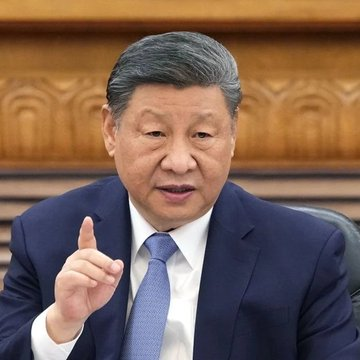
BEIJING — In a major ideological pivot that has stunned both domestic observers and international analysts, Chinese President Xi Jinping has issued a directive calling for a fundamental restructuring of how the state interacts with its citizens. During a high-level conference in Beijing this week, the President asserted that the state must be “controlled by the people,” emphasizing that government organs exist to serve the public rather than dominate them.
The remarks, which draw heavily on the Marxist-Maoist concept of “Serving the People,” represent one of the most explicit calls for administrative transparency and public oversight in the history of the modern People’s Republic.
“Serving, Not Controlling”: The New Mandate
The centerpiece of President Xi’s address was a direct command to the country’s sprawling bureaucratic apparatus.
“State organs must change from controlling the public to serving them, and accept public oversight,” the President stated. “The state must be controlled by the people, and not the other way around.”
According to reports from the Xinhua News Agency, the President’s vision for “Socialist Democracy with Chinese Characteristics” in 2026 involves:
- Accountability Frameworks: Implementing digital systems where citizens can directly rate and review the performance of local government offices.
- Public Oversight: Strengthening the “Mass Line” by allowing broader public criticism of official corruption or inefficiency—provided it aligns with the core leadership of the CPC.
- Modernization of Governance: Shifting the role of the state from a “regulator” to a “service provider,” particularly in the tech and social welfare sectors.
Historical Context: A Return to the “Cave Dwelling” Questions
This shift is not entirely new but rather a radical revival of a question posed to Mao Zedong in a cave in Yan’an in 1945: How can the Party maintain long-term governance and avoid the cycle of rise and fall? Mao’s answer was “democracy” and “public oversight.”
In his 2026 New Year message and subsequent April briefings, Xi Jinping has repeatedly referenced this “answer,” suggesting that for the 15th Five-Year Plan (2026–2030) to succeed, the government must regain the absolute trust of a public facing shifting economic realities.
The Skeptic’s View: Oversight vs. Stability
While the language is remarkably populist, international human rights groups remain cautious. Analysts at the Council on Foreign Relations note that “public oversight” in the Chinese context often refers to a “supervised” form of feedback that does not allow for a challenge to the Communist Party’s ultimate authority.
- The Paradox: How can a state be “controlled by the people” while the Party maintains a “defining feature” of absolute leadership?
- Digital Governance: Some fear that “serving the people” will involve even deeper integration of AI and data tracking to “predict” and “meet” needs before citizens even express them.
Frequently Asked Questions (FAQs)
Q: Is this a move toward Western-style democracy?
A: No. Beijing has explicitly rejected Western “liberal democracy.” This is “Whole-Process People’s Democracy,” which prioritizes economic outcomes and administrative efficiency over multi-party elections.
Q: What does “public oversight” look like in practice?
A: In 2026, this increasingly looks like the use of the “Social Credit” and “Citizen Feedback” apps, where the government uses big data to identify which officials are failing to meet local quotas for healthcare, housing, or jobs.
Q: Why is Xi Jinping saying this now?
A: With the 15th Five-Year Plan beginning, the leadership needs to mobilize “public enthusiasm and creativity” to overcome economic headwinds. High-quality growth requires a government that helps businesses and families rather than hindering them with red tape.
Q: Does this affect the IRGC or Iran situation?
A: Indirectly. As China positions itself as a “role model” for global governance, Xi’s domestic rhetoric of “serving the people” is being used as a soft-power tool to contrast with what Beijing calls “Western interventionism” in the Middle East.
Comparison: The Governance Shift (2018 vs. 2026)
| Feature | 2018 Doctrine | 2026 Directive |
| Primary Goal | Poverty Alleviation | High-Quality Service Sector |
| Role of State | Strategic Planner | Service Provider |
| Oversight | Internal Party Discipline | Public & Digital Oversight |
| Keyword | “Stability” | “Service” |
Reflecto News will continue to analyze how these directives are implemented across China’s provincial governments in the coming months.
Questions people ask
What is China's current share of global manufacturing?
China now accounts for twenty eight percent of global manufacturing. This industrial output exceeds the combined manufacturing production of the United States, Japan, and Germany, making China the leading global industrial power according to recent reports.
Why were Andrew Tate and Tristan Tate arrested in Miami?
Andrew Tate and his brother Tristan Tate were taken into custody in Miami by the United States Marshals Service. They face thirty eight new charges in the United Kingdom, including rape and child pornography offences, and prosecutors are seeking their extradition.
What warning did Moscow issue about oil prices?
Kirill Dmitriev, the Chief Executive of the Russian Direct Investment Fund, warned that a tsunami of skyrocketing oil prices is approaching. Moscow describes this potential energy shock as a major threat to global markets.
What political shift is projected for Benjamin Netanyahu's coalition?
Political polls project that Prime Minister Benjamin Netanyahu's coalition is on track to lose its majority in the upcoming October election. This projection indicates a potential political shift in Jerusalem.
Why did a Russian military aircraft land in Tehran?
A Russian airborne command aircraft, widely known as a doomsday plane, landed in Tehran. The arrival of the aircraft represents a high stakes show of support from Russia for Iran during a period of heightened regional tensions.
What did President Masoud Pezeshkian claim about the United States and Israel?
Iranian President Masoud Pezeshkian claimed that the United States and Israel failed in a forty eight hour plan to topple the Iranian government. He made these statements during a televised address marking two years since his inauguration.