Reflecto News is an online news platform covering major international political events, global economic developments, and security conflicts. The site provides updates on topics such as Chinese manufacturing dominance, Middle Eastern political tensions, and high profile legal arrests. Readers can access current articles organized by categories like World News, Iran, and USA.
“We are a bit behind, but the pace is picking up,” the Russian president said, announcing the deployment of 16 new satellites as Moscow seeks a domestic alternative to Elon Musk’s network.
MOSCOW — President Vladimir Putin has announced that Russia is developing its own low-orbit satellite communications system, claiming the technology is already comparable to Elon Musk’s Starlink and may even surpass it in certain aspects .
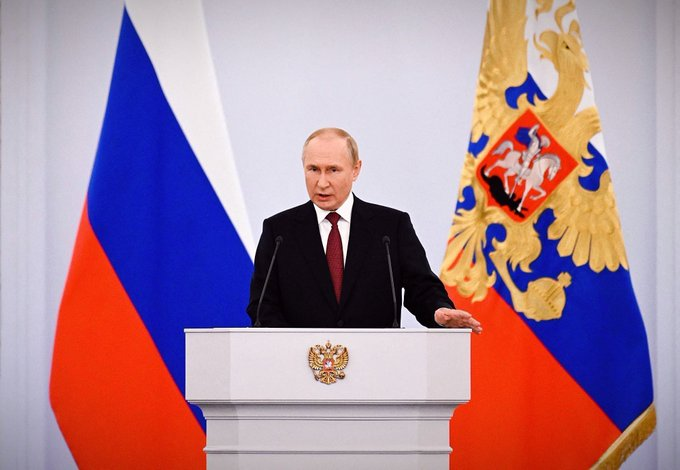
Speaking at a meeting with servicemen in the Kremlin on Russia’s National Day (June 12), Putin stated that the country’s low-orbit satellite constellation is actively being deployed. He acknowledged that the system is not yet as large as its American counterpart but emphasized that work is proceeding at an increasing pace .
“The structure of this low-orbit satellite constellation is in no way inferior to Starlink, and in some ways may even be superior,” Putin said, according to state media .
The ‘Rassvet’ Project: Russia’s Starlink Rival
The satellite network Putin referred to is known as the Rassvet (Рассвет) project, which translates to “Dawn” or “Sunrise” . The system is being developed by the Russian aerospace company Bureau 1440, a private firm within the IKS Holding structure that also has a subsidiary in Belarus .
The Rassvet project is part of the broader Sfera (Sphere) federal target program and is designated as a state priority, overseen at the highest levels of government .
Key technical details of the system include:
| Parameter | Rassvet (Russia) | Starlink (SpaceX) |
|---|---|---|
| Operational Altitude | ~800 km | ~550 km |
| Satellite Mass | ~370 kg | ~260-300 kg |
| Terminal Weight | Up to 15 kg | 1-4 kg |
| Target Constellation Size (2035) | ~900 satellites | ~12,000+ satellites (as of 2026) |
16 Satellites in Orbit, But Challenges Remain
Putin revealed that Russia has recently launched an additional 16 spacecraft to join the orbital group, bringing the total active satellites in the test constellation to this number . However, he conceded that “this is still not enough” and that the primary challenge now is to “ramp up the scale” .
Crucially, some analysts and Ukrainian intelligence officials believe Russia’s Starlink rival is currently facing significant technical hurdles.
An OSINT investigation published by Frontliner in late May noted that while Russia successfully placed 16 Rassvet-3 spacecraft into orbit in March 2026, the project is significantly behind schedule. The sheer scale of the requirement is daunting: to achieve global coverage, Bureau 1440 aims to deploy 292 satellites by 2027, meaning Russia would need to launch roughly 30 spacecraft per month—a pace it has never sustained .
According to Defense Express, cited by United24 Media, tracking data indicates that of the 16 satellites launched in March:
- Only six have begun climbing toward their designated operational orbit (~800 km) .
- One satellite has already reentered the atmosphere and burned up after failing to activate its propulsion system .
- Eight satellites remain at altitudes between 320-340 km and are not yet progressing to their target orbit .
Ukrainian media Dialog.UA reported on the satellite anomaly, with Ukrainian officials noting that 16 functioning test satellites are insufficient to substantially influence the war against Ukraine at this stage .
Why Russia Needs Its Own System
The push for a domestic satellite network has become a strategic priority for Moscow, driven by two main factors.
1. Military Necessity in Ukraine: The war in Ukraine has highlighted the critical role of satellite communications. Ukrainian forces have effectively utilized Starlink for drone operations, coordination, and communication, giving them a significant battlefield advantage. Russian troops, by contrast, have struggled with unstable communications and have limited access to commercial networks .
2. Geopolitical Vulnerability: Elon Musk’s SpaceX deactivated Starlink terminal access across Russian-held territories in February 2026, exposing Moscow’s reliance on Western technology . The U.S. Defense Intelligence Agency (DIA) believes this disruption contributed to Ukrainian military gains .
Future Plans: ‘Sfera’ and Commercial Ambitions
Beyond military applications, Russia views the project as a commercial necessity. The country is vast, and as of 2023, more than 24,000 settlements had no internet access. A domestic satellite system would provide broadband coverage to remote regions and offer developing nations a geopolitical alternative to the US-controlled Starlink .
Former Russian Defense Minister and current Security Council Secretary Sergei Shoigu previously announced that the launch into commercial operation of the domestic low-orbit satellite communication system is planned for the end of next year .
Military expert Yuri Knutov told NEWS.ru that the Russian “Sfera” system (which encompasses Rassvet) will be cheaper than Starlink and will not be subject to the political manipulation or censorship that he claims characterizes Musk’s network .
Putin emphasized that the creation of this system is essential for controlling advanced weaponry, particularly heavy drones, which require stable, high-bandwidth satellite links .
“We are a bit behind, but the pace is picking up,” Putin said, acknowledging the current deficit in the number of satellites while asserting that “the tasks of a technological and scientific nature have been fully resolved” .
Frequently Asked Questions (FAQs)
Q1: What is the name of Russia’s Starlink alternative?
A: The primary system is called Rassvet (Рассвет), which is a key component of the larger Sfera (Sphere) federal space program .
Q2: Who is building the Russian satellite system?
A: The project is led by Bureau 1440, a private aerospace company that operates within the IKS Holding structure. They have a subsidiary in Belarus, CJSC AeroKosmicheskie Pribory, which supplies components .
Q3: How many satellites does Russia currently have in this constellation?
A: According to Putin, Russia has deployed 16 satellites as part of the initial test group . However, independent tracking suggests that only a portion of these are successfully raising their orbit to the operational altitude, and at least one has been lost .
Q4: Does Russia’s satellite system actually work?
A: Russia claims the system is in the deployment phase. However, OSINT analysts and Ukrainian officials report that the current 16 satellites (functioning in test mode) are insufficient to provide widespread coverage or significantly impact the battlefield .
Q5: Why is Russia rushing to build this system?
A: Russia needs a secure, domestic communications network for its military, which has faced significant disadvantages on the battlefield in Ukraine compared to Ukrainian forces using Starlink. It also wants to avoid reliance on US-controlled technology .
This is a developing story. Reflecto News will continue to provide updates on the Rassvet satellite project and the state of Russia’s space-based communications systems.
Questions people ask
What is China's current share of global manufacturing?
China now accounts for twenty eight percent of global manufacturing. This industrial output exceeds the combined manufacturing production of the United States, Japan, and Germany, making China the leading global industrial power according to recent reports.
Why were Andrew Tate and Tristan Tate arrested in Miami?
Andrew Tate and his brother Tristan Tate were taken into custody in Miami by the United States Marshals Service. They face thirty eight new charges in the United Kingdom, including rape and child pornography offences, and prosecutors are seeking their extradition.
What warning did Moscow issue about oil prices?
Kirill Dmitriev, the Chief Executive of the Russian Direct Investment Fund, warned that a tsunami of skyrocketing oil prices is approaching. Moscow describes this potential energy shock as a major threat to global markets.
What political shift is projected for Benjamin Netanyahu's coalition?
Political polls project that Prime Minister Benjamin Netanyahu's coalition is on track to lose its majority in the upcoming October election. This projection indicates a potential political shift in Jerusalem.
Why did a Russian military aircraft land in Tehran?
A Russian airborne command aircraft, widely known as a doomsday plane, landed in Tehran. The arrival of the aircraft represents a high stakes show of support from Russia for Iran during a period of heightened regional tensions.
What did President Masoud Pezeshkian claim about the United States and Israel?
Iranian President Masoud Pezeshkian claimed that the United States and Israel failed in a forty eight hour plan to topple the Iranian government. He made these statements during a televised address marking two years since his inauguration.