Reflecto News is an online news platform covering major international political events, global economic developments, and security conflicts. The site provides updates on topics such as Chinese manufacturing dominance, Middle Eastern political tensions, and high profile legal arrests. Readers can access current articles organized by categories like World News, Iran, and USA.
President’s Dramatic Threat Aimed at Forcing Negotiations and Reopening the Strait of Hormuz; Aides, Including Marco Rubio, Viewed It as Calculated Pressure Tactic
By Reflecto News Staff
April 19, 2026
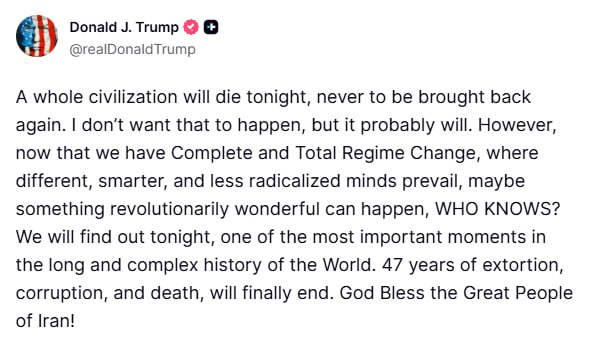
President Donald Trump issued one of the most dramatic ultimatums of his presidency shortly after Easter, warning Iran that unless a deal was reached within 12 hours, “a whole civilization will die tonight, never to be brought back again.”
The statement, posted on Truth Social on the Tuesday following Easter, set a tight deadline tied to demands that Iran reopen the Strait of Hormuz and make significant concessions on its nuclear program and regional activities. Trump added that he did not want the outcome but suggested it was likely without compliance.
Behind the scenes, senior aides including Secretary of State Marco Rubio reportedly saw the ultimatum as a deliberate pressure tactic designed to intimidate Iran into ending the conflict and accelerating negotiations, according to sources cited by The Wall Street Journal.
President Donald Trump addressing the nation on Iran policy, where strong rhetoric has been a hallmark of his approach to negotiations.
Details of the Ultimatum
At approximately 8:06 a.m. on the Tuesday after Easter, Trump posted the stark warning, linking it to Iran’s effective closure of the vital shipping lane and broader demands for a comprehensive deal. The 12-hour window created intense global tension, with diplomats scrambling for mediation efforts and markets reacting to the heightened risk of escalation.
The threat followed earlier warnings targeting Iranian infrastructure, including power plants and bridges, and came amid ongoing US airstrikes on military targets and the maintenance of a naval blockade. Trump has repeatedly framed the pressure as necessary to achieve a “good deal” that prevents Iran from acquiring nuclear weapons.
Despite the dramatic language, the ultimatum did not result in the threatened destruction. Instead, it contributed to diplomatic maneuvering that led to the current fragile two-week ceasefire between the US and Iran.
Map of the Persian Gulf and Strait of Hormuz, the central focus of Trump’s ultimatum demanding reopening of the shipping lane.
Internal White House Perspective
Administration officials viewed the move through the lens of the “madman theory” of foreign policy — projecting unpredictability to force concessions. Aides believed the extreme rhetoric would compel Iran to the negotiating table without necessarily requiring full execution of the threatened actions.
Secretary of State Marco Rubio and others reportedly helped manage the fallout, including outreach to third-party mediators such as Pakistan, while emphasizing that the goal remained a negotiated end to hostilities rather than outright regime destruction or civilizational collapse.
This approach aligns with Trump’s pattern of combining maximum public pressure with private diplomatic channels, as seen in ongoing talks he has described as “very good.”
International Reactions and Aftermath
The ultimatum drew swift international concern, with allies and adversaries alike expressing alarm over the potential for massive escalation. European officials, including France’s foreign minister, pushed back against any notion of destroying a civilization, while regional actors monitored developments closely.
Ultimately, the high-stakes deadline contributed to the announcement of a two-week ceasefire, though both sides continue to trade accusations of violations and test the agreement’s limits. The episode also highlighted Trump’s internal deliberations on military risks, including his reported reluctance to pursue high-casualty operations such as a ground seizure of Kharg Island.
Frequently Asked Questions (FAQs)
Q1: What exactly was Trump’s ultimatum to Iran?
A: On the Tuesday after Easter, Trump warned that unless Iran reached a deal within 12 hours, “a whole civilization will die tonight, never to be brought back again,” referring to severe consequences if the Strait of Hormuz remained closed and other demands unmet.
Q2: Was the threat carried out?
A: No. The dramatic rhetoric contributed to diplomatic movement that resulted in a two-week ceasefire rather than the threatened destruction of infrastructure or escalation.
Q3: How did administration aides view the ultimatum?
A: Aides, including Marco Rubio, reportedly saw it as a calculated pressure tactic to intimidate Iran into serious negotiations and force an end to the conflict, consistent with a “madman theory” approach.
Q4: What were the main demands in the ultimatum?
A: Reopening the Strait of Hormuz to commercial shipping, concessions on Iran’s nuclear program, and steps toward a broader deal ending hostilities.
Q5: How does this connect to the current ceasefire?
A: The ultimatum created urgency that helped lead to the fragile US-Iran ceasefire now in effect, though it faces tests from alleged violations and differing interpretations.
Q6: What does this reveal about Trump’s Iran strategy?
A: It combines bold public rhetoric and high-pressure deadlines with behind-the-scenes diplomacy and caution on high-casualty ground operations, aiming for a decisive deal while minimizing prolonged US military entanglement.
Reflecto News Analysis
President Trump’s post-Easter 12-hour ultimatum, threatening the destruction of “a whole civilization,” stands as one of the most provocative statements in modern US foreign policy. While it gripped the world and sparked frantic diplomatic activity, aides’ assessment that it served primarily as a pressure tactic underscores the administration’s strategy: using extreme rhetoric to accelerate negotiations without necessarily crossing into irreversible military action.
The episode fits Trump’s broader pattern — maximum leverage through public bravado paired with private restraint, as evidenced by his reported resistance to high-risk operations like seizing Kharg Island over casualty concerns. It contributed to the current ceasefire but also exposed the fragility of the pause, with ongoing alerts in Israel, accusations of violations in Lebanon, and continued volatility around the Strait of Hormuz.
As talks continue and the ceasefire faces early tests, this moment illustrates both the effectiveness and the risks of Trump’s negotiating style. Success would mean a lasting deal curbing Iran’s nuclear ambitions and stabilizing energy markets; failure could return the region to open conflict with global repercussions.
For the latest developments on US-Iran negotiations, the status of the ceasefire, and related regional tensions, stay tuned to Reflecto News — your trusted source for accurate, timely international coverage.
Related Coverage:
- Trump’s Ultimatum and the Path to US-Iran Ceasefire
- Behind-the-Scenes: Administration Strategy on Iran Pressure Tactics
- Strait of Hormuz and Kharg Island: Strategic Stakes in the Conflict
Images used for illustrative purposes from public and news sources.
Questions people ask
What is China's current share of global manufacturing?
China now accounts for twenty eight percent of global manufacturing. This industrial output exceeds the combined manufacturing production of the United States, Japan, and Germany, making China the leading global industrial power according to recent reports.
Why were Andrew Tate and Tristan Tate arrested in Miami?
Andrew Tate and his brother Tristan Tate were taken into custody in Miami by the United States Marshals Service. They face thirty eight new charges in the United Kingdom, including rape and child pornography offences, and prosecutors are seeking their extradition.
What warning did Moscow issue about oil prices?
Kirill Dmitriev, the Chief Executive of the Russian Direct Investment Fund, warned that a tsunami of skyrocketing oil prices is approaching. Moscow describes this potential energy shock as a major threat to global markets.
What political shift is projected for Benjamin Netanyahu's coalition?
Political polls project that Prime Minister Benjamin Netanyahu's coalition is on track to lose its majority in the upcoming October election. This projection indicates a potential political shift in Jerusalem.
Why did a Russian military aircraft land in Tehran?
A Russian airborne command aircraft, widely known as a doomsday plane, landed in Tehran. The arrival of the aircraft represents a high stakes show of support from Russia for Iran during a period of heightened regional tensions.
What did President Masoud Pezeshkian claim about the United States and Israel?
Iranian President Masoud Pezeshkian claimed that the United States and Israel failed in a forty eight hour plan to topple the Iranian government. He made these statements during a televised address marking two years since his inauguration.