Reflecto News is an online news platform covering major international political events, global economic developments, and security conflicts. The site provides updates on topics such as Chinese manufacturing dominance, Middle Eastern political tensions, and high profile legal arrests. Readers can access current articles organized by categories like World News, Iran, and USA.
Reflecto News
April 20, 2026
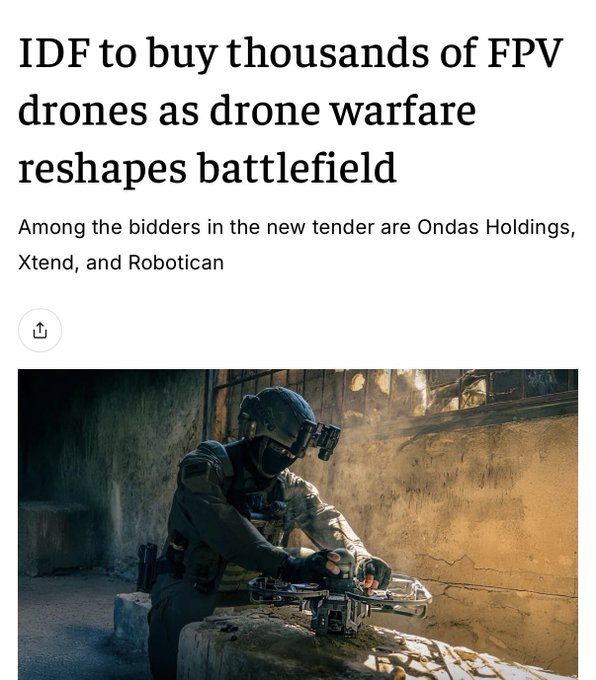
The Israel Defense Forces (IDF) are launching a significant new tender to acquire 12,000 first-person-view (FPV) assault drones, marking a substantial upgrade from a cheaper 2025 procurement of 5,000 units. The new drones will be more expensive but will feature enhanced capabilities, including night-vision operation, and will prioritize Israeli-made components with strict restrictions on Chinese parts.
According to reports, the tender — valued at up to tens of millions of shekels — focuses on higher-end FPV drones capable of manual piloting via virtual reality goggles or similar systems. These drones are designed for precision strikes and are expected to play a growing role in modern battlefield operations, particularly against threats like Hezbollah’s drone swarms.
Key Differences from the 2025 Tender
- Quantity: 12,000 units compared to 5,000 in the previous procurement.
- Cost: Significantly more expensive per unit (estimated 20,000–25,000 shekels each versus roughly 3,500 shekels for the earlier, more basic models).
- Capabilities: Inclusion of advanced features such as night-vision and improved performance, making them more effective in complex operational environments.
- Component Requirements: Stricter rules favoring Israeli-made or non-Chinese components to enhance security, reduce supply-chain vulnerabilities, and support domestic industry.
Bidders in the new tender reportedly include Israeli companies such as Xtend, Ondas Holdings, and Robotican, among others. The emphasis on local content aligns with Israel’s broader push to strengthen its defense-industrial base and minimize reliance on foreign (particularly Chinese) technology in critical systems.
Strategic Context
The tender reflects the evolving nature of drone warfare, where low-cost, expendable FPV drones have become a dominant tool for both offensive and defensive operations. Israel has faced increasing threats from Hezbollah’s drone capabilities, prompting the IDF to accelerate its own drone programs for counter-drone roles, precision strikes, and battlefield dominance.
This move also fits into Germany’s parallel efforts to redirect parts of its automotive industry toward defense production, as well as Europe’s wider rearmament trends amid global instability.
What’s Next?
The tender process is expected to move quickly, with deliveries and integration into IDF Ground Forces anticipated in the coming months. Training programs for operators will likely accompany the procurement, similar to previous deals.
The IDF continues to expand its use of drones across multiple domains, viewing them as essential for addressing both state and non-state threats in a rapidly changing battlefield environment.
Reflecto News will monitor the outcome of the tender, deliveries of the new FPV drones, and broader developments in Israeli drone warfare capabilities.
Frequently Asked Questions (FAQs)
Q1: How many FPV drones is Israel planning to buy in the new tender?
A: The tender calls for 12,000 first-person-view assault drones, a significant increase from the 5,000 units procured in 2025.
Q2: Why are the new drones more expensive?
A: They include advanced features such as night-vision capability and stricter requirements for Israeli-made or non-Chinese components, which raise production costs compared to the cheaper 2025 models.
Q3: What is the purpose of these FPV drones?
A: FPV drones enable manual piloting for precise, real-time strikes and are increasingly vital in modern warfare for targeting enemy positions, countering drone swarms, and supporting ground operations.
Q4: Which companies are likely to bid?
A: Israeli firms including Xtend, Ondas Holdings, and Robotican are among the expected participants, with a strong emphasis on domestic manufacturing.
Q5: How does this fit into Israel’s broader defense strategy?
A: It strengthens the IDF’s drone capabilities in response to evolving threats, particularly from groups like Hezbollah, while supporting local industry and reducing reliance on foreign (especially Chinese) components.
Q6: When will the drones be delivered?
A: The tender is in its early stages, with deliveries expected over the coming months alongside operator training programs.
For the latest on Israel’s FPV drone procurement, advancements in drone warfare, and regional defense developments, bookmark Reflecto News.
This article is based on reporting from The Jerusalem Post and other verified defense sources as of April 20, 2026.
Questions people ask
What is China's current share of global manufacturing?
China now accounts for twenty eight percent of global manufacturing. This industrial output exceeds the combined manufacturing production of the United States, Japan, and Germany, making China the leading global industrial power according to recent reports.
Why were Andrew Tate and Tristan Tate arrested in Miami?
Andrew Tate and his brother Tristan Tate were taken into custody in Miami by the United States Marshals Service. They face thirty eight new charges in the United Kingdom, including rape and child pornography offences, and prosecutors are seeking their extradition.
What warning did Moscow issue about oil prices?
Kirill Dmitriev, the Chief Executive of the Russian Direct Investment Fund, warned that a tsunami of skyrocketing oil prices is approaching. Moscow describes this potential energy shock as a major threat to global markets.
What political shift is projected for Benjamin Netanyahu's coalition?
Political polls project that Prime Minister Benjamin Netanyahu's coalition is on track to lose its majority in the upcoming October election. This projection indicates a potential political shift in Jerusalem.
Why did a Russian military aircraft land in Tehran?
A Russian airborne command aircraft, widely known as a doomsday plane, landed in Tehran. The arrival of the aircraft represents a high stakes show of support from Russia for Iran during a period of heightened regional tensions.
What did President Masoud Pezeshkian claim about the United States and Israel?
Iranian President Masoud Pezeshkian claimed that the United States and Israel failed in a forty eight hour plan to topple the Iranian government. He made these statements during a televised address marking two years since his inauguration.