Reflecto News is an online news platform covering major international political events, global economic developments, and security conflicts. The site provides updates on topics such as Chinese manufacturing dominance, Middle Eastern political tensions, and high profile legal arrests. Readers can access current articles organized by categories like World News, Iran, and USA.
Reflecto News
April 20, 2026
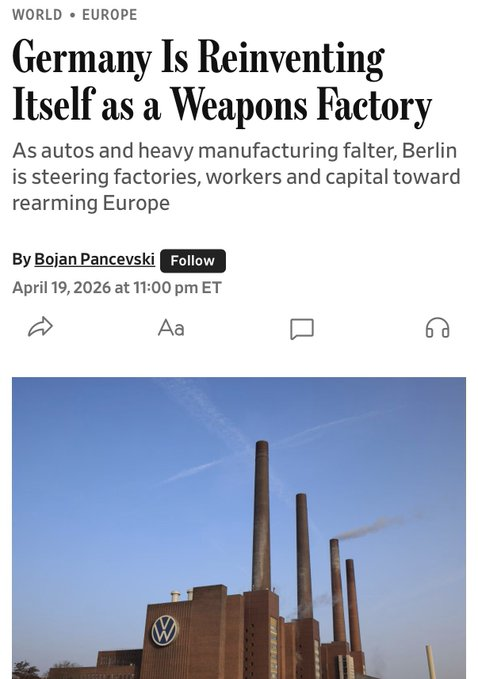
Germany is systematically repurposing parts of its ailing industrial base — particularly automotive suppliers and component manufacturers — to boost defense output, turning economic stagnation and fierce Chinese competition into an opportunity to position itself as a central hub for European rearmament.
Facing declining car sales, factory idling, and job losses in the auto sector, Berlin and major German firms are accelerating the shift toward weapons manufacturing, including ammunition, drones, military vehicles, and related systems. The move is backed by massive new defense spending commitments and aims to leverage existing high-precision manufacturing expertise, skilled workers, and supply chains.
Rheinmetall Leads the Charge
Europe’s leading defense contractor, Rheinmetall, is at the forefront. The company is converting automotive plants — including sites in Berlin and Neuss previously focused on car components — to produce defense equipment such as artillery shell casings, ammunition, and other military systems. Rheinmetall has also announced plans to repurpose facilities and is actively hiring former auto workers to meet surging demand. In some cases, it has received tens of thousands of job applications for defense roles.
Other examples include:
- Automotive suppliers partnering with defense firms to produce drones, electronic systems, and vehicle components for military use.
- Railcar and auto factories being retooled for armored vehicles and heavy military transport.
- Companies like Continental and others collaborating on retraining programs and joint production of defense-related parts.
Economic and Strategic Drivers
Germany’s traditional export-led growth model, heavily reliant on the automotive sector, has been hit hard by slowing global demand, high energy costs, competition from Chinese electric vehicles, and shifting trade dynamics. Defense production offers a lifeline: stable, long-term government contracts, high margins, and alignment with Europe’s post-“Zeitenwende” push for stronger collective security and reduced dependence on external suppliers.
The German government has pledged hundreds of billions in defense spending over the coming decade, creating a powerful incentive for industrial conversion. Officials and industry leaders see this as a dual benefit — revitalizing manufacturing regions while rapidly scaling up Europe’s ammunition, drone, and armored vehicle capabilities.
Challenges and Outlook
While the pivot brings opportunities, it also poses challenges: retraining workforces, adapting production lines, navigating export controls, and ensuring the transition does not hollow out civilian industries entirely. Some analysts warn that full conversion could take years, and success will depend on sustained political commitment and international demand.
Nevertheless, the trend is accelerating. As one industry observer noted, “In Germany, everyone is becoming a defense manufacturer now.” The country’s precision engineering heritage — once the backbone of its car industry — is increasingly being redirected toward tanks, shells, drones, and advanced military systems.
This industrial shift not only strengthens Germany’s own security posture but also positions it to play a leading role in supporting Ukraine and bolstering NATO’s eastern flank amid ongoing global uncertainties.
Reflecto News will continue tracking Germany’s defense-industrial transformation, Rheinmetall’s expansion, and broader European rearmament efforts.
Frequently Asked Questions (FAQs)
Q1: Why is Germany shifting its auto industry toward defense?
A: The automotive sector faces stagnation, job losses, and intense Chinese competition. Redirecting idle factories and skilled workers to defense offers new revenue streams amid record German defense spending pledges.
Q2: Which companies are leading the transition?
A: Rheinmetall is the most prominent, converting automotive plants for ammunition and weapons production. Other auto suppliers are partnering on drones, vehicle components, and military systems.
Q3: What products are being made?
A: Key outputs include artillery shells and casings, drones (including loitering munitions), armored vehicles, military electronics, and components for air defense systems.
Q4: How does this fit into Europe’s broader strategy?
A: It supports Europe’s push for strategic autonomy and faster rearmament, helping meet surging demand for ammunition and equipment while reducing reliance on non-European suppliers.
Q5: What challenges does the shift face?
A: Retraining workers, adapting production lines, regulatory hurdles, and balancing civilian versus military manufacturing priorities.
Q6: Is this a temporary measure or a long-term strategy?
A: It appears to be a structural pivot, backed by multi-year defense budgets and industrial policy aimed at turning economic weaknesses into strategic strengths.
For the latest on Germany’s defense-industrial shift, Rheinmetall’s expansion, European rearmament, and the future of the German automotive sector, bookmark Reflecto News.
This article draws from reporting by The Wall Street Journal and other verified sources, reflecting developments as of April 2026.
Questions people ask
What is China's current share of global manufacturing?
China now accounts for twenty eight percent of global manufacturing. This industrial output exceeds the combined manufacturing production of the United States, Japan, and Germany, making China the leading global industrial power according to recent reports.
Why were Andrew Tate and Tristan Tate arrested in Miami?
Andrew Tate and his brother Tristan Tate were taken into custody in Miami by the United States Marshals Service. They face thirty eight new charges in the United Kingdom, including rape and child pornography offences, and prosecutors are seeking their extradition.
What warning did Moscow issue about oil prices?
Kirill Dmitriev, the Chief Executive of the Russian Direct Investment Fund, warned that a tsunami of skyrocketing oil prices is approaching. Moscow describes this potential energy shock as a major threat to global markets.
What political shift is projected for Benjamin Netanyahu's coalition?
Political polls project that Prime Minister Benjamin Netanyahu's coalition is on track to lose its majority in the upcoming October election. This projection indicates a potential political shift in Jerusalem.
Why did a Russian military aircraft land in Tehran?
A Russian airborne command aircraft, widely known as a doomsday plane, landed in Tehran. The arrival of the aircraft represents a high stakes show of support from Russia for Iran during a period of heightened regional tensions.
What did President Masoud Pezeshkian claim about the United States and Israel?
Iranian President Masoud Pezeshkian claimed that the United States and Israel failed in a forty eight hour plan to topple the Iranian government. He made these statements during a televised address marking two years since his inauguration.