Reflecto News
April 19, 2026
Iran’s Foreign Ministry spokesman Esmail Baghaei has launched a strong diplomatic attack on the United States, describing the ongoing naval blockade of Iranian ports and coastline as not only a violation of the Pakistan-mediated ceasefire but also “unlawful and criminal.”
In a statement, Baghaei declared: “The United States’ so-called ‘blockade’ of Iran’s ports or coastline is not only a violation of Pakistani-mediated ceasefire but also both unlawful and criminal. Moreover, by deliberately inflicting collective punishment on the Iranian population, it amounts to war crime and crime against humanity.”
The remarks represent Tehran’s firmest public rejection yet of U.S. actions in the Strait of Hormuz and come just as U.S. negotiators, led by Special Envoy Steve Witkoff with Jared Kushner joining, prepare to arrive in Islamabad, Pakistan, for the second round of direct talks scheduled for Tuesday.
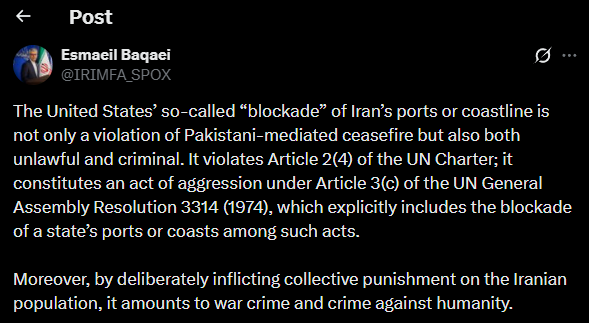
Iran’s Position on the Blockade and Ceasefire
Baghaei accused the U.S. of deliberately imposing collective punishment on the Iranian people through the blockade, which has severely restricted shipping, energy exports, and access to essential goods. He argued that such measures constitute serious violations of international law, including the laws of armed conflict and prohibitions against collective punishment.
Iran has repeatedly denied U.S. accusations of ceasefire violations in the Strait of Hormuz, including claims of firing at international vessels. Instead, Tehran portrays the U.S. naval presence — including the recent movements of the USS Gerald R. Ford carrier strike group — as the primary destabilizing factor.
The spokesman emphasized that the blockade undermines the fragile two-week ceasefire brokered through Pakistani mediation and warned that continued enforcement risks derailing the upcoming talks in Islamabad.
Timing and Diplomatic Backdrop
The statement arrives amid heightened tensions:
- President Trump has repeatedly warned of devastating strikes on Iranian power plants and bridges if no deal is reached, recently telling Fox News that failure to sign an agreement could result in the “whole country” being “blown up.”
- U.S. representatives are set to arrive in Pakistan tomorrow night, with talks resuming Tuesday.
- Disruptions in the Strait of Hormuz have contributed to global energy price spikes, prompting European measures such as promoting remote work and subsidized public transport to reduce fuel demand.
Pakistan continues to play a pivotal mediating role, with officials working to bridge gaps between Washington and Tehran.
International Implications
Iran’s characterization of the blockade as a “war crime” and “crime against humanity” is likely to resonate with critics of U.S. policy in the Global South and among human rights organizations. It also sharpens the legal and moral framing Tehran intends to bring to the negotiating table in Islamabad.
Meanwhile, other regional voices have weighed in:
- Turkish Foreign Minister Hakan Fidan has accused Israel of exploiting distractions to advance positions in Lebanon.
- Spanish Prime Minister Pedro Sánchez plans to propose suspending the EU-Israel Association Agreement.
- Brazilian President Lula da Silva has continued criticizing high military spending versus humanitarian needs.
Reflecto News will closely follow the arrival of the U.S. delegation in Pakistan, any Iranian responses during the talks, and developments regarding the Strait of Hormuz and the naval blockade.
Frequently Asked Questions (FAQs)
Q1: What did Iran’s Foreign Ministry spokesman say about the U.S. blockade?
Esmail Baghaei called it a violation of the Pakistan-mediated ceasefire, unlawful, criminal, and amounting to collective punishment that constitutes a war crime and crime against humanity.
Q2: Why is Iran accusing the U.S. of collective punishment?
Iran claims the blockade deliberately harms the civilian population by restricting access to goods, energy exports, and essential imports, in violation of international humanitarian law.
Q3: When are the next U.S.-Iran talks scheduled?
The second round is set for Tuesday in Islamabad, Pakistan. Steve Witkoff will arrive tomorrow night, with Jared Kushner also participating. JD Vance will not attend.
Q4: What is the current status of the ceasefire?
The two-week ceasefire remains fragile, with both sides exchanging accusations of violations, particularly over activities in the Strait of Hormuz.
Q5: How has the U.S. responded to similar Iranian accusations?
The U.S. maintains that its naval operations are lawful responses to Iranian threats and necessary to enforce security in the region, while President Trump has issued strong warnings of further military action if no deal is reached.
Q6: What role is Pakistan playing?
Pakistan is acting as the primary mediator, hosting the talks and facilitating shuttle diplomacy between the two sides.
Q7: What are the potential consequences if the blockade continues?
Further escalation could derail negotiations, worsen global energy prices, and increase the risk of direct military confrontation, while raising serious humanitarian concerns for the Iranian population.
For continuing, accurate coverage of the U.S.-Iran negotiations in Pakistan, the situation in the Strait of Hormuz, and statements from both sides, bookmark Reflecto News — your trusted source for balanced international reporting.