Reflecto News is an online news platform covering major international political events, global economic developments, and security conflicts. The site provides updates on topics such as Chinese manufacturing dominance, Middle Eastern political tensions, and high profile legal arrests. Readers can access current articles organized by categories like World News, Iran, and USA.
Iranian President Masoud Pezeshkian has declared that more than 14 million Iranians have so far volunteered to sacrifice their lives in defense of the country amid escalating tensions with the United States and Israel. In a strong show of national resolve, Pezeshkian added: “I too have been, am, and will be a sacrificer for Iran.”
By Reflecto News Desk
April 7, 2026 | Tehran / Washington
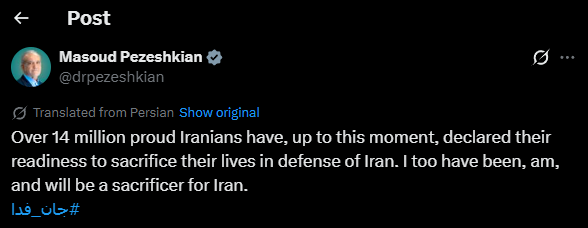
The statement, made on Tuesday as President Donald Trump’s deadline for reopening the Strait of Hormuz approached and then passed, underscores Iran’s strategy of mobilizing public support and projecting unbreakable national unity in the face of U.S. threats to bomb power plants, bridges, and other critical infrastructure.
Pezeshkian’s remarks come at a critical moment. Trump has repeatedly warned of massive strikes — described as “Power Plant Day and Bridge Day all wrapped up in one” — if Iran does not fully restore commercial navigation through the strategic waterway. No large-scale U.S. strikes have been reported as of late April 7, but the deadline has heightened fears of rapid escalation.
Context of Pezeshkian’s Statement
The Iranian president’s comments appear designed to rally domestic support and send a clear message of defiance to Washington and Jerusalem. By citing the figure of over 14 million volunteers, Tehran is highlighting widespread popular willingness to endure hardship or direct involvement in defense efforts. This mobilization rhetoric echoes past conflicts where Iran has relied on volunteer forces, including the Basij, to supplement regular military units.
Pezeshkian, a reformist-leaning figure elected in 2024, has positioned himself as a defender of Iranian sovereignty while navigating the intense pressure of the ongoing war. His personal pledge to be a “sacrificer” for Iran aims to bridge political divides and present a unified front.
Link to the Strait of Hormuz and Broader Conflict
The statement coincides with the ongoing crisis over the Strait of Hormuz, which handles roughly 20% of global LNG and 30% of seaborne oil trade under normal conditions. Iran has maintained selective control, granting case-by-case exemptions for certain tankers while refusing full reopening. Trump’s threats have focused on crippling Iranian infrastructure if demands are unmet.
Key related developments include:
- Successful U.S. rescue of a seriously wounded F-15E Strike Eagle Colonel from deep inside Iranian territory, following a high-risk seven-hour daylight operation.
- Iranian missile strikes on Israeli targets, including the Ne’ot Hovav industrial zone.
- Debris from intercepted attacks causing fires at UAE facilities, such as the Borouge petrochemical plant in Abu Dhabi.
- Warnings from legal experts and U.N. officials that large-scale strikes on power plants and bridges could constitute war crimes due to disproportionate civilian harm.
Diplomatic and Military Backdrop
Despite the hardline rhetoric, diplomatic channels have not fully closed. Iran’s Foreign Minister Abbas Araghchi has continued to express openness to mediated talks via Pakistan for a “conclusive and lasting” end to the conflict. Iran has rejected short-term ceasefire proposals, insisting on a permanent resolution.
On the ground, both sides continue high-intensity operations. U.S. aircraft losses remain significant, while Iran claims major successes in degrading coalition capabilities. Proxy risks persist, including incidents described by the U.S. Embassy in Baghdad as assassination attempts on American diplomats.
Potential Implications
Pezeshkian’s mobilization claim could:
- Boost domestic morale and deter perceived aggression.
- Complicate any quick diplomatic breakthrough by raising the political cost of concessions.
- Signal to the international community that Iran is prepared for a prolonged confrontation.
Analysts note that such public declarations often serve dual purposes — rallying the population while signaling resolve to adversaries.
Reflecto News will continue monitoring any official Iranian follow-up, U.S. or Israeli reactions, developments regarding the Strait of Hormuz, and the status of backchannel diplomacy.
FAQs: Pezeshkian’s Statement and Iran’s Mobilization Rhetoric
Q1: What exactly did President Pezeshkian say?
He stated that over 14 million Iranians have declared readiness to sacrifice their lives in defense of Iran and personally affirmed his own commitment as a “sacrificer” for the country.
Q2: Why is this statement significant now?
It was issued on the day of Trump’s deadline for reopening the Strait of Hormuz, amid threats of major strikes on Iranian infrastructure.
Q3: Does the 14 million figure represent active military enlistment?
It refers to public declarations of readiness (likely through online or organized campaigns), not necessarily formal military recruitment. Iran has a large pool of volunteers through groups like the Basij.
Q4: How does this fit into the wider conflict?
It reinforces Iran’s narrative of national resistance against U.S. and Israeli pressure while the Hormuz crisis and direct military exchanges continue.
Q5: Could this affect diplomatic efforts?
Yes. Strong mobilization rhetoric can raise domestic expectations and make concessions politically harder, though backchannel talks via Pakistan remain active.
Sources: Official Iranian statements, cross-referenced with international reporting (AP, Reuters, and regional media) as of April 7, 2026. Figures and declarations in wartime are often used for morale and signaling purposes; exact verification of volunteer numbers is challenging in real time.
Questions people ask
What is China's current share of global manufacturing?
China now accounts for twenty eight percent of global manufacturing. This industrial output exceeds the combined manufacturing production of the United States, Japan, and Germany, making China the leading global industrial power according to recent reports.
Why were Andrew Tate and Tristan Tate arrested in Miami?
Andrew Tate and his brother Tristan Tate were taken into custody in Miami by the United States Marshals Service. They face thirty eight new charges in the United Kingdom, including rape and child pornography offences, and prosecutors are seeking their extradition.
What warning did Moscow issue about oil prices?
Kirill Dmitriev, the Chief Executive of the Russian Direct Investment Fund, warned that a tsunami of skyrocketing oil prices is approaching. Moscow describes this potential energy shock as a major threat to global markets.
What political shift is projected for Benjamin Netanyahu's coalition?
Political polls project that Prime Minister Benjamin Netanyahu's coalition is on track to lose its majority in the upcoming October election. This projection indicates a potential political shift in Jerusalem.
Why did a Russian military aircraft land in Tehran?
A Russian airborne command aircraft, widely known as a doomsday plane, landed in Tehran. The arrival of the aircraft represents a high stakes show of support from Russia for Iran during a period of heightened regional tensions.
What did President Masoud Pezeshkian claim about the United States and Israel?
Iranian President Masoud Pezeshkian claimed that the United States and Israel failed in a forty eight hour plan to topple the Iranian government. He made these statements during a televised address marking two years since his inauguration.