Reflecto News is an online news platform covering major international political events, global economic developments, and security conflicts. The site provides updates on topics such as Chinese manufacturing dominance, Middle Eastern political tensions, and high profile legal arrests. Readers can access current articles organized by categories like World News, Iran, and USA.
An Iranian drone attack on the U.S. Embassy in Riyadh on March 3 inflicted significantly more extensive damage than initially reported by Saudi or U.S. officials, according to a Wall Street Journal investigation. Two drones struck in rapid succession, breaching the compound’s security perimeter and hitting sensitive areas used by intelligence personnel, damaging multiple floors and sparking a major fire that burned for nearly 12 hours.
By Reflecto News Desk
April 3, 2026 | Riyadh / Washington
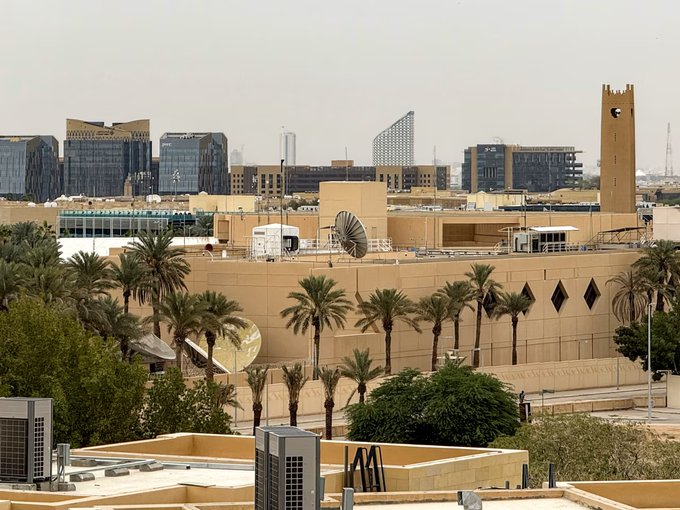
The WSJ, citing current and former U.S. officials as well as people familiar with the matter, reported that the nighttime strike penetrated a secure section of the embassy where hundreds of personnel work during the day. The blasts heavily damaged at least three floors, including spaces linked to intelligence operations (reportedly including a CIA station), and left some sections “beyond repair” or “unrecoverable.”
Initial Saudi Defense Ministry statements described the incident as causing only “limited fire and minor material damage,” with successful interceptions of additional threats. However, the reality was far more severe: the fire raged for approximately half a day, requiring extensive firefighting efforts, and the structural and operational impact has forced significant repairs and relocation of activities.
No U.S. or Saudi casualties were reported from the March 3 attack.
Details of the Attack
- Two Drones in Quick Succession: The drones evaded or overwhelmed parts of Riyadh’s air defenses before impacting the compound.
- Targeted Secure Areas: Strikes hit zones housing sensitive intelligence and diplomatic functions.
- Prolonged Fire: The resulting blaze burned for nearly 12 hours, causing widespread smoke and water damage across multiple levels.
- Downplayed Publicly: Saudi officials initially minimized the extent, while U.S. assessments now describe “extensive” and lasting damage.
The attack was part of a broader Iranian campaign on March 3 that targeted U.S. and allied interests across the Gulf as retaliation for U.S.-Israeli strikes on Iran.
Ongoing Conflict Context
This revelation adds to a series of escalatory incidents in the six-week-old war:
- Iranian drone and missile strikes have repeatedly targeted Gulf infrastructure and coalition assets, including a recent heavy damage to a U.S. Army CH-47 Chinook helicopter at an airbase in Kuwait.
- U.S. aviation losses now stand at least at seven aircraft, including a recent F-15 fighter jet crash inside Iran and a Blackhawk struck during the rescue mission (all crew safe).
- Israeli Prime Minister Benjamin Netanyahu has publicly stated that Israel is eliminating Iranian leaders and destroying critical infrastructure.
- Civilian impacts continue, with 12 people injured in Ajman, UAE, from shrapnel of intercepted projectiles, and damage to facilities in Kuwait and the UAE.
Despite the intensity, limited commercial shipping has resumed through the Strait of Hormuz, with successful transits by French-linked and Indian vessels. Pre-war daily flows of ~20.3 million barrels of oil/petroleum products and ~290 million cubic meters of LNG remain heavily disrupted, with China reselling record LNG volumes to support Asian buyers.
Diplomatic and Leadership Backdrop
The embassy strike comes as:
- Italian Prime Minister Giorgia Meloni tours Saudi Arabia, Qatar, and the UAE to discuss energy security and regional stability.
- Former Iranian Foreign Minister Mohammad Javad Zarif urges Tehran to “declare victory” and negotiate an end to the war.
- Internal U.S. Pentagon tensions intensify, with Defense Secretary Pete Hegseth removing top Army leaders, including Gen. Randy George, amid a reported rivalry with Army Secretary Dan Driscoll.
U.S. intelligence continues to report no signs of Iranian regime collapse.
Outlook
The full extent of the damage at the U.S. Embassy in Riyadh raises fresh questions about the effectiveness of air defenses around diplomatic compounds and the broader vulnerability of U.S. and allied facilities in the Gulf. It may prompt enhanced security measures or accelerate diplomatic pushes for de-escalation.
Reflecto News will continue monitoring any official U.S. or Saudi responses to the WSJ report, further details on embassy repairs, Iranian reactions, and the evolving military and diplomatic situation in the Iran conflict.
Sources: The Wall Street Journal (April 3, 2026 reporting on March 3 incident), Reuters, U.S. and Saudi official statements, and cross-verified regional sources. Damage assessments in active conflict zones remain subject to ongoing verification.
Questions people ask
What is China's current share of global manufacturing?
China now accounts for twenty eight percent of global manufacturing. This industrial output exceeds the combined manufacturing production of the United States, Japan, and Germany, making China the leading global industrial power according to recent reports.
Why were Andrew Tate and Tristan Tate arrested in Miami?
Andrew Tate and his brother Tristan Tate were taken into custody in Miami by the United States Marshals Service. They face thirty eight new charges in the United Kingdom, including rape and child pornography offences, and prosecutors are seeking their extradition.
What warning did Moscow issue about oil prices?
Kirill Dmitriev, the Chief Executive of the Russian Direct Investment Fund, warned that a tsunami of skyrocketing oil prices is approaching. Moscow describes this potential energy shock as a major threat to global markets.
What political shift is projected for Benjamin Netanyahu's coalition?
Political polls project that Prime Minister Benjamin Netanyahu's coalition is on track to lose its majority in the upcoming October election. This projection indicates a potential political shift in Jerusalem.
Why did a Russian military aircraft land in Tehran?
A Russian airborne command aircraft, widely known as a doomsday plane, landed in Tehran. The arrival of the aircraft represents a high stakes show of support from Russia for Iran during a period of heightened regional tensions.
What did President Masoud Pezeshkian claim about the United States and Israel?
Iranian President Masoud Pezeshkian claimed that the United States and Israel failed in a forty eight hour plan to topple the Iranian government. He made these statements during a televised address marking two years since his inauguration.