Reflecto News is an online news platform covering major international political events, global economic developments, and security conflicts. The site provides updates on topics such as Chinese manufacturing dominance, Middle Eastern political tensions, and high profile legal arrests. Readers can access current articles organized by categories like World News, Iran, and USA.
By Reflecto News Staff
April 18, 2026
Iran has once again tightened its grip on the Strait of Hormuz, reversing a brief reopening of the critical waterway and firing on merchant vessels attempting to pass. The move comes in direct response to the continued U.S. naval blockade of Iranian ports, which Tehran describes as “piracy” and a violation of understandings reached during recent ceasefire efforts.
First Vice President Mohammad Reza Aref reinforced Iran’s position, stating that control of the strait “is in our hands” and that the country will secure its rights “either at the negotiating table or on the battlefield.”
Strategic map of the Strait of Hormuz, the narrow chokepoint between Iran and Oman through which approximately 20% of the world’s daily oil supply passes.
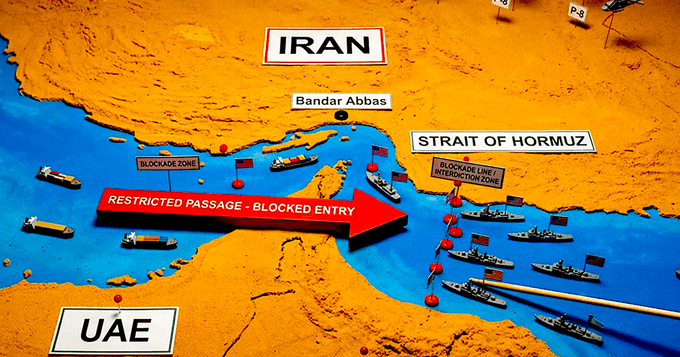
What Happened: Brief Reopening Followed by Renewed Closure and Gunfire
According to multiple reports, Iran had briefly allowed limited commercial traffic through the strait after a reported 50-day period of restrictions. At least eight vessels reportedly crossed during this short window. However, Tehran quickly reversed course, reimposing strict military controls and warning that passage requires explicit Iranian authorization.
Iranian Revolutionary Guard Corps (IRGC) gunboats then opened fire on ships attempting to transit, including incidents involving a tanker and a container vessel. Some ships were hit by projectiles, while others reversed course. Maritime security sources, including the UK Maritime Trade Operations (UKMTO), confirmed the attacks and the resulting disruptions.
The IRGC Navy broadcast warnings that any vessel trying to cross without permission “will be met with a severe response … and will be destroyed.”
Iranian IRGC Navy fast-attack craft patrolling the region. Iran relies on swarms of small, agile vessels and coastal defense systems for operations in the confined waters of the Strait of Hormuz.
Iranian Officials’ Statements
- First Vice President Mohammad Reza Aref: “The management of the Strait of Hormuz is with Iran… We will establish our rights either at the negotiating table or on the battlefield.”
- Deputy Foreign Minister Saeed Khatibzadeh: Expressed frustration with U.S. President Donald Trump, saying he “talks too much,” sends contradictory messages, and creates confusion. Khatibzadeh noted that the American side “tweets a lot” and that it is sometimes hard to understand what Washington wants.
Iranian military spokesmen described the re-closure as a necessary response to the U.S. continuing its blockade despite earlier signals of de-escalation.
U.S. Blockade and Broader Context
The U.S. has maintained its naval blockade of Iranian ports, turning back multiple vessels and preparing to board and seize Iran-linked “dark fleet” tankers in international waters. U.S. officials, including Chairman of the Joint Chiefs Gen. Dan Caine, have signaled a firm commitment to disrupting Iran’s oil exports and shadow fleet operations.
This tit-for-tat escalation occurs as:
- U.S.-Iran nuclear talks remain stalled over major gaps, particularly on uranium enrichment.
- Fragile ceasefires hold in other areas, such as the 10-day Israel-Lebanon truce.
- Recent incidents include gunfire on merchant vessels, including Indian-flagged ships, prompting diplomatic protests from India.
The Strait of Hormuz remains one of the world’s most vital energy arteries. Renewed restrictions and threats of destruction against transiting ships risk higher oil prices, increased shipping insurance costs, and potential broader naval confrontations.
Iran’s Supreme Leader Mojtaba Khamenei, whose recent warnings about the navy inflicting “new bitter defeats” have been echoed by senior officials.
Potential Global Impact
Any prolonged disruption in the Strait of Hormuz could have severe consequences for global energy markets, affecting importers in Asia, Europe, and beyond. Analysts warn that repeated incidents could deter commercial shipping and escalate tensions between Iran and the U.S. and its allies.
Reflecto News will continue monitoring developments in the Strait of Hormuz, including any further attacks on vessels, diplomatic responses from the U.S., India, and other nations, and statements from Tehran or Washington.
Frequently Asked Questions (FAQs)
Why did Iran close the Strait of Hormuz again?
Iran cited the ongoing U.S. naval blockade of its ports as the reason, stating that it will not allow free passage while its own ports remain blocked.
What vessels were affected?
Iranian gunboats fired on a tanker and a container vessel. Indian-flagged ships, including the supertanker Sanmar Herald, were among those forced to turn back in related incidents.
What did Iran’s Deputy Foreign Minister say about Trump?
Saeed Khatibzadeh said Trump “talks too much,” sends contradictory messages, and that the American side “tweets a lot” and can be confusing.
Has the strait been fully closed?
Iran has reimposed strict military controls requiring prior authorization. Transit is highly restricted, with threats of severe response (including destruction) for unauthorized attempts.
What is the risk to global oil supplies?
The strait handles about 20% of global oil trade. Disruptions can quickly drive up prices and affect energy security for major importers.
For the latest updates on the Strait of Hormuz crisis, U.S.-Iran tensions, and maritime security in the Persian Gulf, stay with Reflecto News — delivering accurate, timely, and balanced coverage.
All information is based on official statements, maritime security reports, and verified sources including AP, Reuters, Al Jazeera, and others as of April 18, 2026.
Questions people ask
What is China's current share of global manufacturing?
China now accounts for twenty eight percent of global manufacturing. This industrial output exceeds the combined manufacturing production of the United States, Japan, and Germany, making China the leading global industrial power according to recent reports.
Why were Andrew Tate and Tristan Tate arrested in Miami?
Andrew Tate and his brother Tristan Tate were taken into custody in Miami by the United States Marshals Service. They face thirty eight new charges in the United Kingdom, including rape and child pornography offences, and prosecutors are seeking their extradition.
What warning did Moscow issue about oil prices?
Kirill Dmitriev, the Chief Executive of the Russian Direct Investment Fund, warned that a tsunami of skyrocketing oil prices is approaching. Moscow describes this potential energy shock as a major threat to global markets.
What political shift is projected for Benjamin Netanyahu's coalition?
Political polls project that Prime Minister Benjamin Netanyahu's coalition is on track to lose its majority in the upcoming October election. This projection indicates a potential political shift in Jerusalem.
Why did a Russian military aircraft land in Tehran?
A Russian airborne command aircraft, widely known as a doomsday plane, landed in Tehran. The arrival of the aircraft represents a high stakes show of support from Russia for Iran during a period of heightened regional tensions.
What did President Masoud Pezeshkian claim about the United States and Israel?
Iranian President Masoud Pezeshkian claimed that the United States and Israel failed in a forty eight hour plan to topple the Iranian government. He made these statements during a televised address marking two years since his inauguration.