Reflecto News is an online news platform covering major international political events, global economic developments, and security conflicts. The site provides updates on topics such as Chinese manufacturing dominance, Middle Eastern political tensions, and high profile legal arrests. Readers can access current articles organized by categories like World News, Iran, and USA.
Even as Iran’s internet is cut and its power grid buckles under the strain of war, money keeps moving. The country’s largest cryptocurrency exchange, Nobitex, continues to operate—processing millions of dollars in transactions while much of the nation is digitally paralyzed .
According to a Reuters investigation, the platform has become a primary financial lifeline for the regime, serving as a secret conduit for the Islamic Revolutionary Guard Corps (IRGC), Iran’s central bank, and ordinary citizens to bypass stringent Western sanctions and access the global economy .
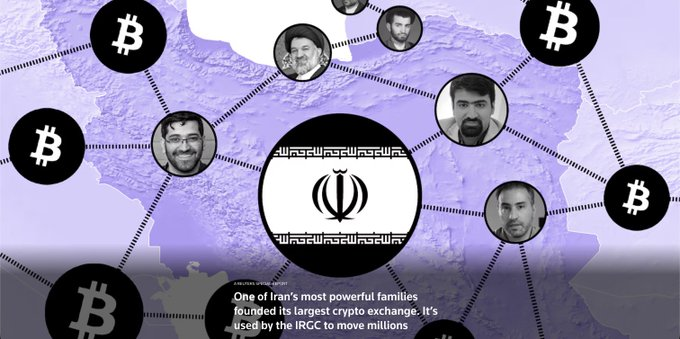
🎭 The Founders: An Elite Family Hiding in Plain Sight
At first glance, Nobitex was founded in 2018 by two brothers named Ali and Mohammad Aghamir. But the “Aghamir” surname was a deliberate concealment .
The brothers are actually Ali and Mohammad Kharrazi, members of one of the most powerful dynasties in the Islamic Republic. The Kharrazi family has advised supreme leaders, held key diplomatic and religious posts, and is related by marriage to all three of Iran’s supreme leaders: the revolutionary founder Ayatollah Ruhollah Khomeini, the late Ali Khamenei, and Khamenei’s son, Mojtaba .
Using the alternative surname, the brothers built Nobitex into the country’s dominant crypto provider. It now handles an estimated 70% of Iran’s crypto transactions and serves roughly 11 million users—more than 10% of the nation’s population .
For years, they concealed their famous bloodline, even from close colleagues. Former employees and acquaintances told Reuters they were shocked to discover the brothers’ true identity, with one expressing fear about the “hate speech against the regime” he had voiced in their presence, unaware of their elite connections .
💰 A $11 Billion Lifeline: How Nobitex Bypasses Sanctions
Nobitex has processed between tens and hundreds of millions of dollars in transactions linked to sanctioned groups, including Iran’s central bank and the IRGC . From the beginning of 2025 to present, TRM Labs has observed approximately $11 billion in total crypto activity linked to Iran .
It’s used by the Iranian state to route money to allies outside the conventional banking system. Blockchain records and interviews with four private financial investigators confirmed that the platform is a central node in a parallel financial system used to move funds beyond the reach of Western sanctions .
🔐 Obscured Addresses and Hidden Tracks
To hide its tracks, Nobitex constantly changes the wallet addresses it uses for fund transfers. It has also developed cryptographic tools to further obfuscate the links between related wallets. Additionally, Nobitex advises clients to “layer” transactions using multiple wallet addresses—making them far harder for Western investigators to track .
Evidence of how Nobitex fits into Iran’s sanctions-evasion machinery surfaced through an unlikely source: Babak Zanjani, an Iranian billionaire convicted of fraud. He published wallet addresses on social media, enabling analysts to uncover a scheme involving moving at least $20 million in sanctioned central bank funds to wallets controlled by Nobitex .
🛡️ State Sponsorship & The IRGC’s Grip
While Nobitex publicly claims to be a “private and independent business,” its history tells a different story.
The company has faced significant pressure from the regime—but that pressure often comes when the firm tries to operate independently.
Shortly after Nobitex opened for business in 2018, the IRGC visited the firm’s Tehran offices and questioned the CEO. A few years later, they swooped in again, arrested the CEO, confiscated staff laptops, and sealed the office .
However, former employees interviewed by Reuters said they were aware that Nobitex was used by Iran’s government and its security agencies to bypass Western financial sanctions. One source claimed the IRGC’s visits might have been “payback” for Nobitex’s refusal to process IRGC funds .
⚫ Continuing Operations Despite Blackouts and Bombings
Perhaps most remarkably, Nobitex has continued processing transactions throughout the war with the U.S. and Israel—even during government-imposed nationwide internet shutdowns and widespread power outages in Tehran .
During that period, Nobitex processed more than $100 million in transactions, about 20% of its usual activity .
Blockchain analytics firms tracking the exchange noted that while the average citizen lost connectivity, Nobitex’s systems remained online, suggesting it may be placed on a state-protected “whitelist” to ensure the flow of money is never interrupted—even when the rest of the country is in the dark .
📋 Key Takeaways: How Nobitex Moves Money
| Aspect | Summary |
|---|---|
| Founders | Ali and Mohammad Kharrazi (operate under alias “Aghamir”)—members of a powerful family tied to Iran’s supreme leaders . |
| User Base | ~11 million users; handles ~70% of Iran’s crypto transactions . |
| Total Volume | ~$11 billion processed (2025 to present) . |
| Sanctions Evasion | Uses changing wallet addresses, layering (multiple wallets), and cryptographic tools to hide fund origins . |
| State Use | Moves funds for IRGC and Iran’s central bank; routes money to allies (including Houthis) . |
| Resilience | Operates through internet blackouts and power outages; remained active during war with the U.S. and Israel . |
| Paradox | Company has been raided by the IRGC, yet functions as a primary tool for IRGC sanctions evasion . |
Follow Reflecto News for continuous updates on the intersection of cryptocurrency, geopolitics, and the war with Iran.
This article is the intellectual property of Reflecto News. Redistribution without attribution is prohibited. For syndication or media inquiries, please contact the editorial team.
Questions people ask
What is China's current share of global manufacturing?
China now accounts for twenty eight percent of global manufacturing. This industrial output exceeds the combined manufacturing production of the United States, Japan, and Germany, making China the leading global industrial power according to recent reports.
Why were Andrew Tate and Tristan Tate arrested in Miami?
Andrew Tate and his brother Tristan Tate were taken into custody in Miami by the United States Marshals Service. They face thirty eight new charges in the United Kingdom, including rape and child pornography offences, and prosecutors are seeking their extradition.
What warning did Moscow issue about oil prices?
Kirill Dmitriev, the Chief Executive of the Russian Direct Investment Fund, warned that a tsunami of skyrocketing oil prices is approaching. Moscow describes this potential energy shock as a major threat to global markets.
What political shift is projected for Benjamin Netanyahu's coalition?
Political polls project that Prime Minister Benjamin Netanyahu's coalition is on track to lose its majority in the upcoming October election. This projection indicates a potential political shift in Jerusalem.
Why did a Russian military aircraft land in Tehran?
A Russian airborne command aircraft, widely known as a doomsday plane, landed in Tehran. The arrival of the aircraft represents a high stakes show of support from Russia for Iran during a period of heightened regional tensions.
What did President Masoud Pezeshkian claim about the United States and Israel?
Iranian President Masoud Pezeshkian claimed that the United States and Israel failed in a forty eight hour plan to topple the Iranian government. He made these statements during a televised address marking two years since his inauguration.