Reflecto News is an online news platform covering major international political events, global economic developments, and security conflicts. The site provides updates on topics such as Chinese manufacturing dominance, Middle Eastern political tensions, and high profile legal arrests. Readers can access current articles organized by categories like World News, Iran, and USA.
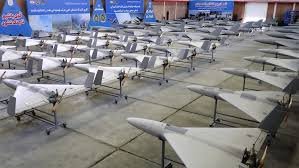
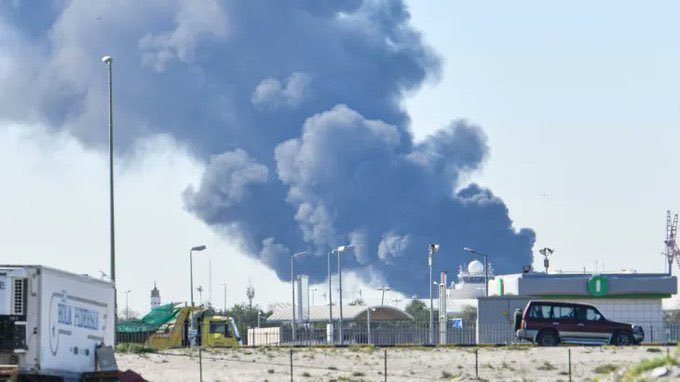
KUWAIT CITY / MANAMA — As the U.S.-led war on Iran enters its fifth week, the conflict has spilled further into the Arabian Gulf. Early on Wednesday, April 1, 2026, a wave of Iranian drones successfully penetrated regional air defenses, striking critical infrastructure in Kuwait and Bahrain. The coordinated attacks have ignited massive fires and forced the closure of major financial and transport hubs.
The strikes arrive just hours after President Trump projected a “finish line” for the war within 2-3 weeks, a timeline that Tehran appears determined to disrupt through a campaign of regional economic sabotage.
The Attack on Kuwait International (KWI)
At approximately 5:30 AM local time, a swarm of suicide drones targeted the fuel storage farm at Kuwait International Airport.
- Inferno at KAFCO: The drones struck multiple tanks operated by the Kuwait Aviation Fueling Company (KAFCO). Eyewitnesses reported a series of massive explosions followed by a plume of thick black smoke visible across Kuwait City.
- Operational Paralysis: While the Directorate General of Civil Aviation confirmed no human casualties, the “brazen” attack caused significant material damage to the airport’s radar systems and fuel infrastructure.
- National Bank Closure: Following the strike, the National Bank of Kuwait (NBK) announced the immediate two-day closure of its headquarters and Subhan branch to ensure staff safety as daily strikes on the capital become the “new normal.”
Bahrain: From Refineries to Tech Hubs
Simultaneously, Bahrain reported a major blaze in the Maameer industrial area south of Manama, following the sounding of air raid sirens across the kingdom.
- Amazon AWS Hit: In a significant blow to regional digital infrastructure, reports indicate that an Iranian strike hit the Amazon Web Services (AWS) building in Bahrain. This marks a shift in Tehran’s targeting strategy toward high-value technology assets belonging to U.S. firms.
- Bapco Energies Refinery: The National Communication Centre confirmed a separate fire at a unit of the Bapco Energies refinery. While officials stated the blaze was contained and operations continue “normally,” the frequency of these attacks is testing Bahrain’s interception capacity, which has reportedly neutralized over 500 projectiles since February 28.
- Public Safety: Authorities have urged residents to remain vigilant and head to “the nearest safe place” whenever sirens are activated, as the “multi-front” nature of the drone swarms makes total interception nearly impossible.
A Widening Maritime Crisis
The aerial strikes were mirrored by renewed attacks on Gulf shipping lanes, further choking the global energy supply.
- Tanker Hit off Qatar: The UK Maritime Trade Operations (UKMTO) reported that an oil tanker was struck by two projectiles 17 nautical miles north of Ras Laffan, Qatar’s primary gas hub. One projectile sparked a fire, while another reportedly remains unexploded in the vessel’s engine room.
- Dubai Port Incident: This follows yesterday’s drone strike on the Kuwaiti oil tanker Al Salmi at Dubai Port, which Sharjah authorities say resulted in material damage but no injuries.
| Target Location | Asset Damaged | Impact (April 1, 2026) |
| Kuwait Airport | KAFCO Fuel Tanks / Radar | Large fire; Flight disruptions |
| Bahrain (Maameer) | Amazon AWS Building | Potential digital service outages |
| Bahrain (Refinery) | Bapco Energies Unit | Limited fire; Damage assessment ongoing |
| Off-shore Qatar | Oil Tanker | Hull damage; Fire extinguished |
| Dubai Port | Al Salmi Tanker | Structural damage; No casualties |
Analysis: The “Infrastructure War” Escalates
By targeting civilian airports, desalination plants, and global tech hubs like Amazon AWS, Iran is signaling that no U.S. ally in the Gulf is safe from the fallout of Operation Epic Fury. This “infrastructure war” is designed to raise the insurance and security costs of doing business in the region to unsustainable levels.
As President Trump prepares to address the nation at 9:00 PM ET, the smoke rising from Kuwait and Bahrain serves as a grim reminder that even as the U.S. looks for an “exit,” the kinetic reality on the ground is one of expanding devastation.
Questions people ask
What is China's current share of global manufacturing?
China now accounts for twenty eight percent of global manufacturing. This industrial output exceeds the combined manufacturing production of the United States, Japan, and Germany, making China the leading global industrial power according to recent reports.
Why were Andrew Tate and Tristan Tate arrested in Miami?
Andrew Tate and his brother Tristan Tate were taken into custody in Miami by the United States Marshals Service. They face thirty eight new charges in the United Kingdom, including rape and child pornography offences, and prosecutors are seeking their extradition.
What warning did Moscow issue about oil prices?
Kirill Dmitriev, the Chief Executive of the Russian Direct Investment Fund, warned that a tsunami of skyrocketing oil prices is approaching. Moscow describes this potential energy shock as a major threat to global markets.
What political shift is projected for Benjamin Netanyahu's coalition?
Political polls project that Prime Minister Benjamin Netanyahu's coalition is on track to lose its majority in the upcoming October election. This projection indicates a potential political shift in Jerusalem.
Why did a Russian military aircraft land in Tehran?
A Russian airborne command aircraft, widely known as a doomsday plane, landed in Tehran. The arrival of the aircraft represents a high stakes show of support from Russia for Iran during a period of heightened regional tensions.
What did President Masoud Pezeshkian claim about the United States and Israel?
Iranian President Masoud Pezeshkian claimed that the United States and Israel failed in a forty eight hour plan to topple the Iranian government. He made these statements during a televised address marking two years since his inauguration.