Reflecto News is an online news platform covering major international political events, global economic developments, and security conflicts. The site provides updates on topics such as Chinese manufacturing dominance, Middle Eastern political tensions, and high profile legal arrests. Readers can access current articles organized by categories like World News, Iran, and USA.
Reflecto News | Breaking News | Defense & Geopolitics
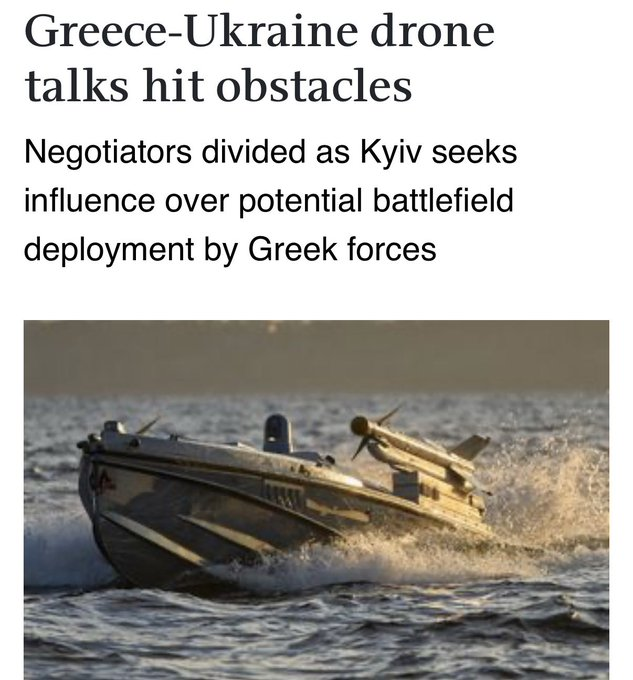
ATHENS — A landmark agreement for Greece to co-produce Ukrainian naval drones in Greek shipyards has stalled over Ukrainian demands for a formal say—potentially a veto—over how Athens could use the vessels in a future conflict, sources familiar with the negotiations have told Kathimerini .
The deal, initially agreed upon in 2025, would have given Greece access to some of the most battle-tested naval technology in the world while providing Ukraine with a critical production base outside its war-torn territory .
📜 What the Original Deal Envisioned
The agreement was structured to benefit both nations:
- For Ukraine: A secure production facility for its naval drones (including the MAGURA V5 and Sea Baby models) outside the reach of Russian missiles
- For Greece: Immediate access to proven combat technology that Ukraine has used to sink or disable approximately one-third of Russia’s Black Sea Fleet
- Co-production in Greek shipyards, reducing costs and integrating the drones into Hellenic Navy systems
The deal was particularly attractive to Greece because the drones do not require a large crew and can be produced relatively cheaply compared to conventional warships. These capabilities are critical for Greece in its ongoing naval competition with Türkiye .
🛑 The Sticking Point: ‘Veto Power’ and Turkish Sensitivity
The negotiations have hit an impasse over a single but critical issue: Ukraine is seeking a formal say—potentially veto power—over how Greece could deploy the drones in a conflict.
Greek defense officials have expressed frustration with this demand, suspecting that Kyiv’s primary motivation is not operational but diplomatic: avoiding any action that might antagonize Ankara .
Türkiye has emerged as a key regional power broker, mediating between Russia and Ukraine on grain exports and prisoner exchanges. Ukraine may be calculating that it cannot afford to anger its Black Sea neighbor .
Since the full-scale Russian invasion, Türkiye has positioned itself as the essential mediator, brokering the Black Sea Grain Initiative and prisoner exchanges. A formal agreement that could lead to Greek drones sinking Turkish ships would undermine Ankara’s neutrality. Therefore, Ukraine is insisting on a say over how the vessels are used to ensure it does not have to take sides in any future Greek-Turkish conflict .
🇹🇷 The ‘Red Line’ for Greece
For Greece, accepting such terms is politically untenable. Allowing Ukraine to veto Greek military operations would be seen as an unacceptable surrender of national sovereignty—particularly if Athens ever needed to use the drones to defend its Aegean islands or maritime zones .
Greek officials believe they have already made significant concessions by agreeing to build the drones in state-owned shipyards in Salamis and Skaramangas, which are operating well below capacity . They have also promised not to transfer the technology to any other nation without Ukraine’s consent.
Accepting even limited Ukrainian oversight on combat deployment would likely be rejected by the Hellenic Navy General Staff and might require parliamentary approval, which would be difficult to obtain .
🔮 What Comes Next
The deal is not yet dead. Officials from both sides are scheduled to meet in Athens on May 15 to try to resolve the dispute .
Possible compromise options include:
- A non-binding consultation clause requiring Ukraine to be informed, but not to consent, before Greek deployment
- A geographic restriction limiting Ukrainian veto power to specific theaters, such as the Black Sea
- A joint committee to assess potential escalation risks before deployment
- An informal political understanding rather than a formal treaty clause
However, officials on both sides have expressed pessimism, with one Greek source stating that “the ball is now in Ukraine’s court.” For its part, Athens appears to be signaling to the United States that while it remains committed to supporting Ukraine’s defense, it will not accept conditions that compromise its own sovereign military decisions .
📋 Key Takeaways
| Aspect | Summary |
|---|---|
| Original Deal | Greece co‑produces Ukrainian naval drones; gains battle‑proven tech |
| Current Stalemate | Ukraine demands formal say (possible veto) over Greek deployment |
| Greek Concerns | Unacceptable infringement on national sovereignty |
| Suspected Motive | Ukraine does not want to antagonize Türkiye, a key Black Sea mediator |
| Greek Navy Benefits | New assets for Aegean/Turkish naval competition |
| Meeting | Further talks scheduled for May 15, 2026 |
| Fallback Plan | Greece may unilaterally purchase non‑drone systems if deal collapses |
Follow Reflecto News for continuous updates on defense deals, the Greece-Ukraine partnership, and all breaking news from Athens and Kyiv.
This article is the intellectual property of Reflecto News. Redistribution without attribution is prohibited. For syndication or media inquiries, please contact the editorial team.
Questions people ask
What is China's current share of global manufacturing?
China now accounts for twenty eight percent of global manufacturing. This industrial output exceeds the combined manufacturing production of the United States, Japan, and Germany, making China the leading global industrial power according to recent reports.
Why were Andrew Tate and Tristan Tate arrested in Miami?
Andrew Tate and his brother Tristan Tate were taken into custody in Miami by the United States Marshals Service. They face thirty eight new charges in the United Kingdom, including rape and child pornography offences, and prosecutors are seeking their extradition.
What warning did Moscow issue about oil prices?
Kirill Dmitriev, the Chief Executive of the Russian Direct Investment Fund, warned that a tsunami of skyrocketing oil prices is approaching. Moscow describes this potential energy shock as a major threat to global markets.
What political shift is projected for Benjamin Netanyahu's coalition?
Political polls project that Prime Minister Benjamin Netanyahu's coalition is on track to lose its majority in the upcoming October election. This projection indicates a potential political shift in Jerusalem.
Why did a Russian military aircraft land in Tehran?
A Russian airborne command aircraft, widely known as a doomsday plane, landed in Tehran. The arrival of the aircraft represents a high stakes show of support from Russia for Iran during a period of heightened regional tensions.
What did President Masoud Pezeshkian claim about the United States and Israel?
Iranian President Masoud Pezeshkian claimed that the United States and Israel failed in a forty eight hour plan to topple the Iranian government. He made these statements during a televised address marking two years since his inauguration.