Reflecto News is an online news platform covering major international political events, global economic developments, and security conflicts. The site provides updates on topics such as Chinese manufacturing dominance, Middle Eastern political tensions, and high profile legal arrests. Readers can access current articles organized by categories like World News, Iran, and USA.
Published on Reflecto News | World News | Defense & Geopolitics
Germany has begun pre-positioning naval assets in the Mediterranean Sea in preparation for a possible deployment to the Strait of Hormuz, as European nations move to secure the critical waterway once a sustained ceasefire is in place. The move comes as the fragile truce between the United States and Iran holds, though Iran has yet to commit to a second round of peace talks .
Defense Minister Boris Pistorius told the Rheinische Post newspaper that a minesweeper and a support vessel are being sent to the Mediterranean region ahead of schedule “to save time.” The ships will be positioned to join an international mission to secure shipping lanes through the strait, through which approximately one-fifth of the world’s oil passes, as soon as parliamentary approval is granted .
“A deployment in the [Strait of Hormuz] is only possible when we have a mandate from the German Bundestag. To save time, we have decided to send some of the units to the Mediterranean ahead of schedule so as not to lose any time once we have the mandate.” — Boris Pistorius, German Defense Minister
Post-War Mission, Not Combat Role
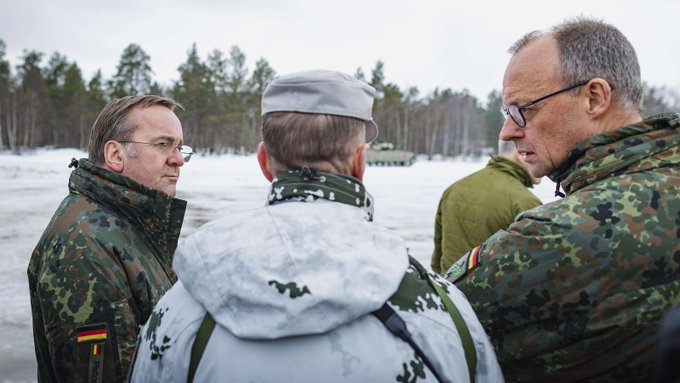
Chancellor Friedrich Merz has made clear that any German contribution would be a post-conflict stabilization effort rather than participation in active hostilities. Berlin envisions a role focused on mine-clearing operations and maritime reconnaissance — capabilities where Germany has traditionally played a leading role within NATO .
“We are ready to contribute to guaranteeing freedom of navigation in the Strait of Hormuz through mine clearance operations and maritime surveillance.” — Friedrich Merz, German Chancellor
The distinction is critical. Germany, like other European NATO allies, refused to join the US-Israeli offensive campaign against Iran that began on February 28. Pistorius compared the current planning to the EU’s Aspides mission in the Red Sea, which began in February 2024 as a response to Houthi attacks on commercial shipping. In that case, pre-positioning German vessels in the theater accelerated the start of the deployment once parliamentary approval was secured .
Parliamentary Approval Required
The deployment cannot proceed without a formal mandate from the German Bundestag. Under Germany’s parliamentary control of armed forces deployments, any mission beyond NATO territory requires explicit legislative approval. The government is expected to seek a mandate once the conditions for a mission are met .
The German parliament has previously approved naval deployments to the Red Sea and the Mediterranean with broad cross-party support. In February 2024, the Bundestag approved participation in the EU’s Aspides mission — which protects shipping in the Red Sea and the Bab el-Mandeb Strait — with 538 votes in favor and only 31 against . Similar support might be expected for a mission to secure the Strait of Hormuz.
Defense officials are confident that the Bundestag could approve the onward deployment of the pre-positioned ships from the Mediterranean to the Gulf “very quickly” once a legal framework and a sustainable ceasefire are in place .
A European-Led Initiative
Germany’s planned contribution comes as part of a broader European-led effort to restore freedom of navigation through the Strait of Hormuz. France and the United Kingdom have been organizing what they describe as a “multinational peaceful mission” designed to be “strictly defensive” and “separate from the warring parties to the conflict” .
The European initiative reflects a growing consensus among NATO’s European members that they must shoulder more responsibility for securing global shipping lanes — even as they refuse to participate directly in the US-led military campaign against Iran.
Logistics and Timing
Pistorius has not provided a timeline for when the ships will depart for the Mediterranean or when they might be cleared to enter the Gulf. The vessels expected to be deployed include a minesweeper and a command and supply vessel — assets specifically suited for post-conflict stabilization rather than offensive operations .
German officials have emphasized that several conditions must be met before a full deployment can occur, including:
- A sustained ceasefire between the US and Iran
- A legal framework under international law
- Approval from the German Bundestag
Whether the current indefinite ceasefire will prove durable enough to allow such a mission remains uncertain. President Donald Trump has extended the truce at Pakistan’s request, but Iran has refused to send a delegation for a second round of peace talks, and Tehran continues to insist that the US naval blockade of Iranian ports must be lifted before any direct negotiations can proceed.
What Comes Next
Germany’s decision to pre-position naval assets reflects a strategic calculation: even if a peace agreement remains distant, the diplomatic window may not stay open forever. By moving ships now, Berlin ensures it will be ready to act if and when conditions allow.
For now, the German ships will wait in the Mediterranean — positioned, but not yet deployed; ready, but not yet authorized. Whether they will eventually sail through the Suez Canal and into the Gulf depends on the course of the ceasefire and the success of the US-Iran peace process.
Frequently Asked Questions (FAQs)
Q1: What ships is Germany sending to the Mediterranean?
According to Defense Minister Pistorius, Germany plans to send a minesweeper and a support vessel (a command and supply ship). Reports have suggested that two minesweepers and one supply vessel may ultimately be involved in the mission .
Q2: Is Germany joining the war against Iran?
No. Germany has consistently refused to join the US-Israeli offensive campaign against Iran. Any German deployment to the Strait of Hormuz would be focused on mine-clearing and maritime surveillance — strictly post-conflict stabilization efforts, not combat operations .
Q3: What approval does Germany need for this mission?
The German Bundestag (parliament) must approve any deployment of armed forces outside NATO territory. The government is expected to seek a mandate once conditions — including a sustained ceasefire and a legal framework — are met .
Q4: Why is Germany moving ships now if no mandate has been approved?
Defense Minister Pistorius said the ships are being pre-positioned “to save time.” Once the Bundestag approves the mission, the German vessels will already be in the Mediterranean, ready to transit to the Gulf without delay. A similar approach was used successfully for the EU’s Aspides mission in the Red Sea .
Q5: What role would Germany play in the Strait of Hormuz?
Germany is expected to contribute mine-clearing capabilities and maritime surveillance. Chancellor Merz has stated that Germany is ready to help “guarantee freedom of navigation” through the strait using these assets .
Q6: Is the ceasefire still in effect?
Yes. President Trump extended the ceasefire at Pakistan’s request. It now has no fixed expiration date but remains fragile. Iran has yet to commit to a second round of peace talks, and the US naval blockade remains in place.
Stay informed with Reflecto News – Your trusted source for breaking defense and geopolitical intelligence. Subscribe for real-time updates on European naval deployments, the Strait of Hormuz crisis, and global security developments.
Questions people ask
What is China's current share of global manufacturing?
China now accounts for twenty eight percent of global manufacturing. This industrial output exceeds the combined manufacturing production of the United States, Japan, and Germany, making China the leading global industrial power according to recent reports.
Why were Andrew Tate and Tristan Tate arrested in Miami?
Andrew Tate and his brother Tristan Tate were taken into custody in Miami by the United States Marshals Service. They face thirty eight new charges in the United Kingdom, including rape and child pornography offences, and prosecutors are seeking their extradition.
What warning did Moscow issue about oil prices?
Kirill Dmitriev, the Chief Executive of the Russian Direct Investment Fund, warned that a tsunami of skyrocketing oil prices is approaching. Moscow describes this potential energy shock as a major threat to global markets.
What political shift is projected for Benjamin Netanyahu's coalition?
Political polls project that Prime Minister Benjamin Netanyahu's coalition is on track to lose its majority in the upcoming October election. This projection indicates a potential political shift in Jerusalem.
Why did a Russian military aircraft land in Tehran?
A Russian airborne command aircraft, widely known as a doomsday plane, landed in Tehran. The arrival of the aircraft represents a high stakes show of support from Russia for Iran during a period of heightened regional tensions.
What did President Masoud Pezeshkian claim about the United States and Israel?
Iranian President Masoud Pezeshkian claimed that the United States and Israel failed in a forty eight hour plan to topple the Iranian government. He made these statements during a televised address marking two years since his inauguration.