Reflecto News is an online news platform covering major international political events, global economic developments, and security conflicts. The site provides updates on topics such as Chinese manufacturing dominance, Middle Eastern political tensions, and high profile legal arrests. Readers can access current articles organized by categories like World News, Iran, and USA.
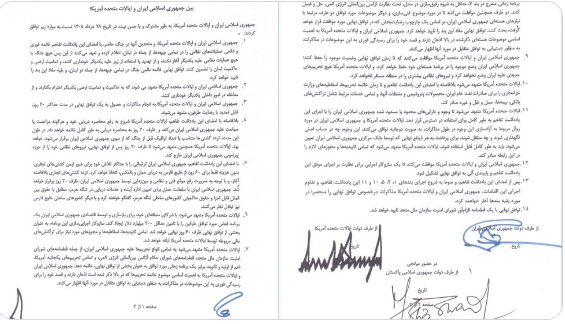
The 14-point “Islamabad Memorandum of Understanding” was published by Iranian President Pezeshkian’s office, revealing President Trump’s digital signature, as the two nations formalize an end to the four-month war .
TEHRAN/WASHINGTON — In a historic diplomatic development, Iranian President Masoud Pezeshkian has released the full text of the memorandum of understanding (MOU) between Iran and the United States, showing the document was digitally signed by both President Pezeshkian and U.S. President Donald Trump .
The release of the 14-point “Islamabad Memorandum of Understanding” marks the first time a U.S. president and an Iranian president have signed a joint accord since the 1979 Islamic Revolution . The document formally ends the military conflict that began with U.S. and Israeli strikes on Iran on February 28 .
The 14-Point Memorandum: Full Text
Below is the complete text of the MOU as released by the Iranian government :
Paragraph 1: The United States of America and the Islamic Republic of Iran and their allies in the current war, by signing this MOU, declare the immediate and permanent termination of military operations on all fronts, including in Lebanon, and undertake from now on not to initiate any war or any military operation against each other, and to refrain (from) the threat or use of force against each other and ensuring the territorial integrity and sovereignty of Lebanon. The final deal will confirm the permanent termination of the war on all fronts, including in Lebanon and other provisions of this paragraph.
Paragraph 2: The United States of America and the Islamic Republic of Iran undertake to respect each other’s sovereignty and territorial integrity and to refrain from interfering in each other’s internal affairs.
Paragraph 3: The United States of America and the Islamic Republic of Iran commit to negotiating and achieving the final deal in maximum 60 days, extendable with mutual consent.
Paragraph 4: Immediately upon the signing of this MoU, the United States of America will begin the removal of its naval blockade and any disturbances or impediments against the Islamic Republic of Iran, and will fully end the naval blockade within 30 days. During this period, the traffic of vessels will be in proportion to the numbers of pre-war traffic being restored by the Islamic Republic of Iran. The United States of America further undertakes to remove its forces from the proximity of the Islamic Republic of Iran within 30 days after the final deal.
Paragraph 5: Upon the signing of this MoU, the Islamic Republic of Iran will make arrangements using its best efforts for the safe passage of commercial vessels with no charge, for 60 days only, from the Persian Gulf to the Sea of Oman and vice versa. The traffic of commercial vessels will immediately start, and considering the need for removing the technical and military obstacles, and demining by the Islamic Republic of Iran will be instated within 30 days. The Islamic Republic of Iran will conduct dialog with the Sultanate of Oman to define the future administration and maritime services in the Strait of Hormuz in discussion with other Persian Gulf littoral states in line with the applicable international law and the sovereign rights of coastal states of the Strait of Hormuz.
Paragraph 6: The United States of America undertakes with regional partners to develop a definitive, mutually agreed plan with at least USD 300 billion for the reconstruction and economic development of the Islamic Republic of Iran. The mechanism for the implementation of this plan will be finalized as part of a final deal within 60 days. All required licences, waivers and permissions needed for the relevant financial transactions will be granted by the United States of America.
Paragraph 7: The United States of America undertakes to terminate all types of sanctions against the Islamic Republic of Iran, including the United Nations Security Council resolutions, IAEA Board of Governors resolutions, and all unilateral US sanctions, primary and secondary, in an agreed upon schedule as part of the final deal.
Paragraph 8: The Islamic Republic of Iran reaffirms that it shall not procure or develop nuclear weapons. The United States of America and the Islamic Republic of Iran have agreed to resolve the disposition of stockpiled enriched material pursuant to a mechanism that will be mutually agreed upon in accordance with the schedule mentioned in paragraph seven, with the minimum methodology to be down blended on site under the supervision of the IAEA. The two parties also agreed to discuss the issue of enrichment and other mutually agreed matters related to the Islamic Republic of Iran’s nuclear needs, based on a satisfactory framework being agreed upon in the final deal.
Paragraph 9: Pending the final deal, the United States of America and the Islamic Republic of Iran agree to maintain the status quo. The Islamic Republic of Iran will maintain the current status quo of its nuclear programme, and the United States of America will not impose any new sanctions and will not deploy additional forces in the region.
Paragraph 10: The United States of America undertakes that immediately upon the signing of this MoU and until the termination of sanctions, US Department of Treasury will issue waivers for the export of Iranian crude oil, petroleum products and derivatives, and all associated services, including banking transactions, insurances, transportation, etc.
Paragraph 11: The United States of America undertakes to make fully available for use the frozen or restricted funds and assets of the Islamic Republic of Iran upon the implementation of this MoU. The United States of America and the Islamic Republic of Iran will mutually agree on the procedures related to the release of these funds during negotiations. Such funds, whether retained in the original account or transferred, shall be made fully usable for payment to any ultimate beneficiary designated by the Central Bank of the Islamic Republic of Iran.
Paragraph 12: The United States of America and the Islamic Republic of Iran agree that an executive mechanism will be established to monitor the successful implementation of this MoU and the future compliance of the final deal.
Paragraph 13: After signing this MoU, and subject to the beginning of the implementation of paragraphs 1, 4, 5, 10 and 11 of this MoU, and the continuing implementation of these measures, the United States of America and the Islamic Republic of Iran will start negotiations regarding the final deal exclusively on the other paragraphs.
Paragraph 14: The final deal will be endorsed by a binding UNSC resolution .
Key Provisions and Analysis
Nuclear Commitments
Under the agreement, Iran has reaffirmed that it “shall not procure or develop nuclear weapons” . The MOU commits both sides to resolving the fate of Iran’s stockpile of enriched material “pursuant to a mechanism that will be mutually agreed upon,” with “the minimum methodology to be down blended on site under the supervision of the IAEA” .
However, the nuclear issue is not fully resolved. The agreement leaves broader questions about Iran’s nuclear program—including the future of uranium enrichment—to 60 days of follow-on negotiations .
Strait of Hormuz and Maritime Provisions
The agreement provides for the immediate reopening of the Strait of Hormuz, with commercial vessel traffic to begin immediately and full capacity restored within 30 days . Iran agreed to waive tolls on commercial vessels for 60 days .
However, the document does not permanently settle the fate of the Strait. It calls for Iran to conduct “dialog with the Sultanate of Oman to define the future administration and maritime services in the Strait of Hormuz in discussion with other Persian Gulf littoral states” .
Economic Provisions: Sanctions, Assets, and Reconstruction
The MOU includes several major economic commitments from the United States :
- Immediate sanctions waivers for Iranian oil exports and associated services
- Unfreezing of Iranian assets held abroad
- US commitment to work with regional partners to establish a plan worth “at least USD 300 billion” for Iran’s reconstruction and economic development
Critics have noted that this represents significant economic concessions from Washington . As one analysis noted, “the U.S. first offered key negotiation cards, including sanctions relief, unfreezing of assets, and permission for crude oil exports, while Iran merely verbally promised to abandon nuclear weapons development” .
What’s Not Included
The MOU notably omits provisions addressing Iran’s ballistic missile program or its support for regional proxy groups . These issues were initially listed by the Trump administration as key objectives .
President Trump has signaled openness to Iran retaining some missile capabilities. At the G7 summit, he stated: “If Saudi Arabia and Qatar, and they all have some, I would say in relative proportion, I think it’s okay” for Iran to have ballistic missiles .
Reactions and Next Steps
The agreement has sparked sharp reactions in Washington. Republican Senator Bill Cassidy called it the “worst foreign policy blunder in decades,” while others praised Trump for ending the war .
Negotiations on the final agreement are expected to begin in Switzerland, though plans for a formal signing ceremony on Friday were postponed . The two sides have 60 days to negotiate the final terms, which must be endorsed by a binding UN Security Council resolution .
This is a developing story. Reflecto News will continue to provide updates on the implementation of the U.S.-Iran peace agreement and the 60-day negotiations in Switzerland.
Questions people ask
What is China's current share of global manufacturing?
China now accounts for twenty eight percent of global manufacturing. This industrial output exceeds the combined manufacturing production of the United States, Japan, and Germany, making China the leading global industrial power according to recent reports.
Why were Andrew Tate and Tristan Tate arrested in Miami?
Andrew Tate and his brother Tristan Tate were taken into custody in Miami by the United States Marshals Service. They face thirty eight new charges in the United Kingdom, including rape and child pornography offences, and prosecutors are seeking their extradition.
What warning did Moscow issue about oil prices?
Kirill Dmitriev, the Chief Executive of the Russian Direct Investment Fund, warned that a tsunami of skyrocketing oil prices is approaching. Moscow describes this potential energy shock as a major threat to global markets.
What political shift is projected for Benjamin Netanyahu's coalition?
Political polls project that Prime Minister Benjamin Netanyahu's coalition is on track to lose its majority in the upcoming October election. This projection indicates a potential political shift in Jerusalem.
Why did a Russian military aircraft land in Tehran?
A Russian airborne command aircraft, widely known as a doomsday plane, landed in Tehran. The arrival of the aircraft represents a high stakes show of support from Russia for Iran during a period of heightened regional tensions.
What did President Masoud Pezeshkian claim about the United States and Israel?
Iranian President Masoud Pezeshkian claimed that the United States and Israel failed in a forty eight hour plan to topple the Iranian government. He made these statements during a televised address marking two years since his inauguration.