Reflecto News is an online news platform covering major international political events, global economic developments, and security conflicts. The site provides updates on topics such as Chinese manufacturing dominance, Middle Eastern political tensions, and high profile legal arrests. Readers can access current articles organized by categories like World News, Iran, and USA.
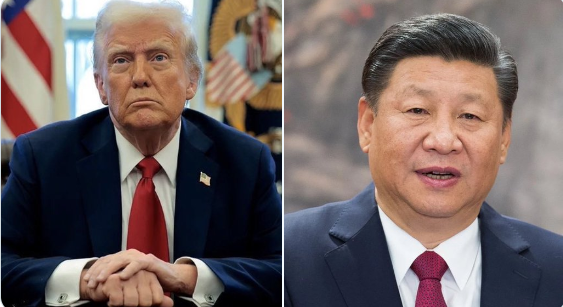
WASHINGTON D.C. — In a sharp display of political theater following a major legal setback, President Donald Trump took to his Truth Social platform late Tuesday to issue a stinging, sarcastic congratulatory message to Chinese President Xi Jinping. The President lauded Xi and the “Great Country of China” on what he termed a “massive Birthright Citizenship WIN.”
The jab comes just hours after the U.S. Supreme Court issued a landmark 6-3 ruling in Trump v. Barbara, decisively striking down President Trump’s executive order that sought to deny automatic citizenship to children born in the United States to undocumented immigrants or temporary foreign residents.
The Context of the Remark: A Legal Defeat
On the final day of its term, the Supreme Court rejected the administration’s attempt to unilaterally narrow the scope of the 14th Amendment’s Citizenship Clause. Chief Justice John Roberts, writing for the majority, emphasized that the court’s decision is anchored in a long-settled understanding of the Constitution, reinforced by the historic 1898 ruling in United States v. Wong Kim Ark.
That foundational case—which centered on a man born in San Francisco to Chinese immigrant parents—established that anyone born on U.S. soil, with very limited exceptions (such as children of foreign diplomats), is automatically an American citizen.
President Trump’s choice to specifically single out President Xi Jinping and China is rooted in his long-standing grievance regarding “birth tourism.” For years, the President has alleged that wealthy foreign nationals, including those from China, exploit American birthright citizenship laws by traveling to the U.S. temporarily for the sole purpose of giving birth, thereby securing U.S. passports for their children.
The President’s Next Steps
Despite the high court’s definitive ruling on constitutional grounds, President Trump signaled that his fight against birthright citizenship is far from over. In a follow-up message on Truth Social, he urged Congress to bypass the court’s decision through swift legislative action:
“The Supreme Court upheld Birthright Citizenship, which is too bad for our Country, but we can easily make it up in Congress through Legislation, with the support of the President, that has now been determined during this process. No long and unwieldy Constitutional Amendment is necessary! Congress should start TODAY to work on ending expensive and unfair to our Country, Birthright Citizenship. They will have my Complete and Total Support!”
A Divided Court
While the ruling was 6-3, it featured a complex breakdown among the justices. Chief Justice Roberts was joined by Justice Amy Coney Barrett and the court’s three liberal justices in affirming that the 14th Amendment’s promise extends to “every free-born person in this land.”
Justice Brett Kavanaugh sided with the majority on the outcome but disagreed with the constitutional reasoning, suggesting instead that a federal statute conveys this right—an opinion that legal scholars note could potentially leave a narrow door open for a future Congress to alter the law. Justices Clarence Thomas, Samuel Alito, and Neil Gorsuch dissented, indicating they would have upheld the President’s executive order.
Frequently Asked Questions (FAQs)
Q: Did China change its own citizenship policies in response?
A: No. China’s nationality law remains strictly governed by the principle of jus sanguinis (right of blood), meaning citizenship is primarily determined by parentage rather than place of birth. There have been no recent shifts in Beijing’s policy; Trump’s comment was a rhetorical jab at the U.S. Supreme Court’s adherence to jus soli (right of the soil).
Q: What is the historical significance of the Wong Kim Ark case mentioned by the court?
A: Decided in 1898, United States v. Wong Kim Ark is the bedrock precedent for American birthright citizenship. It ruled that the 14th Amendment’s Citizenship Clause must be interpreted broadly to include children born in the U.S. to non-citizen parents, preventing the government from denying them citizenship based on their ancestry.
Q: What are the real-world demographics of “birth tourism” in the U.S.?
A: According to data from the Pew Research Center, roughly one-third of all children born to foreign-born mothers in the U.S. have mothers from Mexico. China and India follow as the next most common countries of origin, accounting for approximately 5% each.
Q: Can Congress actually end birthright citizenship through simple legislation?
A: Highly unlikely. Because the Supreme Court majority explicitly grounded its decision in the 14th Amendment of the Constitution, a simple act of Congress would be insufficient to override it. Modifying or repealing a constitutional guarantee would require a formal Constitutional Amendment, which must pass with a two-thirds majority in both the House and Senate and be ratified by three-fourths of the states.
Breakdown of the Supreme Court Vote
| Judicial Stance | Justices | Legal Basis |
| Majority Opinion | John Roberts, Amy Coney Barrett, Elena Kagan, Sonia Sotomayor, Ketanji Brown Jackson | 14th Amendment and Wong Kim Ark precedent |
| Concurring in Judgment | Brett Kavanaugh | Federal statute rather than the Constitution |
| Dissenting | Clarence Thomas, Samuel Alito, Neil Gorsuch | Would have upheld the President’s executive order |
Reflecto News will continue to monitor the legislative response on Capitol Hill and provide updates on any proposed bills aimed at addressing the President’s call to action.
Questions people ask
What is China's current share of global manufacturing?
China now accounts for twenty eight percent of global manufacturing. This industrial output exceeds the combined manufacturing production of the United States, Japan, and Germany, making China the leading global industrial power according to recent reports.
Why were Andrew Tate and Tristan Tate arrested in Miami?
Andrew Tate and his brother Tristan Tate were taken into custody in Miami by the United States Marshals Service. They face thirty eight new charges in the United Kingdom, including rape and child pornography offences, and prosecutors are seeking their extradition.
What warning did Moscow issue about oil prices?
Kirill Dmitriev, the Chief Executive of the Russian Direct Investment Fund, warned that a tsunami of skyrocketing oil prices is approaching. Moscow describes this potential energy shock as a major threat to global markets.
What political shift is projected for Benjamin Netanyahu's coalition?
Political polls project that Prime Minister Benjamin Netanyahu's coalition is on track to lose its majority in the upcoming October election. This projection indicates a potential political shift in Jerusalem.
Why did a Russian military aircraft land in Tehran?
A Russian airborne command aircraft, widely known as a doomsday plane, landed in Tehran. The arrival of the aircraft represents a high stakes show of support from Russia for Iran during a period of heightened regional tensions.
What did President Masoud Pezeshkian claim about the United States and Israel?
Iranian President Masoud Pezeshkian claimed that the United States and Israel failed in a forty eight hour plan to topple the Iranian government. He made these statements during a televised address marking two years since his inauguration.