Reflecto News is an online news platform covering major international political events, global economic developments, and security conflicts. The site provides updates on topics such as Chinese manufacturing dominance, Middle Eastern political tensions, and high profile legal arrests. Readers can access current articles organized by categories like World News, Iran, and USA.
By Reflecto News Desk
April 6, 2026
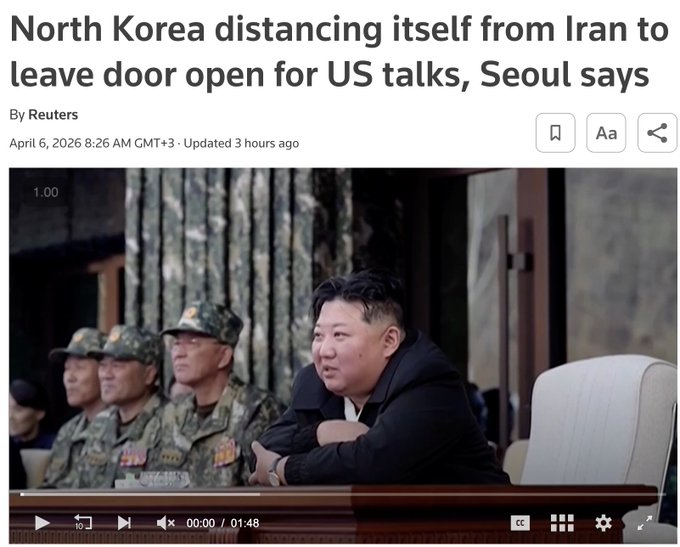
North Korea is carefully distancing itself from longtime partner Iran during the ongoing U.S.-Israel-Iran conflict, refraining from military aid and limiting public support, in what South Korean intelligence interprets as an effort to keep open the possibility of improved relations with the United States, according to a briefing by Seoul’s National Intelligence Service (NIS).
Lawmakers who attended a closed-door NIS briefing told reporters that Pyongyang has provided no weapons or supplies to Iran since the conflict began on February 28, 2026. North Korea also issued no public condolences following the death of Supreme Leader Ayatollah Ali Khamenei in U.S.-Israeli airstrikes and sent no formal message recognizing his son Mojtaba Khamenei as the new leader.
Public statements from Pyongyang have been notably restrained and toned down, avoiding direct criticism of President Donald Trump or strong endorsements of Iran’s position.
North Korean leader Kim Jong-un (file image).
Key Indicators of North Korea’s Restraint
- No Military Support: Despite longstanding ties and past cooperation in missile and military technology, North Korea has not supplied arms or materiel to Iran, according to South Korean assessments.
- Limited Diplomatic Messaging: Pyongyang has avoided high-profile gestures of solidarity, such as condolences for Khamenei or strong public backing for Mojtaba Khamenei’s succession. Any statements have remained minimal and neutral in tone.
- Positive Signals Toward the U.S.: Kim Jong-un has reportedly stated there is “no reason [we] cannot get along well with the U.S.,” a remark South Korean officials view as a deliberate signal aimed at keeping diplomatic channels viable, particularly ahead of a potential Trump-Xi summit.
The NIS assessed this behavior as preparation to “secure new diplomatic space” once the Middle East conflict subsides, allowing North Korea greater flexibility in future negotiations with Washington.
Strategic Calculus Behind Pyongyang’s Approach
Analysts note that North Korea faces intense economic pressure and is navigating a complex international environment. By avoiding deeper entanglement with Iran — a key member of the so-called “Axis of Resistance” — Pyongyang may be positioning itself to exploit any post-conflict openings with the Trump administration, which has previously engaged in direct talks with Kim.
This restraint contrasts with North Korea’s usual rhetorical support for anti-U.S. partners. It also comes amid ongoing North Korean military cooperation with Russia in the Ukraine conflict, highlighting selective alignment based on strategic interests.
South Korean lawmakers described the moves as pragmatic realpolitik, aimed at preserving leverage and avoiding isolation as global dynamics shift.
Broader Context
The assessment emerges against the backdrop of the escalating U.S.-led Operation Epic Fury against Iran, which has included strikes on Iranian leadership targets, energy infrastructure, and military sites. North Korea’s muted response stands out given its history of missile technology exchanges and ideological alignment with Tehran.
U.S. officials have not publicly commented on the South Korean intelligence assessment, but the Trump administration has maintained a mix of pressure and openness to dialogue with Pyongyang on denuclearization and other issues.
Reflecto News will continue monitoring developments in North Korea-Iran relations, any shifts in Pyongyang’s public stance, and reactions from Seoul, Washington, and Beijing. For accurate, timely coverage of the Korean Peninsula, U.S.-North Korea dynamics, and related geopolitical shifts, bookmark Reflecto News and follow our dedicated Asia section.
Questions people ask
What is China's current share of global manufacturing?
China now accounts for twenty eight percent of global manufacturing. This industrial output exceeds the combined manufacturing production of the United States, Japan, and Germany, making China the leading global industrial power according to recent reports.
Why were Andrew Tate and Tristan Tate arrested in Miami?
Andrew Tate and his brother Tristan Tate were taken into custody in Miami by the United States Marshals Service. They face thirty eight new charges in the United Kingdom, including rape and child pornography offences, and prosecutors are seeking their extradition.
What warning did Moscow issue about oil prices?
Kirill Dmitriev, the Chief Executive of the Russian Direct Investment Fund, warned that a tsunami of skyrocketing oil prices is approaching. Moscow describes this potential energy shock as a major threat to global markets.
What political shift is projected for Benjamin Netanyahu's coalition?
Political polls project that Prime Minister Benjamin Netanyahu's coalition is on track to lose its majority in the upcoming October election. This projection indicates a potential political shift in Jerusalem.
Why did a Russian military aircraft land in Tehran?
A Russian airborne command aircraft, widely known as a doomsday plane, landed in Tehran. The arrival of the aircraft represents a high stakes show of support from Russia for Iran during a period of heightened regional tensions.
What did President Masoud Pezeshkian claim about the United States and Israel?
Iranian President Masoud Pezeshkian claimed that the United States and Israel failed in a forty eight hour plan to topple the Iranian government. He made these statements during a televised address marking two years since his inauguration.