Reflecto News is an online news platform covering major international political events, global economic developments, and security conflicts. The site provides updates on topics such as Chinese manufacturing dominance, Middle Eastern political tensions, and high profile legal arrests. Readers can access current articles organized by categories like World News, Iran, and USA.
Reflecto News | Breaking News | Israeli Politics
TEL AVIV — Former Israeli prime ministers Naftali Bennett and Yair Lapid will officially announce the merger of their political parties this evening, forming a unified list under Bennett’s leadership in a dramatic attempt to challenge Prime Minister Benjamin Netanyahu’s Likud in the upcoming elections .
The agreement, finalized on Saturday night, brings together Lapid’s centrist Yesh Atid party and Bennett’s Bennett 2026 movement into a single unified party. The announcement is scheduled for a press conference in Tel Aviv .
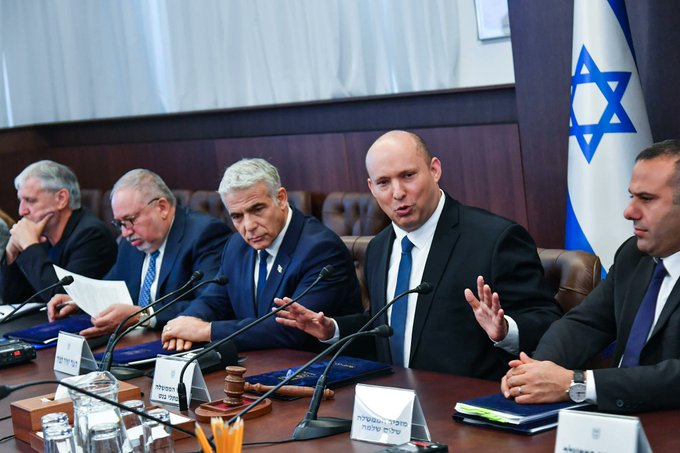
A Strategic Alliance to End Opposition Infighting
According to a statement released by Bennett’s office, the move represents “the first step in the process of healing the State of Israel” and is designed to consolidate what the parties describe as the “reform bloc” .
“This move unites the ‘reform bloc,’ puts an end to internal infighting, and allows for all efforts to be invested toward a decisive victory in the upcoming elections and to lead Israel toward the necessary reform.”
— Naftali Bennett’s office
Lapid, who currently serves as Opposition Leader, has reportedly concluded that in order to defeat Netanyahu, the opposition bloc must unite behind Bennett — a right-wing figure who is nevertheless viewed by Lapid as a liberal and law-abiding leader capable of attracting broad support .
The two leaders previously worked together during the 2021-2022 power-sharing government, in which Bennett served as prime minister for the first half of the term before Lapid took over .
Polling Data: A Competitive Race Against Netanyahu
Recent polling suggests that the Bennett-Lapid merger could substantially reshape Israel’s political landscape.
A Maariv poll cited by both leaders shows Bennett’s party tied with Netanyahu’s Likud, each securing 24 Knesset seats. Under the new arrangement, Lapid’s Yesh Atid — which was polling at just 7 seats — will be absorbed into the larger Bennett-led list .
Channel 12 polling has shown Bennett leading other opposition figures by significant margins, with a head-to-head matchup between Bennett and Netanyahu showing the two tied at 40% each .
The merger effectively consolidates the center-right opposition under a single banner, potentially eliminating vote-splitting that has benefited Netanyahu’s ruling coalition in previous elections .
Door Remains Open for Gadi Eisenkot
While the Bennett-Lapid merger is now confirmed, a third opposition leader — former IDF Chief of Staff Gadi Eisenkot — may yet join the unified slate.
An opposition source with knowledge of the negotiations told The Times of Israel that Eisenkot remains a welcome addition to the alliance .
“The deal was finalized on Saturday night. The door’s definitely open for Gadi Eisenkot to join. Gadi’s a good guy. He could be a central player in this and he’s the one that called for the three-way joining of the parties.”
— Opposition source
Eisenkot heads the Yashar party and has been in negotiations with both Bennett and Lapid in recent weeks. Reports indicate that representatives for all three men had been discussing a potential joint party called “New Israel” . However, intensive negotiations over the weekend resulted in Bennett and Lapid finalizing their agreement first, with Eisenkot reportedly invited to take second place on the unified list .
Historical Context: The 2021-2022 Coalition Government
The political partnership between Bennett and Lapid is not without precedent. Between June 2021 and December 2022, the two led a diverse coalition government that included right-wing, centrist, and left-wing parties, as well as the Arab Ra’am party .
That government, which ousted Netanyahu after 12 consecutive years in power, was the first in Israeli history to include an Arab party as a formal member of the ruling coalition. However, internal fractures led to its collapse in late 2022, paving the way for Netanyahu’s return to power .
Bennett has reportedly learned from the experience of his previous government, which fell apart due to defections from within his own Yamina faction. He is now focused on building a cohesive team of “doers” rather than political influencers — emphasizing governance competence over celebrity appeal .
Upcoming Elections and Political Implications
Israel’s next Knesset elections are required to take place by October 27, 2026, when all 120 seats will be renewed . The Bennett-Lapid merger immediately reshapes the opposition landscape and raises the stakes for Netanyahu’s ruling coalition.
| Party/Alliance | Recent Polling | Status |
|---|---|---|
| Likud (Netanyahu) | 24-25 seats | Incumbent ruling party |
| United Bennett-Lapid List | ~24 seats (combined) | Newly merged opposition |
| Yashar (Eisenkot) | ~16 seats (if separate) | Invited to join |
| Other opposition parties | Various | Remain fragmented |
The merger is expected to create a “sense of hope” among opposition voters, according to an opposition source, who compared the move to opposition unity campaigns that have succeeded in other countries, such as Hungary .
However, even if the combined Bennett-Lapid list — and potentially Eisenkot — becomes the largest single faction in the Knesset, it may still fall short of the 61-seat majority needed to form a government, requiring further coalition negotiations with other opposition and centrist parties .
Frequently Asked Questions (FAQs)
Q1: Who will lead the new joint party?
The unified party will be led by former prime minister Naftali Bennett. Yair Lapid will serve as the number two on the list, under Bennett’s leadership .
Q2: When will the official announcement take place?
The official announcement is scheduled for Sunday evening, April 26, 2026, at a press conference in Tel Aviv .
Q3: Will Gadi Eisenkot join the alliance?
The door remains open for Yashar party leader Gadi Eisenkot to join the unified slate. He has been invited to take a senior position on the joint list, though no final agreement has been announced .
Q4: Why did Bennett and Lapid decide to merge?
The merger is aimed at ending internal opposition infighting, consolidating the “reform bloc,” and focusing resources on a decisive victory against Prime Minister Benjamin Netanyahu’s Likud party in the upcoming elections .
Q5: When will the Israeli elections take place?
The next Knesset elections must be held no later than October 27, 2026 .
Q6: How have polls responded to the potential merger?
Recent polls show that a united Bennett-Lapid list could match or exceed Likud’s seat total, potentially becoming the largest faction in the Knesset. A separate poll indicated that if Eisenkot were to join as well, the combined list would receive 38 seats — the largest in parliament .
Q7: Have Bennett and Lapid worked together before?
Yes. Bennett and Lapid led a power-sharing coalition government from June 2021 to December 2022, with Bennett serving as prime minister for the first 18 months before Lapid took over .
Q8. What is the political significance of this merger?
The merger consolidates the center-right opposition, eliminates vote-splitting between two major anti-Netanyahu figures, and creates a clear alternative to the Likud-led coalition ahead of the October elections .
Key Takeaways for Reflecto News Readers
| Aspect | Summary |
|---|---|
| Announcement | Bennett and Lapid to merge parties under Bennett’s leadership |
| Date | Official announcement: April 26, 2026 |
| Parties involved | Yesh Atid (Lapid) + Bennett 2026 (Bennett) |
| Potential addition | Yashar party (Gadi Eisenkot) invited to join |
| Polling impact | Combined list could tie or surpass Likud (24 seats each in recent poll) |
| Election deadline | October 27, 2026 |
| Historical context | Reunites leaders of 2021-2022 “change government” |
| Primary goal | End opposition infighting; defeat Netanyahu |
Sources and Further Reading
Reflecto News has compiled this report from verified sources including The Times of Israel, The Jerusalem Post, Israel Hayom, Ynetnews, and other international news outlets covering Israeli politics. All information is accurate as of publication.
Follow Reflecto News for continuous updates on Israeli elections, political developments in the Middle East, and all breaking news from around the world.
This article is the intellectual property of Reflecto News. Redistribution without attribution is prohibited. For syndication or media inquiries, please contact the editorial team.
Questions people ask
What is China's current share of global manufacturing?
China now accounts for twenty eight percent of global manufacturing. This industrial output exceeds the combined manufacturing production of the United States, Japan, and Germany, making China the leading global industrial power according to recent reports.
Why were Andrew Tate and Tristan Tate arrested in Miami?
Andrew Tate and his brother Tristan Tate were taken into custody in Miami by the United States Marshals Service. They face thirty eight new charges in the United Kingdom, including rape and child pornography offences, and prosecutors are seeking their extradition.
What warning did Moscow issue about oil prices?
Kirill Dmitriev, the Chief Executive of the Russian Direct Investment Fund, warned that a tsunami of skyrocketing oil prices is approaching. Moscow describes this potential energy shock as a major threat to global markets.
What political shift is projected for Benjamin Netanyahu's coalition?
Political polls project that Prime Minister Benjamin Netanyahu's coalition is on track to lose its majority in the upcoming October election. This projection indicates a potential political shift in Jerusalem.
Why did a Russian military aircraft land in Tehran?
A Russian airborne command aircraft, widely known as a doomsday plane, landed in Tehran. The arrival of the aircraft represents a high stakes show of support from Russia for Iran during a period of heightened regional tensions.
What did President Masoud Pezeshkian claim about the United States and Israel?
Iranian President Masoud Pezeshkian claimed that the United States and Israel failed in a forty eight hour plan to topple the Iranian government. He made these statements during a televised address marking two years since his inauguration.