Reflecto News is an online news platform covering major international political events, global economic developments, and security conflicts. The site provides updates on topics such as Chinese manufacturing dominance, Middle Eastern political tensions, and high profile legal arrests. Readers can access current articles organized by categories like World News, Iran, and USA.
Reflecto News | Trade & Economy | International Affairs
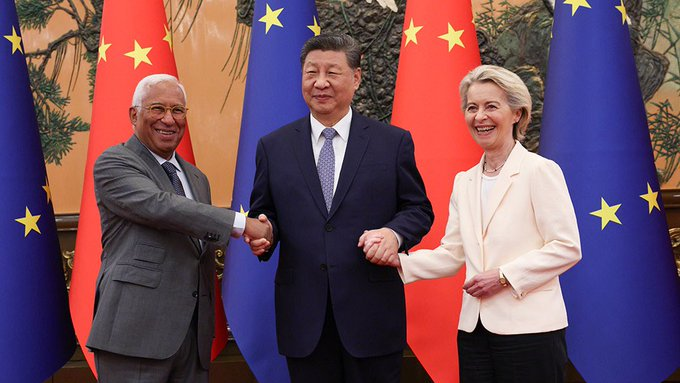
BEIJING — China has issued a formal warning to the European Union, threatening countermeasures if the bloc proceeds with its proposed “Made in Europe” legislation, which Beijing claims is protectionist and violates international trade rules .
The threat, delivered by China’s Ministry of Commerce, escalates tensions between two of the world’s largest economies as the EU seeks to shield its strategic industries—including electric vehicles (EVs), green technology and steel—from foreign competition .
🔥 What the ‘Made in Europe’ Plan Entails
The EU proposal, formally known as the “Industrial Accelerator Act” (IAA) , was unveiled in March 2026. It aims to boost the bloc’s competitiveness by requiring companies accessing public funds in key sectors to meet minimum thresholds for locally made parts .
| Aspect | Details |
|---|---|
| Official Name | Industrial Accelerator Act (IAA) |
| Target Sectors | Electric vehicles (EVs), batteries, green technology, steel, photovoltaics, critical raw materials |
| Key Provisions | Local content quotas for EU-made parts; technology transfer requirements; restrictions on foreign investment in strategic sectors |
| Stated EU Goal | Regain competitive edge, reduce industrial decline and prevent job losses |
The proposal also implicitly targets Chinese manufacturers by requiring foreign firms to establish joint ventures with European partners and share technological know-how to operate in the bloc . The Chinese Chamber of Commerce to the EU has described the plan as a shift towards “discrimination” and “protectionism” .
🇨🇳 China’s Formal Objections & ‘Serious Concerns’
In a formal submission to the European Commission on Friday, April 24, China’s Ministry of Commerce outlined several allegations regarding the draft legislation .
China’s legal arguments against the bill:
- WTO Violations: China argues that the rules violate the General Agreement on Tariffs and Trade (GATT) 1994, as well as agreements on investment measures, intellectual property and subsidies
- Discriminatory Treatment: The text claims the Act imposes ‘institutional discrimination’ against foreign investors, favoring EU-made products while harming fair competition
- Forced Technology Transfer: Beijing accuses the EU of overstepping intellectual property norms by requiring the handover of proprietary tech to local partners
- Investment Chill: The Commerce Ministry stated that these restrictions seriously impact Chinese firms’ expectations for investing in Europe
“The Act imposes multiple restrictive requirements on foreign investment in four strategic emerging industries—batteries, electric vehicles, photovoltaics and critical raw materials—and includes exclusionary EU origin clauses in public procurement and public support policies.” — Chinese Ministry of Commerce Spokesperson
⚔️ The Threat of Countermeasures
While Beijing has expressed willingness to engage in dialogue, it has also issued a clear ultimatum. The Ministry of Commerce stated that if the EU presses ahead with the legislation and harms the interests of Chinese enterprises, “China will have no choice but to take countermeasures to firmly safeguard the legitimate rights and interests of its enterprises” .
Although the specific nature of these countermeasures remains unspecified, analysts anticipate potential actions could include:
- Tariffs on European goods (such as cars, wine or agricultural products)
- Restrictions on European investments in China
- Anti-dumping investigations targeting EU industries
- Reduced procurement of European services or products
🌍 Broader Trade Context: An Escalating Trend
The warning over the Industrial Accelerator Act is the latest flashpoint in a broader trade conflict.
The EU has previously taken China to the World Trade Organization (WTO) over alleged unfair patent licensing rules, accusing Beijing of setting artificially low global royalty rates for European high-tech patents . The WTO recently agreed to establish a dispute panel to hear that case .
These disputes highlight a growing divergence in economic strategy: the EU is pivoting toward economic security and strategic autonomy, while China is pushing back against what it perceives as Western containment policies aimed at slowing its technological rise. The outcome will be crucial for the future of the green energy transition and the global automotive industry .
🔮 What Happens Next?
| Step | Timeline/Possibility |
|---|---|
| Legislative Process | Proposal currently stalled due to internal disagreements among EU members |
| Diplomatic Talks | China offers dialogue; EU is reviewing Beijing’s submitted comments |
| Potential Retaliation | High – if EU passes the Act, countermeasures are “certain” according to MOFCOM |
| Global Impact | Could disrupt EV supply chains and escalate into a broader trade war |
For now, the ball is in the EU’s court. As the debate over the Industrial Accelerator Act continues, European companies remain divided—some fear losing access to the lucrative Chinese market, while others have long complained about unfair competition from state-subsidized Chinese rivals .
Frequently Asked Questions (FAQs)
Q1. Why is China threatening retaliation against the EU?
China claims the EU’s “Industrial Accelerator Act” (also called the “Made in Europe” plan) imposes systemic discrimination against foreign investors, requiring local manufacturing quotas and forced technology transfers that violate WTO rules .
Q2. What sectors will be affected by the “Made in Europe” rules?
The rules target strategic sectors including batteries, electric vehicles (EVs), photovoltaics, green technology, steel and critical raw materials .
Q3. Has any action been taken yet?
China submitted a formal complaint to the European Commission on April 24, 2026, expressing “serious concerns.” The Chinese Ministry of Commerce has vowed to take countermeasures if the bloc passes the legislation .
Q4. Is the EU targeting China specifically?
While the rules are not explicitly named against China, they require local content thresholds that are difficult for foreign—particularly Chinese—firms to meet without moving production to Europe .
Key Takeaways for Reflecto News Readers
| Aspect | Summary |
|---|---|
| China’s Stance | Vows “countermeasures” if EU passes “Made in Europe” rules |
| Core Dispute | Local content quotas, technology transfer rules, public procurement restrictions |
| Legal Basis | China cites violations of WTO (GATT), national treatment, and most-favored-nation principles |
| Status Quo | EU proposal (Industrial Accelerator Act) stalled but advancing |
| Affected Sectors | EVs, batteries, green tech, steel, photovoltaics, critical raw materials |
| Potential Retaliation | Tariffs, investment restrictions, anti-dumping probes |
| Next Steps | Dialogue offer; countermeasures threat looms |
Follow Reflecto News for continuous updates on EU-China trade relations, tariff wars, and global supply chain shifts.
This article is the intellectual property of Reflecto News. Redistribution without attribution is prohibited. For syndication or media inquiries, please contact the editorial team.
Questions people ask
What is China's current share of global manufacturing?
China now accounts for twenty eight percent of global manufacturing. This industrial output exceeds the combined manufacturing production of the United States, Japan, and Germany, making China the leading global industrial power according to recent reports.
Why were Andrew Tate and Tristan Tate arrested in Miami?
Andrew Tate and his brother Tristan Tate were taken into custody in Miami by the United States Marshals Service. They face thirty eight new charges in the United Kingdom, including rape and child pornography offences, and prosecutors are seeking their extradition.
What warning did Moscow issue about oil prices?
Kirill Dmitriev, the Chief Executive of the Russian Direct Investment Fund, warned that a tsunami of skyrocketing oil prices is approaching. Moscow describes this potential energy shock as a major threat to global markets.
What political shift is projected for Benjamin Netanyahu's coalition?
Political polls project that Prime Minister Benjamin Netanyahu's coalition is on track to lose its majority in the upcoming October election. This projection indicates a potential political shift in Jerusalem.
Why did a Russian military aircraft land in Tehran?
A Russian airborne command aircraft, widely known as a doomsday plane, landed in Tehran. The arrival of the aircraft represents a high stakes show of support from Russia for Iran during a period of heightened regional tensions.
What did President Masoud Pezeshkian claim about the United States and Israel?
Iranian President Masoud Pezeshkian claimed that the United States and Israel failed in a forty eight hour plan to topple the Iranian government. He made these statements during a televised address marking two years since his inauguration.