📸 Satellite Imagery Shows Over 40 IRGC Speedboats in Formation Near Qeshm Island
Reflecto News | Breaking News | Iran-US Tensions
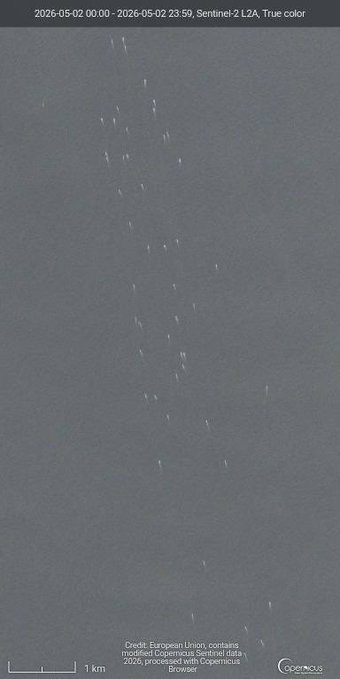
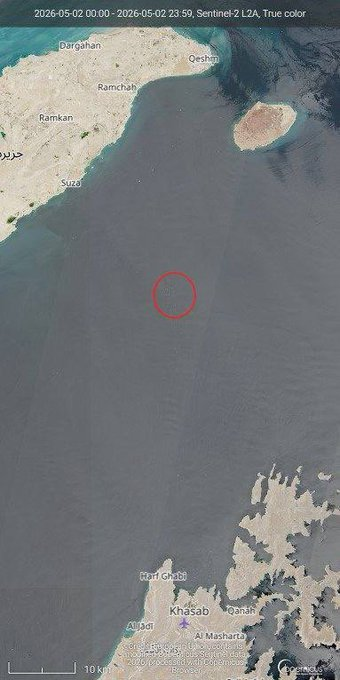
QESHM ISLAND, Strait of Hormuz — Recent satellite imagery has captured an unusual and significant deployment of more than 40 Islamic Revolutionary Guard Corps (IRGC) fast-attack speedboats moving in formation near Qeshm Island, just days after a fragile ceasefire halted direct US-Iranian hostilities but failed to ease tensions in the strategic waterway .
The deployment, which occurred in recent hours, underscores that while Iran’s conventional navy has been largely destroyed by US-Israeli strikes during the two-month war, the IRGC’s so-called “mosquito fleet” of small, agile boats remains a potent and credible threat to commercial and military shipping .
🚤 ‘Mosquito Fleet’ Remains a Key Asymmetric Weapon
The IRGC’s naval forces operate as a “guerrilla force at sea,” experts say—eschewing traditional battleships for hundreds of small, high-speed vessels that can be hidden in caves along the coast and deployed within minutes .
According to a recent analysis by the AP and confirmed by Gen. Dan Caine, chairman of the Joint Chiefs of Staff, while more than 90% of Iran’s regular navy now sits at the bottom of the ocean, the IRGC has retained an estimated 50% of its fleet of fast-attack boats—a force of up to 1,500 small vessels .
“The IRGC’s navy operates more like a guerrilla force at sea. It focuses on asymmetric warfare and hit-and-run tactics instead of classic naval battles.”
— Prof. Saeid Golkar, University of Tennessee at Chattanooga
The boats, which can reach speeds of 100 knots (115 mph), are typically armed with heavy machine guns, rocket launchers, anti-tank missiles, and occasionally anti-ship missiles. Some are also used as crewed suicide bombers or for deploying naval mines .
💣 “We Are Watching You”: A Direct Message?
The massing of over 40 boats near Qeshm Island is the largest such formation observed since a ceasefire between the US and Iran was declared on April 8 .
The imagery emerged just after Supreme Leader Ayatollah Mojtaba Khamenei issued a new directive imposing “new governance rules” in the Persian Gulf and the Strait of Hormuz . The IRGC has officially announced control of Iran’s 2,000 kilometers of southern coastline, threatening to turn these waters into a “source of security and prosperity” for the region—implying that foreign warships, specifically US Navy vessels, are not welcome to operate freely .
Israel Hayom reported that the boats are generally too small to be tracked reliably by satellite, and they moor inside deep dugouts carved into the rocky coastline to avoid detection. Their sudden appearance suggests an intentional message: the so-called “shadow fleet” is still operational and ready to enforce Tehran’s new rules .
⚓ The ‘Tehran Toll Booth’ and the Crypto Connection
Recent satellite images of the fleet correspond with a sharp increase in “escort fees” being imposed by Tehran on passing commercial vessels.
According to OFAC (Office of Foreign Assets Control) warnings issued on May 1, Iran has codified a formal procedure for what is being called the “Tehran Toll Booth” . Under this extralegal regime:
- Commercial ships must request permission and pay a significant fee (some reports suggest millions of dollars per transit) to the IRGC.
- Cryptocurrency: Iran is actively accepting Bitcoin and USDT as payment for these “safe passage” fees to bypass the US dollar blockade.
- The Process: A “conversion window” on Qeshm Island facilitates crypto payments. Ships are given a passcode and then “protected” by an IRGC naval escort while traversing the strait .
According to reports, Iran is generating up to $20 million per day from this scheme . The U.S. Treasury has warned that any digital asset payments made to Iranian wallets or exchanges—even in crypto—are subject to U.S. sanctions and money laundering statutes .
🛑 Boats vs. Blockade: A Show of Force Amid Crisis
The flotilla movement represents a direct defiance of the US naval blockade that has been in effect since April 13, which has crippled Iran’s own oil industry . Iran, in turn, is squeezing the strategic waterway through which 20% of the world’s oil supply normally passes .
Satellite imagery confirms that despite Trump’s claims that Iran is in a “state of collapse,” the IRGC navy retains significant mobility and offensive capability.
For commercial shipping, the situation is perilous. The fleet’s ability to launch “hit-and-run attacks” means that even with a ceasefire, the strait remains a high-risk war zone, compounding global supply chain issues and keeping insurance premiums elevated .
📋 Key Takeaways
| Aspect | Summary |
|---|---|
| The Incident | Satellite images show 40+ IRGC speedboats in formation near Qeshm Island. |
| Capability Status | Despite US claims of destruction, up to 50% of IRGC attack boats remain operational. |
| Tactics | The “Mosquito Fleet” relies on swarm tactics, small size, and hiding in coastal caves. |
| Primary Goal | Enforce Iran’s “new rules” for the Strait of Hormuz and collect “tolls” ($20M/day). |
| Payment Method | Tehran is actively accepting Bitcoin & USDT to bypass the US dollar blockade. |
| Current Threat | The ceasefire has not eliminated the threat; insurance risks for shipping remain high. |
Follow Reflecto News for continuous updates on satellite intelligence, the Iran war, and global energy security.