
Reflecto News is an online news platform covering major international political events, global economic developments, and security conflicts. The site provides updates on topics such as Chinese manufacturing dominance, Middle Eastern political tensions, and high profile legal arrests. Readers can access current articles organized by categories like World News, Iran, and USA.
Published on Reflecto News | World News | Defense & Energy Security
United States Central Command (CENTCOM) has announced that American forces have directed 31 vessels to turn around or return to port as part of the ongoing US naval blockade against Iran, with the majority of intercepted ships identified as oil tankers . The announcement comes as tensions continue to escalate in the strategic Strait of Hormuz, with Iranian forces seizing two commercial vessels in the past 24 hours.
In an operational update posted on social media, CENTCOM noted that the maritime enforcement actions have seen high levels of cooperation, with “the majority of vessels having complied with US directions” following interception in the region .
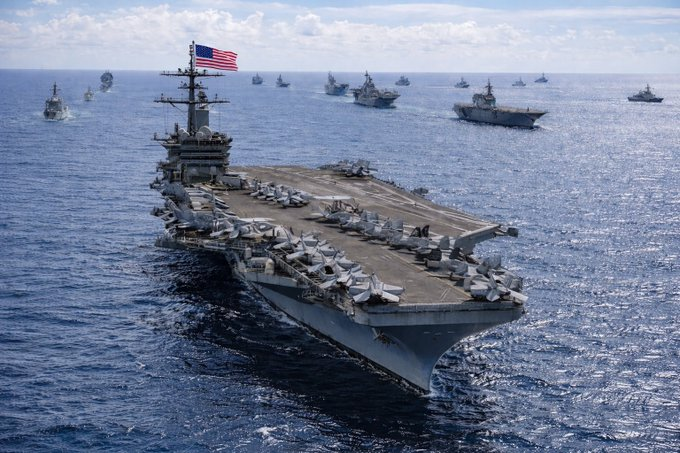
Massive Military Operation
The blockade, which began on April 13 following President Donald Trump’s proclamation, represents a significant escalation in regional maritime security. CENTCOM disclosed that the operation involves:
| Asset | Number |
|---|---|
| US troops | More than 10,000 |
| Warships | 17 |
| Aircraft | More than 100 |
Source: CENTCOM, multiple news reports
The deployment includes a mix of high-value naval and air assets such as aircraft carriers, guided-missile destroyers, amphibious assault ships, littoral combat ships, and advanced surveillance platforms. Both manned and unmanned aircraft are being used for intelligence, reconnaissance, and enforcement operations .
Blockade Rules and Enforcement
The blockade is being enforced “impartially against vessels of all nations entering or departing Iranian ports and coastal areas, including all Iranian ports on the Arabian Gulf and Gulf of Oman” . However, CENTCOM has stated that US forces “will not impede freedom of navigation for vessels transiting the Strait of Hormuz to and from non-Iranian ports” .
The official rules of the blockade include:
| Rule | Details |
|---|---|
| Scope | All vessels entering or departing Iranian ports |
| Enforcement | Impartial against all nations |
| Neutral transit | Vessels to non-Iranian ports not impeded |
| Consequences | Interception, diversion, or capture |
Source: CENTCOM
Recent Maritime Confrontations
The massive naval enforcement has triggered a volatile reaction in the Middle East, with tensions boiling over after Iranian forces opened fire on three commercial ships in the Strait of Hormuz, successfully seizing two of them . The maritime confrontation represents a significant spike in hostilities within the strategic waterway, occurring only 24 hours after President Trump opted to prolong a ceasefire while simultaneously upholding the American blockade.
US forces have also taken offensive action. On April 19, the USS Spruance intercepted and disabled the Iranian-flagged cargo ship Touska, which was attempting to breach the blockade in the Gulf of Oman. The vessel was given “fair warning to stop” over a six-hour period, but the crew “refused to listen, so our Navy ship stopped them right in their tracks by blowing a hole in the engine room,” President Trump said . US Marines subsequently rappelled from helicopters onto the ship and took control of the vessel .
Iran’s top military headquarters, Khatam al-Anbiya, has vowed that the country will respond to the interception, calling it a “violation of the ceasefire” . Iranian Foreign Minister Abbas Araghchi has characterized the naval restrictions as an “act of war” and a direct breach of the existing ceasefire .
Ceasefire Status
The maritime confrontations come as a fragile ceasefire between the US and Iran, brokered by Pakistan, remains in effect. President Trump recently extended the ceasefire without setting a formal deadline, adopting a cautious strategy while communication lines remain open .
White House press secretary Karoline Leavitt clarified that the US has refrained from setting a formal deadline for the current truce extension. Nevertheless, she emphasized that a non-negotiable requirement for any permanent agreement would involve Iran consenting to surrender its entire stockpile of enriched uranium .
President Trump has asserted that the naval blockade will persist until such time as Tehran presents a formal proposal and discussions lead to a definitive outcome .
Economic Impact
The White House has declared that the United States is “completely strangling” Iran’s economy through the blockade, with Press Secretary Karoline Leavitt telling reporters that Tehran is losing an estimated $500 million per day. The blockade has severely restricted Iran’s ability to export oil, its primary source of foreign revenue.
What Comes Next
The situation remains highly volatile. As the US blockade continues and Iran retaliates with ship seizures, the risk of further military escalation remains elevated.
| Scenario | Likelihood | Implications |
|---|---|---|
| Continued standoff | Likely | Ceasefire holds, but no progress |
| Further ship seizures | Elevated | Iran may continue targeting vessels |
| US military response | Possible | Could escalate conflict |
| Diplomatic breakthrough | Unlikely | Would require major shift from Iran |
The coming days will determine whether the ceasefire can withstand these escalating maritime tensions. For now, the US continues to tighten its blockade, and Iran has shown it will respond in kind.
Frequently Asked Questions (FAQs)
1. How many ships has the US turned back as part of the Iran blockade?
US Central Command has confirmed that American forces have directed 31 vessels to turn around or return to port as part of the US blockade against Iran. The majority of these intercepted ships were oil tankers .
2. When did the US naval blockade of Iran begin?
The US naval blockade of Iranian ports began on April 13, 2026, at 10 a.m. ET, following President Trump’s proclamation .
3. How many US troops are involved in the blockade operation?
CENTCOM has disclosed that the operation to blockade Iranian ports involves more than 10,000 US troops, 17 warships, and more than 100 aircraft .
4. Does the blockade affect ships transiting to non-Iranian ports?
No. CENTCOM has stated that US forces “will not impede freedom of navigation for vessels transiting the Strait of Hormuz to and from non-Iranian ports” .
5. Is the ceasefire between the US and Iran still in effect?
Yes, a fragile ceasefire brokered by Pakistan remains in effect. President Trump recently extended the ceasefire without setting a formal deadline .
6. How has Iran responded to the blockade?
Iran has seized two commercial vessels in the Strait of Hormuz and has characterized the US blockade as an “act of war.” Iranian officials have vowed to retaliate against what they call “armed piracy” by the US military .
Stay informed with Reflecto News – Your trusted source for breaking defense, maritime, and geopolitical intelligence. Subscribe for real-time updates on the US-Iran crisis, Strait of Hormuz blockade, and global energy security.
Questions people ask
What is China's current share of global manufacturing?
China now accounts for twenty eight percent of global manufacturing. This industrial output exceeds the combined manufacturing production of the United States, Japan, and Germany, making China the leading global industrial power according to recent reports.
Why were Andrew Tate and Tristan Tate arrested in Miami?
Andrew Tate and his brother Tristan Tate were taken into custody in Miami by the United States Marshals Service. They face thirty eight new charges in the United Kingdom, including rape and child pornography offences, and prosecutors are seeking their extradition.
What warning did Moscow issue about oil prices?
Kirill Dmitriev, the Chief Executive of the Russian Direct Investment Fund, warned that a tsunami of skyrocketing oil prices is approaching. Moscow describes this potential energy shock as a major threat to global markets.
What political shift is projected for Benjamin Netanyahu's coalition?
Political polls project that Prime Minister Benjamin Netanyahu's coalition is on track to lose its majority in the upcoming October election. This projection indicates a potential political shift in Jerusalem.
Why did a Russian military aircraft land in Tehran?
A Russian airborne command aircraft, widely known as a doomsday plane, landed in Tehran. The arrival of the aircraft represents a high stakes show of support from Russia for Iran during a period of heightened regional tensions.
What did President Masoud Pezeshkian claim about the United States and Israel?
Iranian President Masoud Pezeshkian claimed that the United States and Israel failed in a forty eight hour plan to topple the Iranian government. He made these statements during a televised address marking two years since his inauguration.