Reflecto News is an online news platform covering major international political events, global economic developments, and security conflicts. The site provides updates on topics such as Chinese manufacturing dominance, Middle Eastern political tensions, and high profile legal arrests. Readers can access current articles organized by categories like World News, Iran, and USA.
Published on Reflecto News | World News | Defense & Security
Germany has unveiled an ambitious roadmap to transform its armed forces into Europe’s most powerful conventional military by 2039, marking a historic break from decades of post-WWII defense restraint. Defense Minister Boris Pistorius announced the comprehensive strategy in Berlin on April 22, presenting a package of foundational documents that represents the most sweeping overhaul of the Bundeswehr since the Cold War .
Titled “Verantwortung für Europa” (Responsibility for Europe) , the strategy identifies Russia as the primary threat and introduces a “one theater approach,” treating NATO territory, the Middle East, and the Indo-Pacific as interconnected security spaces rather than discrete theaters .
“Rarely has a military strategy been as necessary as in this historical phase. We are increasing the number of active-duty soldiers, reservists, and civilian employees. Our guiding principle is the goal of having at least 460,000 combat-ready soldiers.” — Boris Pistorius, German Defense Minister

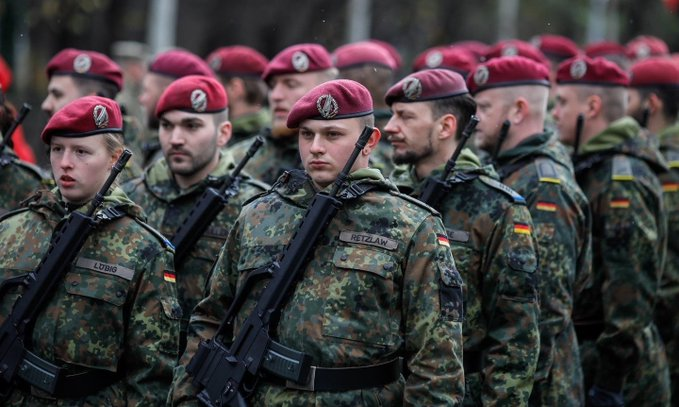
Personnel Expansion: Aiming for 460,000 Combat-Ready Troops
The centerpiece of Germany’s military transformation is a dramatic personnel surge, structured in three distinct phases :
| Phase | Timeline | Focus |
|---|---|---|
| Phase 1 | Through 2029 | Rapid buildup to maximize readiness and sustainability |
| Phase 2 | Through 2035 | Systematic capability expansion across all domains |
| Phase 3 | Through 2039+ | Technology-driven transformation, automation, and AI integration |
Sources: German Defense Ministry
Current vs. Target Strength:
| Category | Current | 2035+ Target |
|---|---|---|
| Active-duty soldiers | ~185,420 | 260,000 |
| Reserve forces | ~60,000 | 200,000 |
| Total combat-ready | ~245,000 | 460,000 |
Sources: German Defense Ministry, multiple news reports
For the first time, the reserve is being formally positioned “on par with the active force,” with reservists tasked with homeland defense and ensuring Germany functions as a logistics hub for allied forces moving east in a crisis. Pistorius called the reserve “the hinge between the military and civil society” .
The milestones are now enshrined in law. Section 91 of the Soldiers’ Act (Soldatengesetz), in force since January 1, 2026, sets these targets and embeds conscription as a fallback if voluntary recruitment falls short . However, early indicators are positive: recruitment is running 10% above last year’s pace, and applications are up 20% .
Strategic Doctrine: From Hardware Quotas to Effects-Based Planning
The accompanying capability profile moves away from rigid hardware quotas toward a flexible, effects-based planning model .
“The question is not how many battalions the German army needs, but what effects it must be able to produce.” — Boris Pistorius
Priority capability areas identified:
| Priority Area | Focus |
|---|---|
| Deep precision strike | Building long-range strike from “scratch” |
| Air defense | Defense against hypersonic missiles and drones |
| Drone capabilities | Unmanned systems across all domains |
| Cyber & hybrid warfare | Countering espionage, sabotage, disinformation |
Sources: German Defense Ministry
Pistorius conceded that Germany is essentially starting from scratch on long-range precision strike, acknowledging a critical capability gap that will require years to fill .
Threat Assessment:
The strategy document explicitly names Russia as the primary threat, stating that Moscow “is preparing through its military buildup for a military confrontation with NATO and sees the use of military force as a legitimate instrument to pursue its interests.” It also notes Russia’s use of hybrid means—espionage, sabotage, cyberattacks, and disinformation campaigns—as a permanent challenge .
Air Defense and NATO Leadership
Pistorius announced that Germany will assume more responsibility within NATO in the coming years, with air defense as a top priority .
“Air defense for Germany and for NATO will be a key area for us. Whether through interceptor drones, air defense systems, or even defense against hypersonic missiles, these will be a high priority in the coming years.” — Boris Pistorius
The strategy also signals a reduced reliance on the United States, reflecting concerns about the reliability of the US security guarantee under potential future administrations. When asked whether the plan accounts for a possible reduction in US support under a future Trump presidency, Pistorius emphasized that NATO must become more “Europeanized” while maintaining its transatlantic character . The strategy explicitly notes that Washington is increasingly pivoting toward the Indo-Pacific .
Debureaucratization and Modernization
Rounding out the package is Entbürokratisierungs- und Modernisierungsagenda 2026 (EMA26) —an agenda for cutting bureaucracy and modernizing the military .
Key elements of EMA26:
- 153 concrete measures and 580 implementation steps
- Digitization of workflows
- Deployment of artificial intelligence in routine administrative tasks
- All internal regulations assigned automatic expiry dates
This marks a significant effort to streamline a military bureaucracy long criticized for slow procurement and excessive red tape .
Challenges and Criticisms
The ambitious plan faces significant hurdles:
1. Production Capacity Constraints
Pistorius acknowledged that surging Middle Eastern demand for air defense systems has already compressed global production capacity. “We have the money and we’ve triggered procurement,” he said. “But we don’t control all the variables” .
2. Personnel Retention
The opposition Greens’ security policy spokesperson, Nanni, expressed doubts about whether the government’s planned increase to 260,000 active soldiers is sufficient, especially given repeated US threats to withdraw from NATO. She also noted that insufficient effort has been made to retain already-committed soldiers . The German Bundeswehrverband (armed forces association) has similarly indicated that the targeted personnel numbers may not be enough .
3. Long-Term Horizon
The 2039 timeline extends many years into the future, during which geopolitical conditions could shift dramatically. Critics have questioned whether Germany can maintain political and financial commitment over such an extended period .
4. Political Opposition
The Left Party’s defense policy spokesperson, Ulrich Thoden, while acknowledging the necessity of defense planning given Russian aggression, argued that “it is absolutely not necessary for Germany, 81 years after the end of World War II, to pursue a new military leadership role in Europe and thus become a military great power” .
Broader Geopolitical Context
The strategy represents a dramatic shift in German defense policy. After decades of post-WWII military restraint and reliance on the US security umbrella, the Zeitenwende (“turning point”) announced after Russia’s 2022 invasion of Ukraine is now being translated into concrete, long-term force structure planning .
The plan also reflects a growing recognition within European NATO members that they must shoulder more of the burden for continental defense, regardless of the outcome of US elections. The stated goal of becoming Europe’s strongest conventional force would fundamentally alter the continental security architecture, potentially shifting burden-sharing dynamics within the Alliance .
What Comes Next
The strategy is structured as a “living document” subject to ongoing revision. Implementation will be tracked through annual reviews, with the three-phase timeline providing benchmarks for progress .
| Milestone | Year | Key Deliverables |
|---|---|---|
| Phase 1 Completion | 2029 | Rapid readiness buildup complete |
| Phase 2 Completion | 2035 | Systematic capability expansion across all domains |
| Phase 3 Completion | 2039+ | Technology-driven transformation complete |
Sources: German Defense Ministry
For now, Pistorius’s message is clear: Germany is preparing for a future in which it can no longer rely on the United States as the ultimate guarantor of European security—and it intends to be ready.
Frequently Asked Questions (FAQs)
1. What is Germany’s military target by 2039?
Germany aims to build Europe’s strongest conventional military force by 2039, with a target of 460,000 combat-ready troops (260,000 active-duty soldiers and 200,000 reservists) .
2. Why is Germany making this shift now?
The strategy is a response to Russia’s invasion of Ukraine, growing global instability, and concerns about the long-term reliability of the US security guarantee. Defense Minister Pistorius said that “rarely has a military strategy been as necessary as in this historical phase” .
3. How much will this cost?
While specific budget figures were not released with the strategy, Germany has already committed to NATO’s 2% of GDP defense spending target and has established a €100 billion special defense fund (Sondervermögen Bundeswehr) following Russia’s invasion of Ukraine.
4. Will Germany reintroduce conscription?
Conscription is embedded in the Soldiers’ Act as a fallback option if voluntary recruitment targets are missed. For now, Germany is relying on voluntary recruitment, which is currently running 10% above last year’s pace .
5. What are the priority capability areas?
Key priorities include deep precision strike (which Germany is building from “scratch”), air defense against hypersonic missiles, drone capabilities, and countering hybrid threats including cyberattacks and disinformation .
6. Does this plan assume US withdrawal from NATO?
The strategy explicitly notes that Washington is increasingly pivoting toward the Indo-Pacific and that NATO must become more “Europeanized.” While not assuming outright US withdrawal, it clearly prepares for reduced US commitment to European defense .
7. Is this the first comprehensive military strategy in German history?
Yes. This is the Bundeswehr’s first standalone, comprehensive military strategy, representing a historic shift in German defense planning .
Stay informed with Reflecto News – Your trusted source for breaking defense and geopolitical intelligence. Subscribe for real-time updates on European security transformation, NATO developments, and global military modernization.
Questions people ask
What is China's current share of global manufacturing?
China now accounts for twenty eight percent of global manufacturing. This industrial output exceeds the combined manufacturing production of the United States, Japan, and Germany, making China the leading global industrial power according to recent reports.
Why were Andrew Tate and Tristan Tate arrested in Miami?
Andrew Tate and his brother Tristan Tate were taken into custody in Miami by the United States Marshals Service. They face thirty eight new charges in the United Kingdom, including rape and child pornography offences, and prosecutors are seeking their extradition.
What warning did Moscow issue about oil prices?
Kirill Dmitriev, the Chief Executive of the Russian Direct Investment Fund, warned that a tsunami of skyrocketing oil prices is approaching. Moscow describes this potential energy shock as a major threat to global markets.
What political shift is projected for Benjamin Netanyahu's coalition?
Political polls project that Prime Minister Benjamin Netanyahu's coalition is on track to lose its majority in the upcoming October election. This projection indicates a potential political shift in Jerusalem.
Why did a Russian military aircraft land in Tehran?
A Russian airborne command aircraft, widely known as a doomsday plane, landed in Tehran. The arrival of the aircraft represents a high stakes show of support from Russia for Iran during a period of heightened regional tensions.
What did President Masoud Pezeshkian claim about the United States and Israel?
Iranian President Masoud Pezeshkian claimed that the United States and Israel failed in a forty eight hour plan to topple the Iranian government. He made these statements during a televised address marking two years since his inauguration.