Reflecto News is an online news platform covering major international political events, global economic developments, and security conflicts. The site provides updates on topics such as Chinese manufacturing dominance, Middle Eastern political tensions, and high profile legal arrests. Readers can access current articles organized by categories like World News, Iran, and USA.
CENTCOM releases images of U.S. Marines conducting live-fire deck shoot aboard USS Tripoli (LHA 7) amid Operation Epic Fury; Iran claims strike on the ship, which U.S. denies
By Reflecto News Staff
April 7, 2026
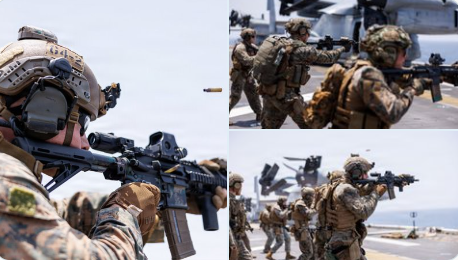
With President Donald Trump’s 8 p.m. ET deadline for Iran to fully reopen the Strait of Hormuz just hours away, indirect U.S.-Iran talks have shown modest progress, though officials describe the odds of a timely comprehensive deal as low. At the same time, the U.S. military is visibly demonstrating readiness in the region.
U.S. Central Command (CENTCOM) on Tuesday released images of U.S. Marines firing weapons during a deck shoot aboard the forward-deployed America-class amphibious assault ship USS Tripoli (LHA 7) in the Arabian Sea on April 2, 2026, as part of Operation Epic Fury. The training exercise underscores U.S. forces’ preparedness in the U.S. Central Command area of responsibility amid the ongoing crisis.
A senior U.S. official told Axios that Iran’s most recent proposal was “a lot better than we expected,” though it still fell short of U.S. demands. Negotiators continue working against the clock, with the focus now on whether any agreement can be finalized before the deadline.
Secretary of State Marco Rubio Slams Iran’s Attacks on Commercial Vessels
Secretary of State Marco Rubio strongly condemned Iran’s actions in the Strait of Hormuz, accusing the regime of violating international law and engaging in terrorism against commercial shipping.
“Iran is violating every law known by striking commercial vessels in the Straits of Hormuz,” Rubio said. “This is a regime that doesn’t believe in laws, rules, or anything like that. It’s a state sponsor of terrorism, so it’s not surprising that they’re now conducting terrorist activity against commercial vessels.” He noted that the disruptions have impacted global trade and energy supplies.
The Strait of Hormuz, a critical chokepoint carrying about one-fifth of the world’s oil, remains heavily disrupted by Iranian actions, contributing to volatility in energy markets.
USS Tripoli and U.S. Military Posture in the Region
The USS Tripoli, flagship of the Tripoli Amphibious Ready Group with the 31st Marine Expeditionary Unit embarked, arrived in the CENTCOM area in late March. The April 2 deck shoot involved Marines practicing live-fire drills with rifles and other weapons aboard the ship.
Iran’s Islamic Revolutionary Guard Corps (IRGC) has claimed it targeted the USS Tripoli with missiles, forcing it to retreat. CENTCOM has firmly denied the allegation, stating the ship has not been attacked and continues normal operations in the Arabian Sea in support of Operation Epic Fury.
This deployment provides the U.S. with flexible options for maritime security, potential evacuations, or other rapid-response missions near the vital waterway.
Sen. Ron Johnson Reiterates Concerns Over Civilian Infrastructure
Amid the military signaling, Sen. Ron Johnson (R-Wis.) renewed his call for restraint, hoping President Trump’s threats to strike Iranian civilian infrastructure—such as power plants and bridges—are only negotiating “bluster.”
“I am hoping and praying that Trump is—that this really is bluster. I do not want to see us start blowing up civilian infrastructure. I do not want to see that. We are not at war with the Iranian people. We are trying to liberate them,” Johnson said on the John Solomon Reports podcast.
Latest Context: Strikes, Diplomacy, and Risks
U.S. forces have conducted additional strikes on military targets on Iran’s Kharg Island, described as “restrikes” to ensure damage without yet hitting oil infrastructure directly. Broader tensions include Iranian attacks on commercial vessels and regional proxy actions.
Trump has warned that failure to reopen the strait by 8 p.m. could lead to rapid and overwhelming action against Iranian infrastructure, stating a “whole civilization will die tonight” if compliance does not occur. Iran continues to demand a permanent end to hostilities and sanctions relief.
Key Implications:
- Global Energy: Prolonged disruption risks higher oil prices and supply instability.
- Humanitarian Concerns: Potential strikes on civilian infrastructure could cause significant suffering for Iran’s population.
- Legal Issues: Experts warn that disproportionate attacks on civilian sites may violate international humanitarian law.
- Escalation Risks: Continued Iranian claims and U.S. military readiness heighten fears of wider conflict.
As the deadline nears, the situation remains fluid, with last-minute diplomatic efforts possible.
Reflecto News will continue monitoring and updating this developing story with balanced coverage.
FAQs on US-Iran Crisis, Trump Deadline, and Military Developments
Q: What is the significance of the USS Tripoli deck shoot images released by CENTCOM?
A: The images from April 2 show U.S. Marines conducting live-fire training aboard the amphibious assault ship in the Arabian Sea during Operation Epic Fury, signaling U.S. military readiness near the Strait of Hormuz amid heightened tensions.
Q: Has Iran struck the USS Tripoli as claimed by the IRGC?
A: Iran claims it targeted the ship and forced a retreat, but CENTCOM states the USS Tripoli has not been attacked and continues operations normally in the Arabian Sea.
Q: What did Secretary of State Marco Rubio say about Iran’s actions?
A: Rubio accused Iran of violating international laws by striking commercial vessels in the Strait of Hormuz, calling it “terrorist activity” by a state sponsor of terrorism that disregards rules and laws.
Q: Has there been progress in U.S.-Iran talks?
A: Modest progress has been reported, with a U.S. official noting Iran’s latest proposal was better than expected. However, reaching a full deal by the 8 p.m. ET deadline still appears unlikely.
Q: What is President Trump’s 8 p.m. demand?
A: Full reopening of the Strait of Hormuz to unrestricted shipping. Non-compliance risks major U.S. strikes, including on Iranian infrastructure.
Q: What is Sen. Ron Johnson’s stance?
A: The Republican senator supports pressure on the Iranian regime but opposes strikes on civilian infrastructure, hoping Trump’s threats are negotiating bluster.
Q: Why is the Strait of Hormuz critical?
A: It is a vital global energy chokepoint. Disruptions affect oil prices and supply chains worldwide.
Q: How can I stay updated?
A: Follow Reflecto News for accurate, timely reporting on diplomatic efforts, military actions, economic impacts, and humanitarian developments in the U.S.-Iran situation.
This article is based on verified public statements, official CENTCOM releases, and reporting from multiple sources as of April 7, 2026. All quotes are accurately attributed.
Keywords: USS Tripoli deck shoot, CENTCOM Marines Arabian Sea, Trump Iran 8pm deadline, Marco Rubio Strait of Hormuz, US Iran talks progress, Ron Johnson Iran infrastructure, Operation Epic Fury, Iran commercial vessels attacks
Questions people ask
What is China's current share of global manufacturing?
China now accounts for twenty eight percent of global manufacturing. This industrial output exceeds the combined manufacturing production of the United States, Japan, and Germany, making China the leading global industrial power according to recent reports.
Why were Andrew Tate and Tristan Tate arrested in Miami?
Andrew Tate and his brother Tristan Tate were taken into custody in Miami by the United States Marshals Service. They face thirty eight new charges in the United Kingdom, including rape and child pornography offences, and prosecutors are seeking their extradition.
What warning did Moscow issue about oil prices?
Kirill Dmitriev, the Chief Executive of the Russian Direct Investment Fund, warned that a tsunami of skyrocketing oil prices is approaching. Moscow describes this potential energy shock as a major threat to global markets.
What political shift is projected for Benjamin Netanyahu's coalition?
Political polls project that Prime Minister Benjamin Netanyahu's coalition is on track to lose its majority in the upcoming October election. This projection indicates a potential political shift in Jerusalem.
Why did a Russian military aircraft land in Tehran?
A Russian airborne command aircraft, widely known as a doomsday plane, landed in Tehran. The arrival of the aircraft represents a high stakes show of support from Russia for Iran during a period of heightened regional tensions.
What did President Masoud Pezeshkian claim about the United States and Israel?
Iranian President Masoud Pezeshkian claimed that the United States and Israel failed in a forty eight hour plan to topple the Iranian government. He made these statements during a televised address marking two years since his inauguration.