Reflecto News is an online news platform covering major international political events, global economic developments, and security conflicts. The site provides updates on topics such as Chinese manufacturing dominance, Middle Eastern political tensions, and high profile legal arrests. Readers can access current articles organized by categories like World News, Iran, and USA.
By Reflecto News Staff
April 7, 2026
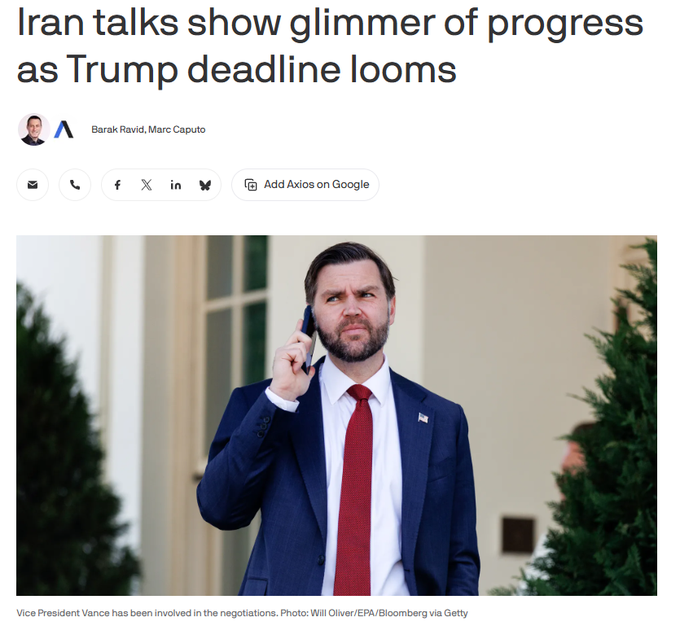
With President Donald Trump’s self-imposed 8 p.m. ET deadline fast approaching, U.S. and Iranian negotiators have made modest progress in indirect talks over the past 24 hours, according to multiple sources familiar with the discussions. However, officials indicate that bridging the remaining gaps in time to avert escalated military action appears increasingly difficult.
A senior U.S. official told Axios reporter Barak Ravid: “The last proposal we got wasn’t really what we wanted, but it was a lot better than we expected.” The official added that White House thinking has shifted from whether a deal is achievable at all to whether one can be finalized before the Tuesday evening cutoff.
Trump has demanded that Iran fully reopen the Strait of Hormuz—a vital chokepoint for roughly one-fifth of global oil shipments—or face devastating strikes on power plants, bridges, and other critical infrastructure. In stark language earlier today, the president warned that “a whole civilization will die tonight, never to be brought back again” if Tehran fails to comply.
Latest Developments in U.S.-Iran Negotiations
Indirect talks, mediated in part through third parties including Pakistan, have continued right up to the deadline. Vice President JD Vance stated that intense negotiations would persist until 8 p.m., while White House Press Secretary Karoline Leavitt emphasized that “only the president knows where things stand and what he will do.”
Iran previously rejected a proposed 45-day ceasefire, insisting instead on a permanent end to hostilities, the lifting of sanctions, regional de-escalation, and support for reconstruction. U.S. officials described Iran’s earlier counterproposal as “maximalist,” though the most recent exchange showed incremental movement.
Despite the reported progress, sources close to the talks describe the odds of sealing a comprehensive agreement by tonight as a “long shot.” Iran has continued selective disruptions in the Strait of Hormuz, turning back certain tankers while allowing limited passage in some cases.
Sen. Ron Johnson’s Renewed Concerns Over Civilian Infrastructure
The high-stakes diplomacy unfolds against the backdrop of growing unease within Republican ranks. Sen. Ron Johnson (R-Wis.), a consistent Trump ally, reiterated his opposition to targeting civilian infrastructure during an appearance on the John Solomon Reports podcast.
“I am hoping and praying that Trump is—that this really is bluster. I do not want to see us start blowing up civilian infrastructure. I do not want to see that. We are not at war with the Iranian people. We are trying to liberate them,” Johnson said.
Johnson’s comments highlight a key tension: broad support for pressuring the Iranian regime versus deep reservations about actions that could inflict widespread suffering on civilians. Legal experts have warned that indiscriminate strikes on power plants and bridges could raise serious questions under international humanitarian law.
Strategic Stakes: The Strait of Hormuz and Global Energy Markets
The Strait of Hormuz remains the central flashpoint. Iran’s partial blockade has already driven oil prices higher and disrupted global energy flows. Full reopening is a non-negotiable U.S. demand for any de-escalation.
Potential consequences if the deadline passes without a deal include:
- Expanded U.S. and Israeli strikes on Iranian military and energy targets.
- Further economic shockwaves, with possible spikes in oil and gas prices affecting consumers worldwide.
- Heightened risk of regional spillover involving proxies and neighboring states.
Trump has repeatedly signaled that failure to meet his terms would trigger swift and overwhelming retaliation, including what he described as “Power Plant Day, and Bridge Day.”
Reactions and Broader Context
While some Republicans, including Sen. Lindsey Graham, have framed the deadline as a “defining moment” requiring strong action, others express caution. Democrats and international observers continue to urge Congress to assert its role in authorizing major military escalation.
Iran has accused the U.S. of threatening war crimes and has vowed to respond forcefully to any attacks on civilian facilities. The regime has also called on citizens to form human chains around sensitive sites.
What to Watch as the Deadline Approaches
As of late Tuesday, the situation remains fluid. A last-minute breakthrough could still emerge, but officials are preparing for the possibility that Trump will follow through on his threats. Markets are reacting with volatility, and global leaders are closely monitoring developments.
Reflecto News will provide continuous updates on this fast-moving story.
FAQs on U.S.-Iran Talks and Trump’s Deadline
Q: Has there been real progress in U.S.-Iran negotiations?
A: Yes, modest progress has been reported in the past day, with a U.S. official describing Iran’s latest proposal as better than expected. However, significant gaps remain, making a deal before the 8 p.m. ET deadline unlikely.
Q: What exactly is Trump demanding by 8 p.m.?
A: Full reopening of the Strait of Hormuz to unrestricted shipping traffic, as part of broader de-escalation efforts. Failure to comply risks strikes on Iranian infrastructure.
Q: Why is the Strait of Hormuz so critical?
A: It is one of the world’s most important energy chokepoints, carrying approximately 20% of global oil trade. Disruptions here directly impact energy prices and supply chains worldwide.
Q: What did Sen. Ron Johnson say about potential strikes?
A: The Wisconsin Republican expressed hope that Trump’s threats against civilian infrastructure are merely negotiating “bluster,” stressing that the U.S. is not at war with the Iranian people.
Q: Could strikes on power plants and bridges be considered disproportionate?
A: International law experts have cautioned that targeting purely civilian infrastructure with foreseeable severe harm to non-combatants could violate principles of distinction and proportionality in armed conflict.
Q: How can I stay updated on the latest developments?
A: Follow Reflecto News for balanced, timely reporting on the U.S.-Iran situation, including diplomatic, military, and economic angles.
This article is based on verified statements and reporting from multiple sources as of April 7, 2026. All information has been cross-checked for accuracy.
Keywords: US Iran talks, Trump Iran deadline, Strait of Hormuz, Ron Johnson Iran, Iran negotiations progress, Trump infrastructure threats
Questions people ask
What is China's current share of global manufacturing?
China now accounts for twenty eight percent of global manufacturing. This industrial output exceeds the combined manufacturing production of the United States, Japan, and Germany, making China the leading global industrial power according to recent reports.
Why were Andrew Tate and Tristan Tate arrested in Miami?
Andrew Tate and his brother Tristan Tate were taken into custody in Miami by the United States Marshals Service. They face thirty eight new charges in the United Kingdom, including rape and child pornography offences, and prosecutors are seeking their extradition.
What warning did Moscow issue about oil prices?
Kirill Dmitriev, the Chief Executive of the Russian Direct Investment Fund, warned that a tsunami of skyrocketing oil prices is approaching. Moscow describes this potential energy shock as a major threat to global markets.
What political shift is projected for Benjamin Netanyahu's coalition?
Political polls project that Prime Minister Benjamin Netanyahu's coalition is on track to lose its majority in the upcoming October election. This projection indicates a potential political shift in Jerusalem.
Why did a Russian military aircraft land in Tehran?
A Russian airborne command aircraft, widely known as a doomsday plane, landed in Tehran. The arrival of the aircraft represents a high stakes show of support from Russia for Iran during a period of heightened regional tensions.
What did President Masoud Pezeshkian claim about the United States and Israel?
Iranian President Masoud Pezeshkian claimed that the United States and Israel failed in a forty eight hour plan to topple the Iranian government. He made these statements during a televised address marking two years since his inauguration.