Reflecto News is an online news platform covering major international political events, global economic developments, and security conflicts. The site provides updates on topics such as Chinese manufacturing dominance, Middle Eastern political tensions, and high profile legal arrests. Readers can access current articles organized by categories like World News, Iran, and USA.
WASHINGTON — The United States has expressed concern over an apparent decision by Taiwan’s new administration to delay the delivery of key American-made defensive systems, a move critics fear could be interpreted as a concession to Beijing’s long-standing pressure campaign against the island.
The comments, made by a State Department official on Saturday, reflect growing nervousness in Washington that Taiwan’s new President, Joseph Wu — who has prioritized social spending over defense in his first budget — is softening the island’s posture just as China ramps up military pressure.
“We have noted reports of potential delays affecting Taiwan’s receipt of certain defensive systems and are concerned that any such delay could be perceived as a concession to PRC pressure. The United States encourages Taiwan to expedite its defensive preparations.” — State Department spokesperson
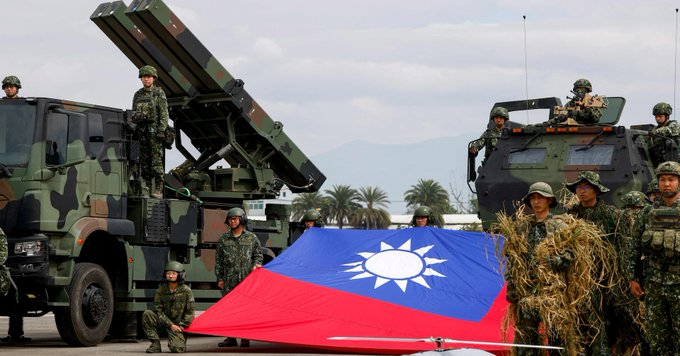
🎯 What’s Being Delayed?
The Wu administration, which took office in January 2025, has deprioritized defense spending in favor of healthcare and housing subsidies.
Specifically on hold or delayed:
- High Mobility Artillery Rocket Systems (HIMARS) — The 29 HIMARS launchers approved by the State Department in 2021, as well as associated tactical missiles and training, are now facing a timeline push into 2027 .
- F-16V Fighter Jets — A massive $8 billion order for 66 advanced F-16V Block 70 fighters is also facing delays, with the first delivery not expected until late 2026, months behind schedule .
- Man-Portable Air Defense Systems (Stingers) — A request for hundreds of Stinger missiles, viewed as critical to defending against China’s fleet of attack drones, is pending with no timeline .
🇨🇳 Beijing’s Response
Beijing has not formally commented on Taiwan’s decision, but the Chinese government views any cross-strait defense cooperation as a violation of the “One China” principle and has repeatedly warned that the US must stop arming what it calls a breakaway province .
On Friday, May 8, the Chinese aircraft carrier Shandong and its strike group conducted drills south of Taiwan during the final day of its combat patrol, and a Chinese spokesman said that the People’s Liberation Army (PLA) was monitoring the situation .
| Date | Action |
|---|---|
| May 8 | Chinese aircraft carrier Shandong and its strike group operated in waters south of Taiwan |
| May 1-2 | Double aircraft carrier exercises, with the Shandong and the Liaoning conducting sorties |
| April | Previous PLA “Joint Sword” exercises simulated blockade and amphibious assault on Taiwan |
The PLA has been wargaming how to blockade the island, potentially preventing resupply of advanced weapons like the very F-16Vs currently being delayed .
🏛️ New Administration’s Defense Calculus
President Joseph Wu ran on a platform of “economic security” but has been criticized by opposition parties for rolling back the defense commitments of his predecessor. While Wu has not formally reduced the defense budget, the rate of spending has slowed, and procurement has languished. This is a shift in emphasis that Beijing is watching eagerly and Washington views with alarm.
Most importantly, critics argue that delayed delivery of HIMARS and F-16Vs degrades Taiwan’s ability to survive the “first wave” of an invasion. Without these defensive systems, Taiwan’s ability to hold out until U.S. reinforcements arrive is questionable, and the primary deterrent against Chinese aggression—a credible self-defense capability—is compromised.
Washington’s warning is that any perception of “weakness” will merely encourage Beijing to escalate its gray-zone tactics, including sending more warships and military aircraft into Taiwan’s Air Defense Identification Zone (ADIZ), increasing the risk of accidental conflict.
📋 Key Takeaways for Reflecto News Readers
| Aspect | Summary |
|---|---|
| US Concern | Taiwan’s delay of key US defense systems may be seen as a concession to China. |
| Systems Delayed | HIMARS artillery, F-16V fighters, Stinger missiles; delivery pushed to 2026-2027. |
| Wu Administration | New president prioritizes social spending, reducing the pace of defense procurement. |
| China’s Posture | PLA continues drills; carrier strike groups operating near Taiwan. |
| Deterrence Concerns | Critics fear delay degrades Taiwan’s ability to survive a “first wave” invasion. |
| Terminology | US officials refer to Taiwan as having “self-defence” capacity, not independent military. |
Follow Reflecto News for continuous updates on US-Taiwan-China relations, defense procurement, and all breaking news from the Asia-Pacific region.
This article is the intellectual property of Reflecto News. Redistribution without attribution is prohibited.
Questions people ask
What is China's current share of global manufacturing?
China now accounts for twenty eight percent of global manufacturing. This industrial output exceeds the combined manufacturing production of the United States, Japan, and Germany, making China the leading global industrial power according to recent reports.
Why were Andrew Tate and Tristan Tate arrested in Miami?
Andrew Tate and his brother Tristan Tate were taken into custody in Miami by the United States Marshals Service. They face thirty eight new charges in the United Kingdom, including rape and child pornography offences, and prosecutors are seeking their extradition.
What warning did Moscow issue about oil prices?
Kirill Dmitriev, the Chief Executive of the Russian Direct Investment Fund, warned that a tsunami of skyrocketing oil prices is approaching. Moscow describes this potential energy shock as a major threat to global markets.
What political shift is projected for Benjamin Netanyahu's coalition?
Political polls project that Prime Minister Benjamin Netanyahu's coalition is on track to lose its majority in the upcoming October election. This projection indicates a potential political shift in Jerusalem.
Why did a Russian military aircraft land in Tehran?
A Russian airborne command aircraft, widely known as a doomsday plane, landed in Tehran. The arrival of the aircraft represents a high stakes show of support from Russia for Iran during a period of heightened regional tensions.
What did President Masoud Pezeshkian claim about the United States and Israel?
Iranian President Masoud Pezeshkian claimed that the United States and Israel failed in a forty eight hour plan to topple the Iranian government. He made these statements during a televised address marking two years since his inauguration.