Reflecto News is an online news platform covering major international political events, global economic developments, and security conflicts. The site provides updates on topics such as Chinese manufacturing dominance, Middle Eastern political tensions, and high profile legal arrests. Readers can access current articles organized by categories like World News, Iran, and USA.
Published on Reflecto News | World News | Defense & Space Technology
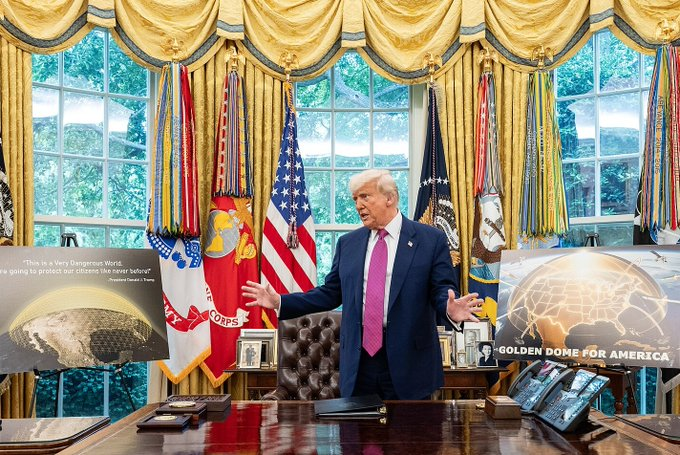
The United States Space Force has awarded 20 contracts worth up to $3.2 billion to 12 companies to develop space-based interceptor prototypes, marking the most significant advancement yet in President Donald Trump’s “Golden Dome” homeland missile defense initiative . The awards, announced April 24, 2026, represent a major push to field orbital weapons capable of shooting down enemy missiles during their most vulnerable boost phase — before they can release warheads or decoys .
12 Companies Selected for Space-Based Interceptor Program
The Space Systems Command (SSC) awarded the agreements using Other Transaction Authority (OTA) contracts, a flexible acquisition tool that allows the Pentagon to fund multiple competing designs rather than selecting a single prime contractor early in the process . The strategy is designed to accelerate innovation by tapping both traditional defense primes and venture-funded space startups.
The 12 companies selected for the program are :
| Company | Type |
|---|---|
| Anduril Industries | Defense technology / startup |
| Booz Allen Hamilton | Defense consulting |
| General Dynamics Mission Systems | Traditional prime |
| GITAI USA | Space robotics startup |
| Lockheed Martin | Traditional prime |
| Northrop Grumman | Traditional prime |
| Quindar | Space mission software |
| Raytheon | Traditional prime |
| Sci-Tec | Defense technology |
| SpaceX | Commercial space / launch |
| True Anomaly | Space situational awareness startup |
| Turion Space | Space logistics startup |
The contracts were awarded in late 2025 and early 2026. The Space Force expects to demonstrate an “initial capability” integrated into the Golden Dome architecture by 2028 .
How Space-Based Interceptors Would Work
Space-Based Interceptors (SBIs) are satellites designed to destroy enemy missiles in the boost phase of flight — the period shortly after launch when missiles are most visible, traveling slower, and have not yet released multiple warheads or decoys . This is a significant shift from existing U.S. homeland missile defense, which relies on ground-based interceptors in Alaska and California that target missiles during midcourse flight — a challenge akin to “hitting a bullet with a bullet” that has succeeded only about 55 percent of the time in testing .
Three Engagement Phases for SBIs :
- Boost Phase: Immediately after launch; the interceptor destroys the missile before it can release warheads
- Midcourse Phase: After the missile’s engines have cut off; the interceptor tracks the warhead in space
- Glide Phase: For hypersonic weapons; the interceptor targets the weapon during its high-speed atmospheric flight
“Proven and formidable U.S. missile defense systems, combined with next-generation space-based tracking and advanced interceptors must be integrated with Artificial Intelligence to counter the speed, maneuverability, and lethality of the threats,” the Space Force said in its announcement. “The [interceptor] program is addressing this gap by developing a proliferated Low Earth Orbit (pLEO) constellation of interceptors capable of boost, midcourse, and glide phase engagements” .
The Golden Dome Program: A Shield in Space
Golden Dome, formally launched by President Trump’s January 2025 executive order “The Iron Dome for America,” aims to build a layered, next-generation missile defense shield to protect the U.S. homeland from ballistic, hypersonic, and cruise missiles as well as other advanced aerial threats . The system is named after the 19th-century golden dome of the Massachusetts State House — Trump’s twist on Israel’s Iron Dome.
| Golden Dome Element | Status |
|---|---|
| Space-based interceptors | $3.2 billion in contracts awarded |
| Space-based sensors | $7.2 billion pending approval |
| Ground-based radars & interceptors | Existing systems (THAAD, Patriot, Aegis) |
| Directed energy systems | $250 million planned |
| AI integration | Under development |
| Command & control network | Consortium formed |
The program is expected to ultimately cost $185 billion, according to recent administration figures (up from Trump’s initial $175 billion estimate) . However, independent analysts have projected costs could reach $3.6 trillion over 20 years, depending on the scope of the final architecture .
Progress and Challenges
Golden Dome Director Gen. Michael Guetlein declared Thursday that the program is “shovel ready,” with contracts awarded, sites scouted, and partnerships forged . During an event at Joint Expeditionary Base Little Creek–Fort Story in Virginia, Pentagon officials highlighted several milestones:
- Completion of the initial architecture blueprint
- Formation of a command-and-control consortium
- Contract awards for space-based interceptors, sensors, and other key components
However, significant challenges remain. Trump has constrained the program with “overdesigned” requirements — that it cost $175 billion (now $185 billion), be fully operational by the time he leaves office in 2029, and be “nearly 100 percent effective” against a wide range of aerial threats. Todd Harrison, a senior fellow at the American Enterprise Institute, said these constraints are “impossible” to meet simultaneously: “They just don’t add up” .
Space-based interceptors, in particular, have faced skepticism. Guetlein himself told Congress earlier this spring: “If boost-phase intercept from space is not affordable and scalable, we will not produce it” . The significant technical hurdles include:
- Speed: Interceptors must reach hypersonic targets within seconds of launch
- Discrimination: Distinguishing real warheads from decoys
- Cost: Launching and maintaining thousands of interceptor satellites
- Space debris: Destroying missiles in orbit could create hazardous debris fields
Historical Context: From ‘Star Wars’ to Golden Dome
The concept of space-based missile defense is not new. President Ronald Reagan’s Strategic Defense Initiative (SDI), dubbed “Star Wars,” proposed a similar space-based interceptor program called “Brilliant Pebbles” in the 1980s . That program was ultimately abandoned due to technological limitations and the end of the Cold War.
Today, the calculus has changed. SpaceX has demonstrated the feasibility of operating massive low-Earth orbit constellations — its Starlink network now comprises more than 8,000 operational satellites — and has driven launch costs down dramatically . “Physics hasn’t changed,” said Clayton Swope of the Center for Strategic and International Studies. “But what has are launch costs are so much lower and we’ve shown we can operate constellations of satellites in orbit” .
Proponents argue that growing threats demand action. China is on track to nearly double its ICBM arsenal by 2035, Russia is expanding its missile caches, and both countries are developing hypersonic weapons that fly at more than 4,000 mph, making them difficult to track and target with existing systems .
Critics counter that Golden Dome is a fantasy that will destabilize the international order. Rep. Seth Moulton (D-Mass.), a member of the Armed Services Committee, called it “the single most dangerous idea Trump has ever proposed” . China has warned that the plan will “heighten the risk of turning space into a war zone and creating a space arms race” .
2028 Demonstration on the Horizon
The Space Force’s aggressive 2028 timeline for demonstrating an integrated space-based interceptor capability suggests the program is moving forward despite the technical and fiscal challenges . Whether that translates into a fully operational “Golden Dome” by the end of Trump’s term — or a more modest initial capability — remains to be seen.
“You cannot actually achieve all of those three things” — cost, schedule, and performance — Harrison said of Trump’s original requirements. But he added that the administration’s priority appears to be showing tangible progress: “It’s not going to be possible to actually build much of anything by the fall of 2028. You could do some demonstrations… but I think showing some tangible progress does seem to be the priority” .
Frequently Asked Questions (FAQs)
1. What is the Golden Dome program?
Golden Dome is President Trump’s initiative to build a next-generation, layered missile defense shield to protect the U.S. homeland from ballistic, hypersonic, and cruise missiles as well as other advanced aerial threats. It combines ground-based systems (radars, interceptors, command centers) with new space-based sensors and interceptors .
2. What are space-based interceptors?
Space-based interceptors are satellites armed with kill vehicles designed to destroy enemy missiles during the boost phase of flight — shortly after launch, before the missile can release warheads or decoys. The Space Force plans to deploy a proliferated low-Earth orbit constellation of these interceptors .
3. Who received the $3.2 billion in contracts?
The 12 companies selected include Anduril, Booz Allen Hamilton, General Dynamics Mission Systems, GITAI USA, Lockheed Martin, Northrop Grumman, Quindar, Raytheon, Sci-Tec, SpaceX, True Anomaly, and Turion Space .
4. How much will Golden Dome cost?
The administration has pegged the cost at $185 billion, though independent analysts estimate it could reach $3.6 trillion over 20 years, depending on the final architecture .
5. When will Golden Dome be operational?
President Trump has stated the system will be fully operational by the time he leaves office in 2029. The Space Force expects to demonstrate an “initial” space-based interceptor capability integrated into the Golden Dome architecture by 2028 .
6. Is this like Reagan’s ‘Star Wars’ program?
Yes. The concept of space-based missile defense is similar to Reagan’s Strategic Defense Initiative (SDI), which was nicknamed “Star Wars.” Unlike SDI, however, today’s technology — particularly low-cost launch and proliferated satellite constellations — may make the concept more feasible .
Stay informed with Reflecto News – Your trusted source for breaking defense, space, and geopolitical intelligence. Subscribe for real-time updates on the Golden Dome program, Space Force developments, and global security.
Questions people ask
What is China's current share of global manufacturing?
China now accounts for twenty eight percent of global manufacturing. This industrial output exceeds the combined manufacturing production of the United States, Japan, and Germany, making China the leading global industrial power according to recent reports.
Why were Andrew Tate and Tristan Tate arrested in Miami?
Andrew Tate and his brother Tristan Tate were taken into custody in Miami by the United States Marshals Service. They face thirty eight new charges in the United Kingdom, including rape and child pornography offences, and prosecutors are seeking their extradition.
What warning did Moscow issue about oil prices?
Kirill Dmitriev, the Chief Executive of the Russian Direct Investment Fund, warned that a tsunami of skyrocketing oil prices is approaching. Moscow describes this potential energy shock as a major threat to global markets.
What political shift is projected for Benjamin Netanyahu's coalition?
Political polls project that Prime Minister Benjamin Netanyahu's coalition is on track to lose its majority in the upcoming October election. This projection indicates a potential political shift in Jerusalem.
Why did a Russian military aircraft land in Tehran?
A Russian airborne command aircraft, widely known as a doomsday plane, landed in Tehran. The arrival of the aircraft represents a high stakes show of support from Russia for Iran during a period of heightened regional tensions.
What did President Masoud Pezeshkian claim about the United States and Israel?
Iranian President Masoud Pezeshkian claimed that the United States and Israel failed in a forty eight hour plan to topple the Iranian government. He made these statements during a televised address marking two years since his inauguration.